
Multivariate Calculus: Learning Objectives 5, 6, 7
Question 1: Let $R$ be the region bounded by $y=x^2$ and $y=2-x$. Consider the integral $\int_0^1 \int_{x^2}^{2-x}f(x,y) \,dydx$.
- State the conditions under which switching the order of integration is valid.
- Rewrite the integral by switching the order of integration.
For part (a), recall Fubini's and Tonelli's theorems. For part (b), sketch the region of integration. The original integral is over a Type I region. To switch the order, you need to express it as one or more Type II regions. Find the intersection point of the boundary curves. Notice if the "top" boundary curve changes when viewed from the y-axis.
- Switching the order of integration is permissible under Fubini's Theorem, which requires the integral of the absolute value of the function to be finite ($\iint\limits_R |f(x,y)| dA < \infty$). A common sufficient condition is that $f(x,y)$ is continuous on a closed, bounded region $R$. Alternatively, under Tonelli's Theorem, if $f(x,y)$ is a non-negative function, the order can be switched.
- $\int_{0}^{1} \int_{0}^{\sqrt{y}} f(x,y) \,dx dy + \int_{1}^{2} \int_{0}^{2-y} f(x,y) \,dx dy$
(a) Conditions for Switching Order: As stated in the answer, Fubini's Theorem or Tonelli's Theorem provides the theoretical foundation for switching the integration order. For most functions encountered in introductory courses, continuity on a compact (closed and bounded) set is sufficient to guarantee that the order can be switched.
(b) Rewriting the Integral:
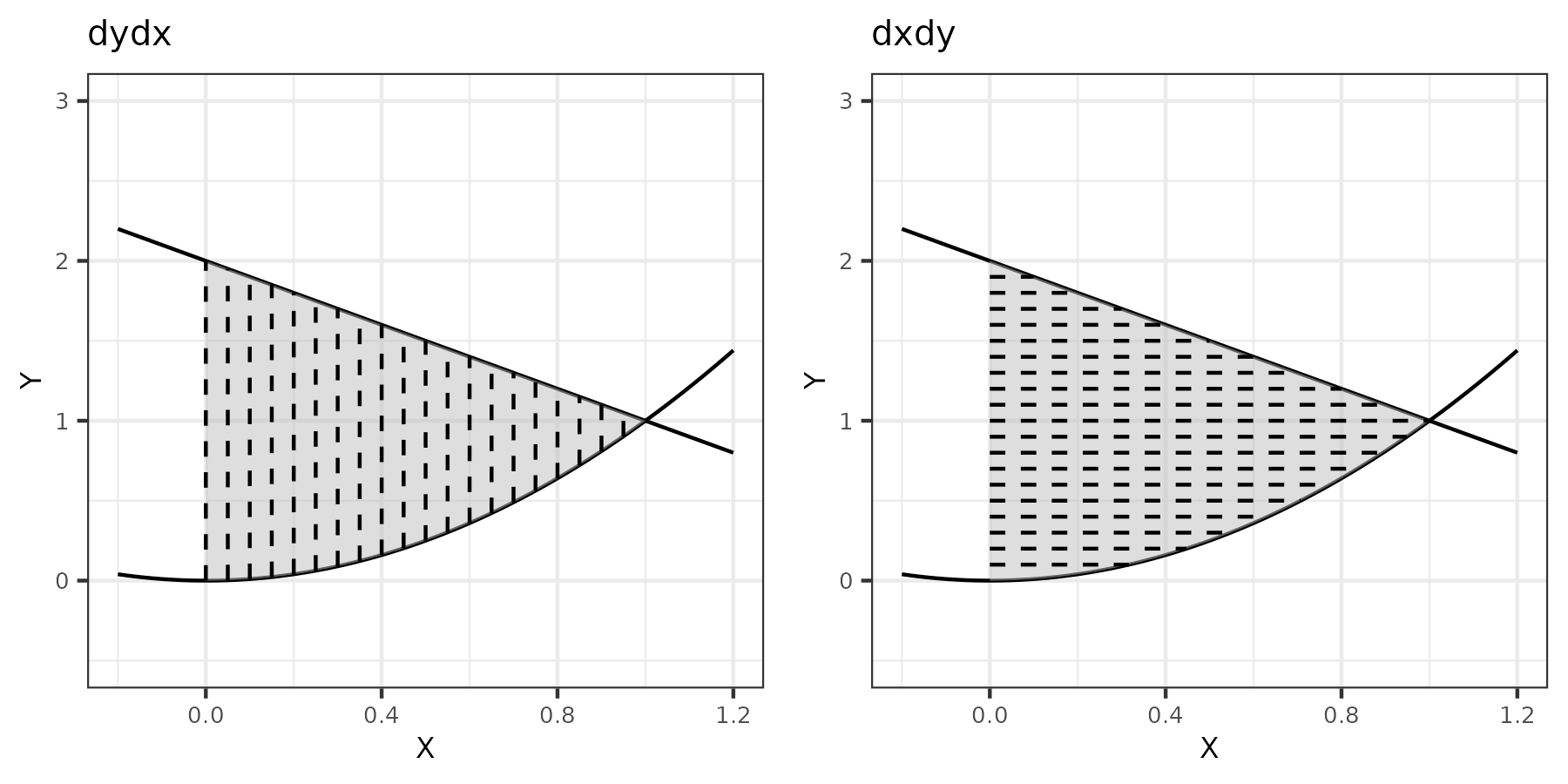
1. Identify the region: The integral $\int_0^1 \int_{x^2}^{2-x}f(x,y) \,dydx$ describes a region where $0 \leq x \leq 1$, and for each $x$, $y$ is bounded below by the parabola $y=x^2$ and above by the line $y=2-x$.
2. Find intersection points: We find where the boundary curves meet: $x^2 = 2-x \implies x^2+x-2 = 0 \implies (x+2)(x-1)=0$. The intersection points are at $x=1$ (giving point $(1,1)$) and $x=-2$ (giving point $(-2,4)$). Since our region is for $0 \leq x \leq 1$, the key intersection is at $(1,1)$.
3. Sketch the region: Sketch the parabola $y=x^2$, the line $y=2-x$, and the vertical lines $x=0$ and $x=1$. The region is bounded by $x=0$ (the y-axis) on the left, $y=x^2$ on the bottom, and $y=2-x$ on the top.
4. Change the perspective (Type II region): To integrate with respect to $x$ first, we need bounds for $x$ in terms of $y$. We need to solve our boundary equations for $x$:
(b) Rewriting the Integral:
1. Identify the region: The integral $\int_0^1 \int_{x^2}^{2-x}f(x,y) \,dydx$ describes a region where $0 \leq x \leq 1$, and for each $x$, $y$ is bounded below by the parabola $y=x^2$ and above by the line $y=2-x$.
2. Find intersection points: We find where the boundary curves meet: $x^2 = 2-x \implies x^2+x-2 = 0 \implies (x+2)(x-1)=0$. The intersection points are at $x=1$ (giving point $(1,1)$) and $x=-2$ (giving point $(-2,4)$). Since our region is for $0 \leq x \leq 1$, the key intersection is at $(1,1)$.
3. Sketch the region: Sketch the parabola $y=x^2$, the line $y=2-x$, and the vertical lines $x=0$ and $x=1$. The region is bounded by $x=0$ (the y-axis) on the left, $y=x^2$ on the bottom, and $y=2-x$ on the top.
4. Change the perspective (Type II region): To integrate with respect to $x$ first, we need bounds for $x$ in terms of $y$. We need to solve our boundary equations for $x$:
- $y=x^2 \implies x = \sqrt{y}$ (since $x \ge 0$ in our region)
- $y=2-x \implies x = 2-y$
- Part 1 ($0 \leq y \leq 1$): The region is bounded on the left by $x=0$ and on the right by the parabola $x=\sqrt{y}$. The integral for this part is $\int_{0}^{1} \int_{0}^{\sqrt{y}} f(x,y) \,dx dy$.
- Part 2 ($1 \leq y \leq 2$): The region is bounded on the left by $x=0$ and on the right by the line $x=2-y$. The integral for this part is $\int_{1}^{2} \int_{0}^{2-y} f(x,y) \,dx dy$.
Question 2: Consider the function $f(x,y) = 3x^2-y$. Evaluate $\iint\limits_R f(x,y) \,dA$ where $R = [0,2] \times [0,3]$ in two different ways:
- First integrate with respect to $y$ and then with respect to $x$.
- First integrate with respect to $x$ and then with respect to $y$.
This is a direct application of Fubini's Theorem on a rectangular domain. Draw the region of integration. Set up the two iterated integrals and evaluate them. The results should be identical.
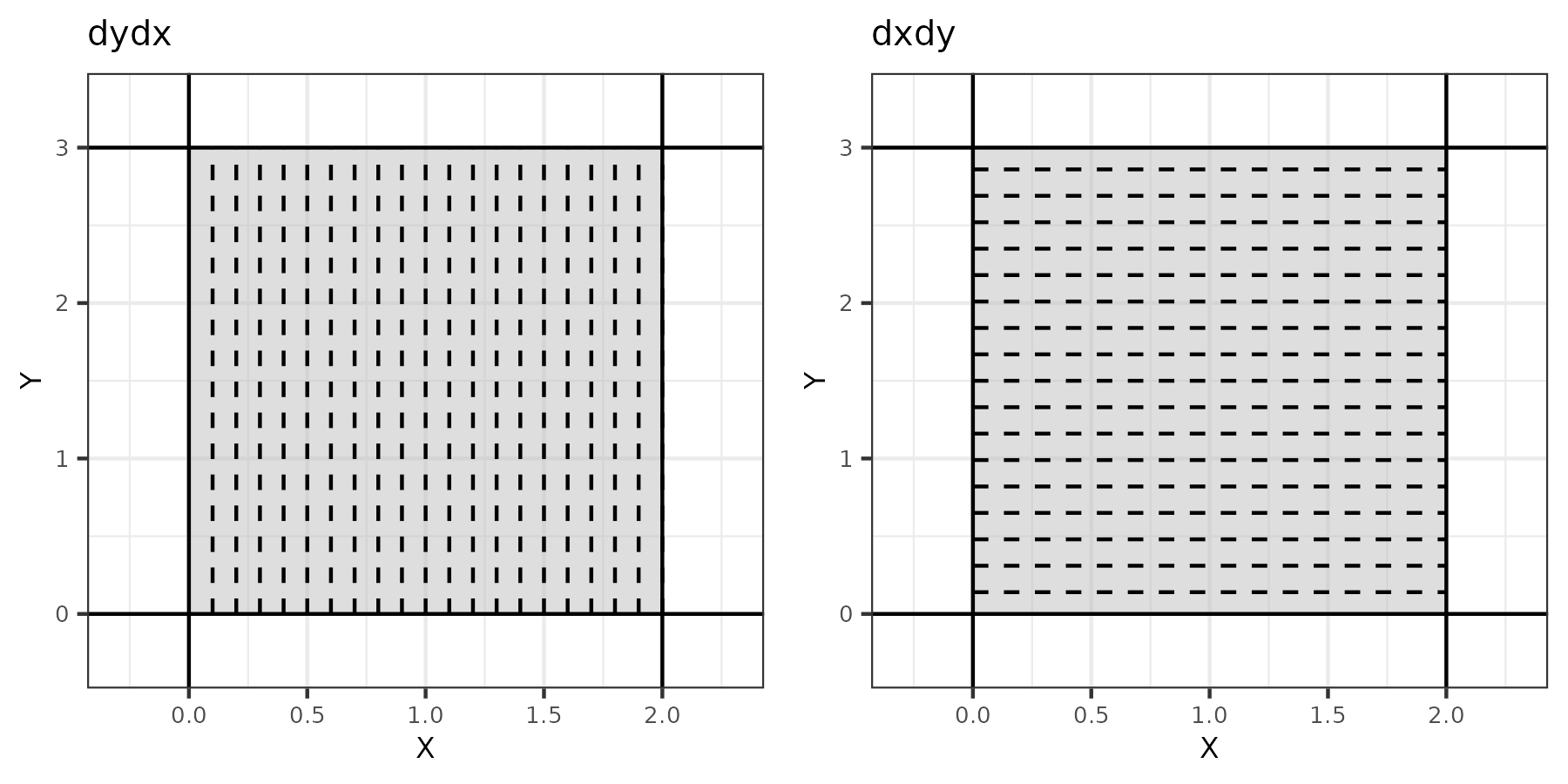
In both cases, the result is 15.
(a) Integrating with respect to y, then x ($dydx$):
$$ \int_0^2 \int_0^3 (3x^2 - y) \, dy \, dx $$
First, evaluate the inner integral with respect to $y$:
$$ \int_0^3 (3x^2 - y) \, dy = \left[ 3x^2y - \frac{1}{2}y^2 \right]_{y=0}^{y=3} = \left( 3x^2(3) - \frac{1}{2}(3)^2 \right) - (0) = 9x^2 - \frac{9}{2} $$
Now, integrate this result with respect to $x$:
$$ \int_0^2 \left( 9x^2 - \frac{9}{2} \right) \, dx = \left[ 3x^3 - \frac{9}{2}x \right]_0^2 = \left( 3(2)^3 - \frac{9}{2}(2) \right) - (0) = 24 - 9 = 15 $$
(b) Integrating with respect to x, then y ($dxdy$): $$ \int_0^3 \int_0^2 (3x^2 - y) \, dx \, dy $$ First, evaluate the inner integral with respect to $x$: $$ \int_0^2 (3x^2 - y) \, dx = \left[ x^3 - yx \right]_{x=0}^{x=2} = (2^3 - y(2)) - (0) = 8 - 2y $$ Now, integrate this result with respect to $y$: $$ \int_0^3 (8 - 2y) \, dy = \left[ 8y - y^2 \right]_0^3 = (8(3) - 3^2) - (0) = 24 - 9 = 15 $$ As expected from Fubini's Theorem, both orders of integration yield the same result.
(b) Integrating with respect to x, then y ($dxdy$): $$ \int_0^3 \int_0^2 (3x^2 - y) \, dx \, dy $$ First, evaluate the inner integral with respect to $x$: $$ \int_0^2 (3x^2 - y) \, dx = \left[ x^3 - yx \right]_{x=0}^{x=2} = (2^3 - y(2)) - (0) = 8 - 2y $$ Now, integrate this result with respect to $y$: $$ \int_0^3 (8 - 2y) \, dy = \left[ 8y - y^2 \right]_0^3 = (8(3) - 3^2) - (0) = 24 - 9 = 15 $$ As expected from Fubini's Theorem, both orders of integration yield the same result.
Question 3: Consider the integral $\iint\limits_R x\sin(xy) \,dA$ over $R = \{(x,y)|0 \leq x \leq \pi, 1 \leq y \leq 2\}$.
- Express the double integral in two different ways.
- Analyze whether evaluating the double integral in one way is easier than the other and why.
- Evaluate the integral.
For part (b), consider the antiderivative of the integrand with respect to each variable. Does one require a more complex technique (like integration by parts) than the other? For part (c), choose the easier order of integration you identified to find the final value.
- Order 1 ($dydx$): $\int_0^{\pi} \int_1^2 x\sin(xy) \,dy\,dx$
Order 2 ($dxdy$): $\int_1^{2} \int_0^{\pi} x\sin(xy) \,dx\,dy$ - Integrating with respect to $y$ first is easier because it involves a simple u-substitution, whereas integrating with respect to $x$ first requires integration by parts.
- The value of the integral is 0.
(a) Two Different Expressions:
Since the region is rectangular, we can set up the iterated integral in either order:
With respect to y first: $\int_0^{\pi} \int_1^2 x\sin(xy) \,dy\,dx$
With respect to x first: $\int_1^{2} \int_0^{\pi} x\sin(xy) \,dx\,dy$
(b) Analysis of Difficulty:
Let's analyze the inner integrals for each case.
(c) Evaluation:
We will use the easier order of integration ($dydx$). $$ \int_0^{\pi} \int_1^2 x\sin(xy) \,dy\,dx $$ Evaluate the inner integral: $$ \int_1^2 x\sin(xy) \,dy = \left[ -\cos(xy) \right]_{y=1}^{y=2} = (-\cos(x \cdot 2)) - (-\cos(x \cdot 1)) = \cos(x) - \cos(2x) $$ Now, evaluate the outer integral: $$ \int_0^{\pi} (\cos(x) - \cos(2x)) \,dx = \left[ \sin(x) - \frac{1}{2}\sin(2x) \right]_0^{\pi} $$ $$ = \left( \sin(\pi) - \frac{1}{2}\sin(2\pi) \right) - \left( \sin(0) - \frac{1}{2}\sin(0) \right) = (0 - 0) - (0 - 0) = 0 $$
Since the region is rectangular, we can set up the iterated integral in either order:
With respect to y first: $\int_0^{\pi} \int_1^2 x\sin(xy) \,dy\,dx$
With respect to x first: $\int_1^{2} \int_0^{\pi} x\sin(xy) \,dx\,dy$
(b) Analysis of Difficulty:
Let's analyze the inner integrals for each case.
- Case 1 ($dy$ first): The integral is $\int x\sin(xy) \,dy$. Here, $x$ is treated as a constant. This is a basic integral that can be solved with the substitution $u=xy$, $du=x\,dy$. The integral becomes $\int \sin(u)\,du = -\cos(u) = -\cos(xy)$. This is straightforward.
- Case 2 ($dx$ first): The integral is $\int x\sin(xy) \,dx$. Here, $y$ is treated as a constant. This integral is of the form $\int x\sin(ax)\,dx$ and requires integration by parts.
(c) Evaluation:
We will use the easier order of integration ($dydx$). $$ \int_0^{\pi} \int_1^2 x\sin(xy) \,dy\,dx $$ Evaluate the inner integral: $$ \int_1^2 x\sin(xy) \,dy = \left[ -\cos(xy) \right]_{y=1}^{y=2} = (-\cos(x \cdot 2)) - (-\cos(x \cdot 1)) = \cos(x) - \cos(2x) $$ Now, evaluate the outer integral: $$ \int_0^{\pi} (\cos(x) - \cos(2x)) \,dx = \left[ \sin(x) - \frac{1}{2}\sin(2x) \right]_0^{\pi} $$ $$ = \left( \sin(\pi) - \frac{1}{2}\sin(2\pi) \right) - \left( \sin(0) - \frac{1}{2}\sin(0) \right) = (0 - 0) - (0 - 0) = 0 $$
Question 4: Reverse the order of the integration in the iterated integral $\int_0^{\sqrt{2}} \int_0^{2-x^2} xe^{x^2} \, dy\,dx$. Then evaluate the new iterated integral.
First, sketch the region of integration described by the limits. The current limits are for a Type I region. Reversing the order is often useful if the inner integral is difficult to evaluate as given. The reversed integral may be simpler.
The reversed integral is $\int_0^2 \int_0^{\sqrt{2-y}} xe^{x^2} \, dx \, dy$, and its value is $\frac{1}{2}(e^2 - 3)$.
1. Identify and Sketch the Region
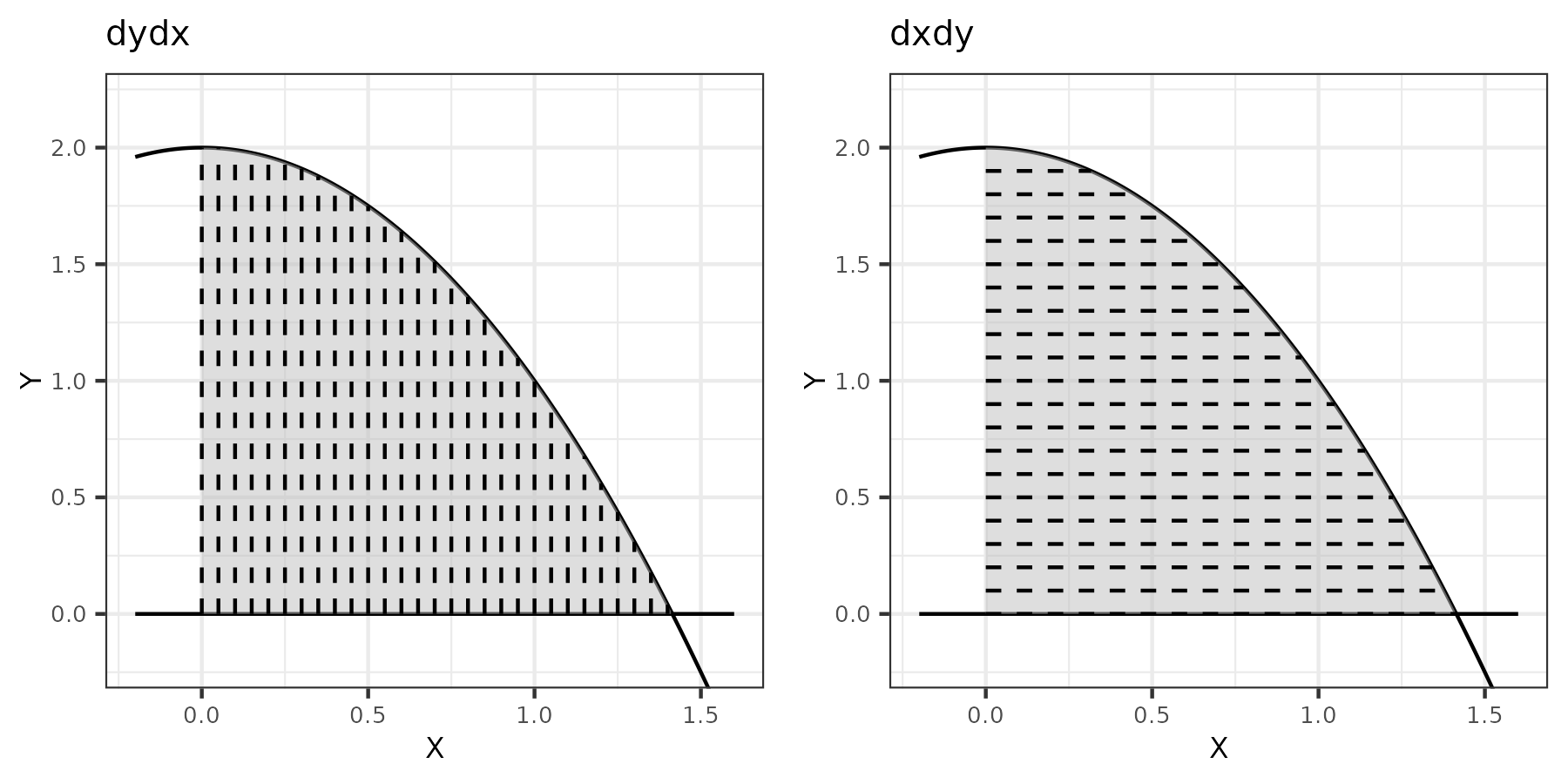
The given integral is $\int_0^{\sqrt{2}} \int_0^{2-x^2} xe^{x^2} \, dy\,dx$. The limits of integration tell us:
2. Reverse the Order of Integration
To reverse the order, we describe the region with $y$ as the outer variable (Type II).
Evaluating the original integral requires integrating $\int xe^{x^2} dy = xye^{x^2}$, which is simple, but the subsequent integral w.r.t $x$ is difficult. The new order is easier.
First, evaluate the inner integral with respect to $x$ using a u-substitution where $u=x^2$ and $du=2x\,dx$: $$ \int_0^{\sqrt{2-y}} xe^{x^2} \, dx = \frac{1}{2} \int_0^{2-y} e^u \, du = \frac{1}{2} \left[e^u\right]_0^{2-y} = \frac{1}{2}(e^{2-y} - e^0) = \frac{1}{2}(e^{2-y} - 1) $$ Now, evaluate the outer integral with respect to $y$: $$ \int_0^2 \frac{1}{2}(e^{2-y} - 1) \, dy = \frac{1}{2} \left[ -e^{2-y} - y \right]_0^2 = \frac{1}{2} \left( (-e^{2-2} - 2) - (-e^{2-0} - 0) \right) $$ $$ = \frac{1}{2} (-e^0 - 2 + e^2) = \frac{1}{2}(-1 - 2 + e^2) = \frac{1}{2}(e^2 - 3) $$
The given integral is $\int_0^{\sqrt{2}} \int_0^{2-x^2} xe^{x^2} \, dy\,dx$. The limits of integration tell us:
- $0 \leq x \leq \sqrt{2}$
- $0 \leq y \leq 2-x^2$
2. Reverse the Order of Integration
To reverse the order, we describe the region with $y$ as the outer variable (Type II).
- Bounds for y: The region extends from $y=0$ up to the vertex of the parabola at $y=2$. So, $0 \leq y \leq 2$.
- Bounds for x: For a given $y$, $x$ starts at the y-axis ($x=0$) and extends to the right boundary, which is the parabola. We solve the parabola's equation for $x$: $y = 2-x^2 \implies x^2 = 2-y \implies x = \sqrt{2-y}$ (since $x \ge 0$). So, $0 \leq x \leq \sqrt{2-y}$.
Evaluating the original integral requires integrating $\int xe^{x^2} dy = xye^{x^2}$, which is simple, but the subsequent integral w.r.t $x$ is difficult. The new order is easier.
First, evaluate the inner integral with respect to $x$ using a u-substitution where $u=x^2$ and $du=2x\,dx$: $$ \int_0^{\sqrt{2-y}} xe^{x^2} \, dx = \frac{1}{2} \int_0^{2-y} e^u \, du = \frac{1}{2} \left[e^u\right]_0^{2-y} = \frac{1}{2}(e^{2-y} - e^0) = \frac{1}{2}(e^{2-y} - 1) $$ Now, evaluate the outer integral with respect to $y$: $$ \int_0^2 \frac{1}{2}(e^{2-y} - 1) \, dy = \frac{1}{2} \left[ -e^{2-y} - y \right]_0^2 = \frac{1}{2} \left( (-e^{2-2} - 2) - (-e^{2-0} - 0) \right) $$ $$ = \frac{1}{2} (-e^0 - 2 + e^2) = \frac{1}{2}(-1 - 2 + e^2) = \frac{1}{2}(e^2 - 3) $$
Question 5: Consider the iterated integral $\iint\limits_R f(x,y) \,dA$ where $ z = f(x,y) = x-2y$ over a triangular region $R$ that has sides on $x= 0$, $y=0$, and the line $x+y = 1$. Evaluate the iterated integral by:
- integrating first with respect to $y$ and then
- integrating first with respect to $x$.
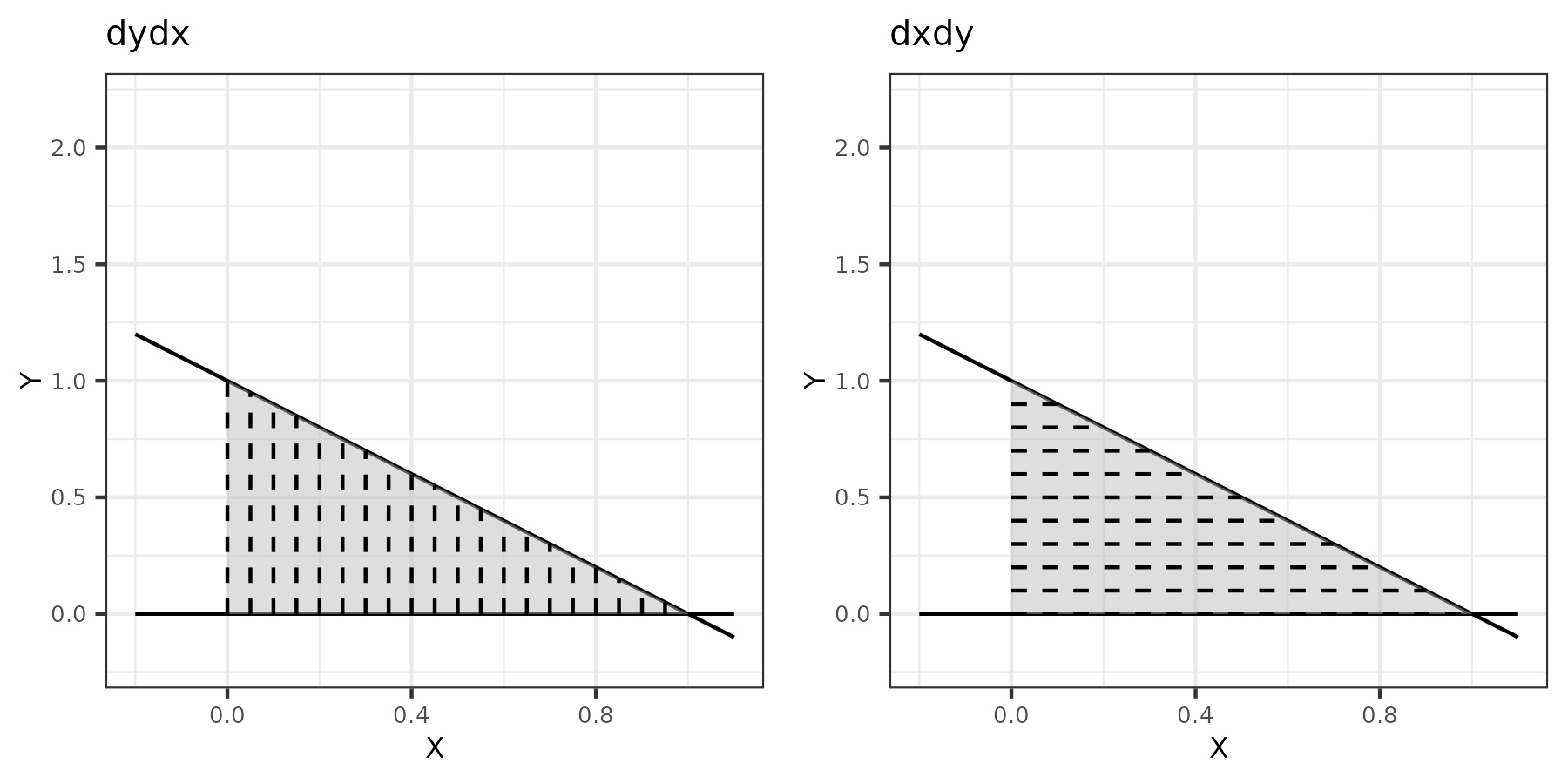
For part (a), set up the integral over a Type I region. The outer integral will be with respect to $x$ from 0 to 1. For part (b), set it up over a Type II region. The outer integral will be with respect to $y$ from 0 to 1. Both methods must yield the same result.
Both methods of integration yield a result of $-\frac{1}{6}$.
The region $R$ is a triangle with vertices at $(0,0)$, $(1,0)$, and $(0,1)$.
(a) Integrating with respect to y, then x ($dydx$):
The region is described by $0 \le x \le 1$ and $0 \le y \le 1-x$. $$ \int_0^1 \int_0^{1-x} (x-2y) \, dy \, dx $$ Inner integral (w.r.t $y$): $$ \int_0^{1-x} (x-2y) \, dy = \left[ xy - y^2 \right]_0^{1-x} = x(1-x) - (1-x)^2 = (x-x^2) - (1-2x+x^2) = -2x^2 + 3x - 1 $$ Outer integral (w.r.t $x$): $$ \int_0^1 (-2x^2 + 3x - 1) \, dx = \left[ -\frac{2}{3}x^3 + \frac{3}{2}x^2 - x \right]_0^1 = -\frac{2}{3} + \frac{3}{2} - 1 = \frac{-4+9-6}{6} = -\frac{1}{6} $$
(b) Integrating with respect to x, then y ($dxdy$):
The region is described by $0 \le y \le 1$ and $0 \le x \le 1-y$. $$ \int_0^1 \int_0^{1-y} (x-2y) \, dx \, dy $$ Inner integral (w.r.t $x$): $$ \int_0^{1-y} (x-2y) \, dx = \left[ \frac{1}{2}x^2 - 2yx \right]_0^{1-y} = \frac{1}{2}(1-y)^2 - 2y(1-y) $$ $$ = \frac{1}{2}(1-2y+y^2) - (2y-2y^2) = \frac{1}{2} - y + \frac{1}{2}y^2 - 2y + 2y^2 = \frac{5}{2}y^2 - 3y + \frac{1}{2} $$ Outer integral (w.r.t $y$): $$ \int_0^1 \left(\frac{5}{2}y^2 - 3y + \frac{1}{2}\right) \, dy = \left[ \frac{5}{6}y^3 - \frac{3}{2}y^2 + \frac{1}{2}y \right]_0^1 = \frac{5}{6} - \frac{3}{2} + \frac{1}{2} = \frac{5-9+3}{6} = -\frac{1}{6} $$
(a) Integrating with respect to y, then x ($dydx$):
The region is described by $0 \le x \le 1$ and $0 \le y \le 1-x$. $$ \int_0^1 \int_0^{1-x} (x-2y) \, dy \, dx $$ Inner integral (w.r.t $y$): $$ \int_0^{1-x} (x-2y) \, dy = \left[ xy - y^2 \right]_0^{1-x} = x(1-x) - (1-x)^2 = (x-x^2) - (1-2x+x^2) = -2x^2 + 3x - 1 $$ Outer integral (w.r.t $x$): $$ \int_0^1 (-2x^2 + 3x - 1) \, dx = \left[ -\frac{2}{3}x^3 + \frac{3}{2}x^2 - x \right]_0^1 = -\frac{2}{3} + \frac{3}{2} - 1 = \frac{-4+9-6}{6} = -\frac{1}{6} $$
(b) Integrating with respect to x, then y ($dxdy$):
The region is described by $0 \le y \le 1$ and $0 \le x \le 1-y$. $$ \int_0^1 \int_0^{1-y} (x-2y) \, dx \, dy $$ Inner integral (w.r.t $x$): $$ \int_0^{1-y} (x-2y) \, dx = \left[ \frac{1}{2}x^2 - 2yx \right]_0^{1-y} = \frac{1}{2}(1-y)^2 - 2y(1-y) $$ $$ = \frac{1}{2}(1-2y+y^2) - (2y-2y^2) = \frac{1}{2} - y + \frac{1}{2}y^2 - 2y + 2y^2 = \frac{5}{2}y^2 - 3y + \frac{1}{2} $$ Outer integral (w.r.t $y$): $$ \int_0^1 \left(\frac{5}{2}y^2 - 3y + \frac{1}{2}\right) \, dy = \left[ \frac{5}{6}y^3 - \frac{3}{2}y^2 + \frac{1}{2}y \right]_0^1 = \frac{5}{6} - \frac{3}{2} + \frac{1}{2} = \frac{5-9+3}{6} = -\frac{1}{6} $$
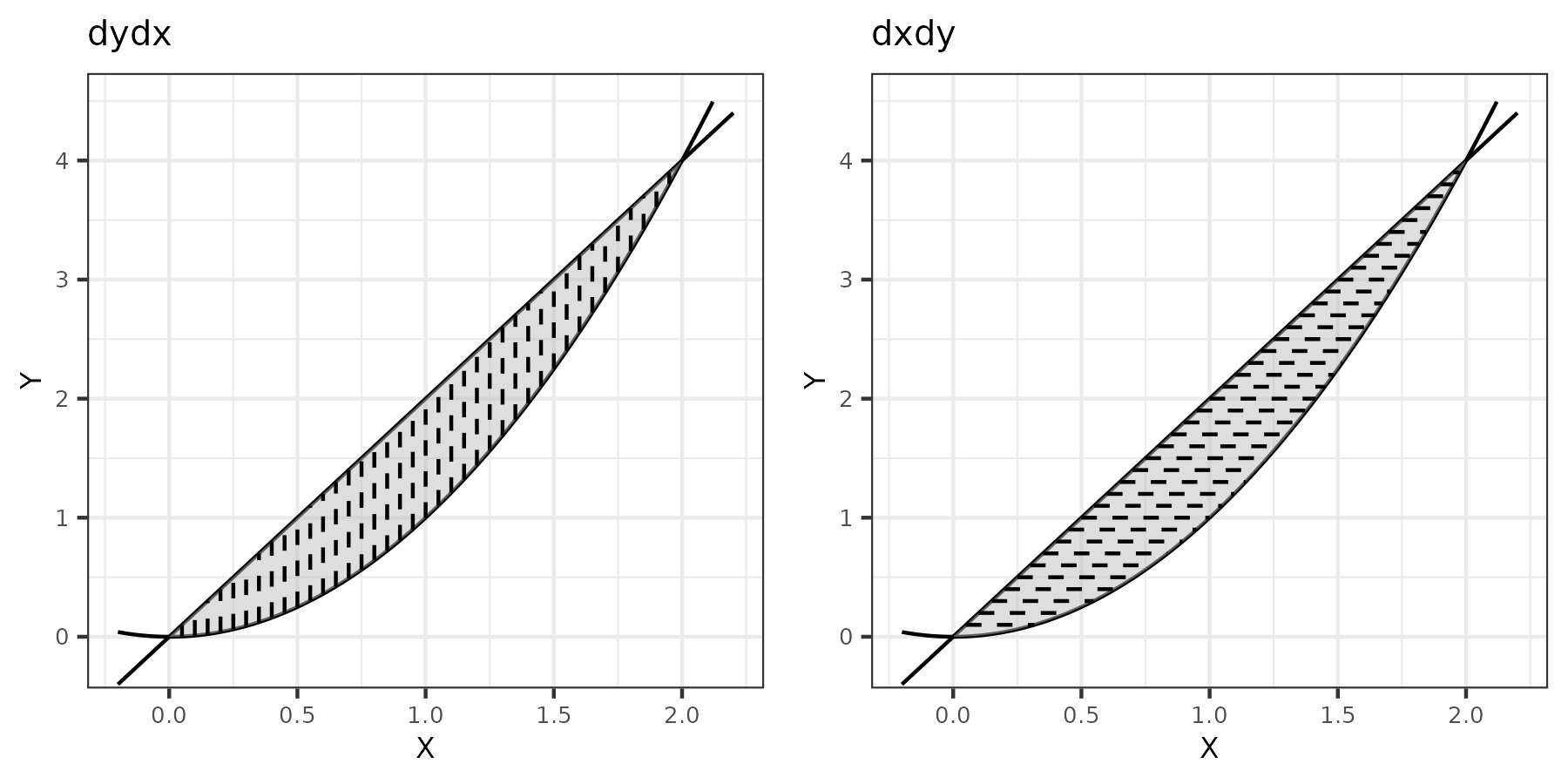
Question 6: Evaluate the iterated integral $\iint\limits_D (x^2 +y^2)\,dA$ over the region $D$ in the first quadrant between the curves $y = 2x$ and $y=x^2$.
First, find the intersection points of the two curves to determine the limits of integration. Then, set up the integral as a Type I region ($dy\,dx$), where the parabola $y=x^2$ is the lower bound and the line $y=2x$ is the upper bound.
$\frac{216}{35}$
1. Find Intersection Points and Sketch the Region
Set the two functions equal to find their intersections: $$ x^2 = 2x \implies x^2 - 2x = 0 \implies x(x-2) = 0 $$ The intersections occur at $x=0$ (giving point $(0,0)$) and $x=2$ (giving point $(2,4)$). The region $D$ is bounded below by $y=x^2$ and above by $y=2x$.
2. Set up and Evaluate the Integral ($dy\,dx$)
We integrate with respect to $y$ first, which is the most direct approach. The limits are $0 \leq x \leq 2$ and $x^2 \leq y \leq 2x$. $$ \int_0^2 \int_{x^2}^{2x} (x^2+y^2) \, dy \, dx $$ Inner integral (w.r.t $y$): $$ \int_{x^2}^{2x} (x^2+y^2) \, dy = \left[ x^2y + \frac{1}{3}y^3 \right]_{x^2}^{2x} $$ $$ = \left( x^2(2x) + \frac{1}{3}(2x)^3 \right) - \left( x^2(x^2) + \frac{1}{3}(x^2)^3 \right) $$ $$ = \left( 2x^3 + \frac{8}{3}x^3 \right) - \left( x^4 + \frac{1}{3}x^6 \right) = \frac{14}{3}x^3 - x^4 - \frac{1}{3}x^6 $$ Outer integral (w.r.t $x$): $$ \int_0^2 \left( \frac{14}{3}x^3 - x^4 - \frac{1}{3}x^6 \right) \, dx = \left[ \frac{14}{3}\frac{x^4}{4} - \frac{x^5}{5} - \frac{1}{3}\frac{x^7}{7} \right]_0^2 $$ $$ = \left[ \frac{7}{6}x^4 - \frac{1}{5}x^5 - \frac{1}{21}x^7 \right]_0^2 = \frac{7}{6}(16) - \frac{1}{5}(32) - \frac{1}{21}(128) $$ $$ = \frac{112}{6} - \frac{32}{5} - \frac{128}{21} = \frac{56}{3} - \frac{32}{5} - \frac{128}{21} $$ Find a common denominator, which is 105: $$ = \frac{56(35)}{105} - \frac{32(21)}{105} - \frac{128(5)}{105} = \frac{1960 - 672 - 640}{105} = \frac{648}{105} $$ Simplify by dividing the numerator and denominator by 3: $$ \frac{648 \div 3}{105 \div 3} = \frac{216}{35} $$
Set the two functions equal to find their intersections: $$ x^2 = 2x \implies x^2 - 2x = 0 \implies x(x-2) = 0 $$ The intersections occur at $x=0$ (giving point $(0,0)$) and $x=2$ (giving point $(2,4)$). The region $D$ is bounded below by $y=x^2$ and above by $y=2x$.
2. Set up and Evaluate the Integral ($dy\,dx$)
We integrate with respect to $y$ first, which is the most direct approach. The limits are $0 \leq x \leq 2$ and $x^2 \leq y \leq 2x$. $$ \int_0^2 \int_{x^2}^{2x} (x^2+y^2) \, dy \, dx $$ Inner integral (w.r.t $y$): $$ \int_{x^2}^{2x} (x^2+y^2) \, dy = \left[ x^2y + \frac{1}{3}y^3 \right]_{x^2}^{2x} $$ $$ = \left( x^2(2x) + \frac{1}{3}(2x)^3 \right) - \left( x^2(x^2) + \frac{1}{3}(x^2)^3 \right) $$ $$ = \left( 2x^3 + \frac{8}{3}x^3 \right) - \left( x^4 + \frac{1}{3}x^6 \right) = \frac{14}{3}x^3 - x^4 - \frac{1}{3}x^6 $$ Outer integral (w.r.t $x$): $$ \int_0^2 \left( \frac{14}{3}x^3 - x^4 - \frac{1}{3}x^6 \right) \, dx = \left[ \frac{14}{3}\frac{x^4}{4} - \frac{x^5}{5} - \frac{1}{3}\frac{x^7}{7} \right]_0^2 $$ $$ = \left[ \frac{7}{6}x^4 - \frac{1}{5}x^5 - \frac{1}{21}x^7 \right]_0^2 = \frac{7}{6}(16) - \frac{1}{5}(32) - \frac{1}{21}(128) $$ $$ = \frac{112}{6} - \frac{32}{5} - \frac{128}{21} = \frac{56}{3} - \frac{32}{5} - \frac{128}{21} $$ Find a common denominator, which is 105: $$ = \frac{56(35)}{105} - \frac{32(21)}{105} - \frac{128(5)}{105} = \frac{1960 - 672 - 640}{105} = \frac{648}{105} $$ Simplify by dividing the numerator and denominator by 3: $$ \frac{648 \div 3}{105 \div 3} = \frac{216}{35} $$
Question 7: Change the order of integration and then evaluate the integral $\int_0^1\int_{x-1}^{1-x} x \,dydx$.
The region is a triangle defined by $0 \le x \le 1$ and bounded by the lines $y=x-1$ and $y=1-x$. To reverse the order, you will need to split the region into two parts at $y=0$.
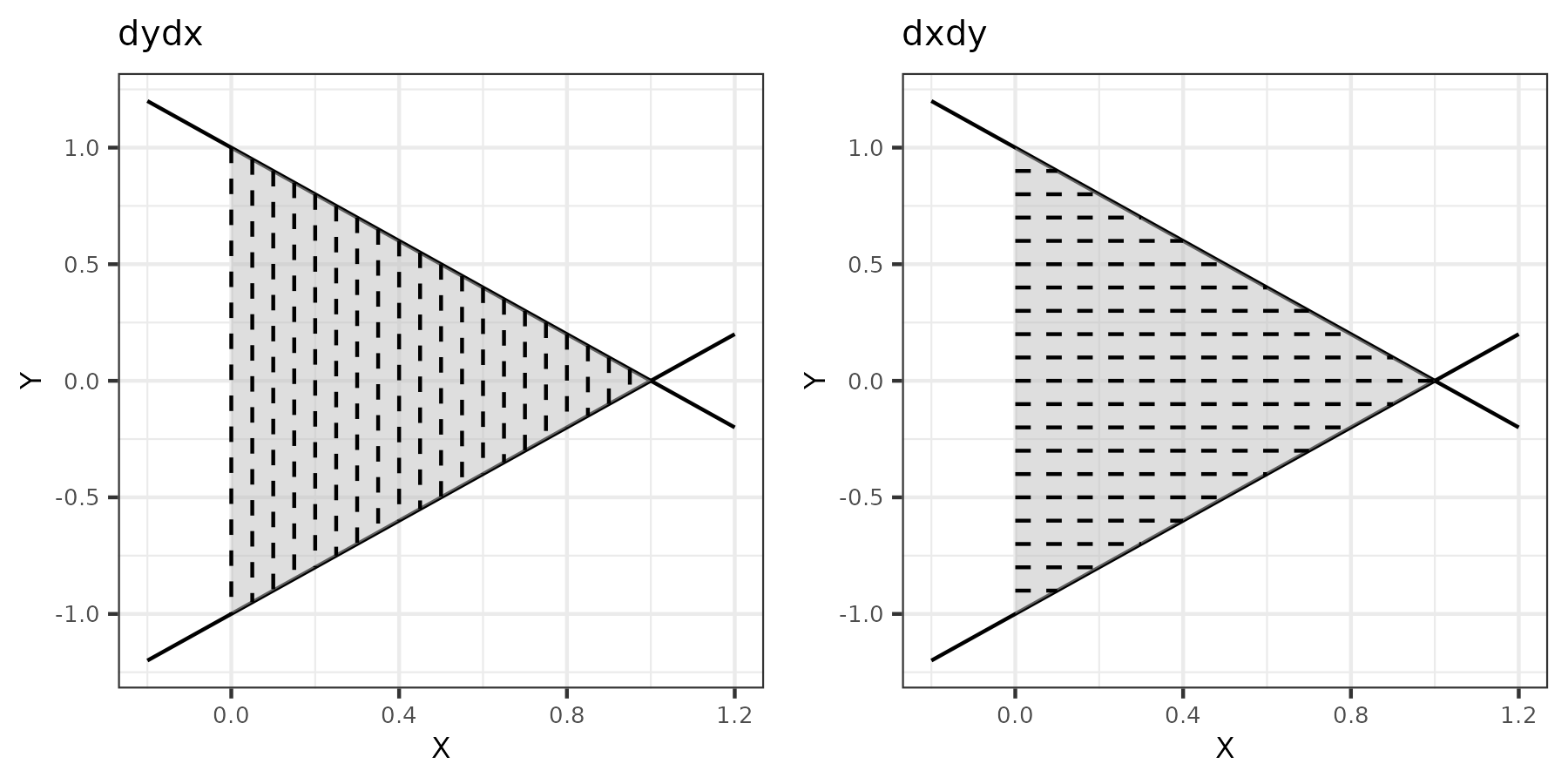
The new integral is $\int_{-1}^0 \int_0^{y+1} x \, dx dy + \int_0^1 \int_0^{1-y} x \, dx dy$, and the value is $\frac{1}{3}$.
1. Identify the Region
The limits are $0 \leq x \leq 1$ and $x-1 \leq y \leq 1-x$. The region is a triangle with vertices at $(0, -1)$, $(0, 1)$, and $(1, 0)$.
2. Change the Order of Integration
To express as a Type II region ($dx dy$), we need to find the bounds of $x$ in terms of $y$. We solve the boundary equations for $x$: $y=x-1 \implies x=y+1$ and $y=1-x \implies x=1-y$. The shape of the region requires us to split the integral at $y=0$.
First integral part: $$ \int_{-1}^0 \left[ \frac{1}{2}x^2 \right]_0^{y+1} dy = \int_{-1}^0 \frac{1}{2}(y+1)^2 \, dy = \frac{1}{2} \left[ \frac{(y+1)^3}{3} \right]_{-1}^0 = \frac{1}{6} [1^3 - 0^3] = \frac{1}{6} $$ Second integral part: $$ \int_0^1 \left[ \frac{1}{2}x^2 \right]_0^{1-y} dy = \int_0^1 \frac{1}{2}(1-y)^2 \, dy = \frac{1}{2} \left[ -\frac{(1-y)^3}{3} \right]_0^1 = -\frac{1}{6} [0^3 - 1^3] = \frac{1}{6} $$ Total value: $$ \frac{1}{6} + \frac{1}{6} = \frac{2}{6} = \frac{1}{3} $$
The limits are $0 \leq x \leq 1$ and $x-1 \leq y \leq 1-x$. The region is a triangle with vertices at $(0, -1)$, $(0, 1)$, and $(1, 0)$.
2. Change the Order of Integration
To express as a Type II region ($dx dy$), we need to find the bounds of $x$ in terms of $y$. We solve the boundary equations for $x$: $y=x-1 \implies x=y+1$ and $y=1-x \implies x=1-y$. The shape of the region requires us to split the integral at $y=0$.
- For $-1 \leq y \leq 0$: The region is bounded by $x=0$ on the left and $x=y+1$ on the right.
- For $0 \leq y \leq 1$: The region is bounded by $x=0$ on the left and $x=1-y$ on the right.
First integral part: $$ \int_{-1}^0 \left[ \frac{1}{2}x^2 \right]_0^{y+1} dy = \int_{-1}^0 \frac{1}{2}(y+1)^2 \, dy = \frac{1}{2} \left[ \frac{(y+1)^3}{3} \right]_{-1}^0 = \frac{1}{6} [1^3 - 0^3] = \frac{1}{6} $$ Second integral part: $$ \int_0^1 \left[ \frac{1}{2}x^2 \right]_0^{1-y} dy = \int_0^1 \frac{1}{2}(1-y)^2 \, dy = \frac{1}{2} \left[ -\frac{(1-y)^3}{3} \right]_0^1 = -\frac{1}{6} [0^3 - 1^3] = \frac{1}{6} $$ Total value: $$ \frac{1}{6} + \frac{1}{6} = \frac{2}{6} = \frac{1}{3} $$
Question 8: Change the order of integration and then evaluate the integral $\int_{-1}^1\int_{-\sqrt{1-y^2}}^{\sqrt{1-y^2}} y \,dxdy$.
The region of integration $\int_{-1}^1\int_{-\sqrt{1-y^2}}^{\sqrt{1-y^2}} ... \,dxdy$ is the unit disk $x^2+y^2 \le 1$. To change the order of integration, describe this same disk as a Type I region. Then evaluate the new integral. The result may be simpler to find by evaluating the integral in the reversed order.
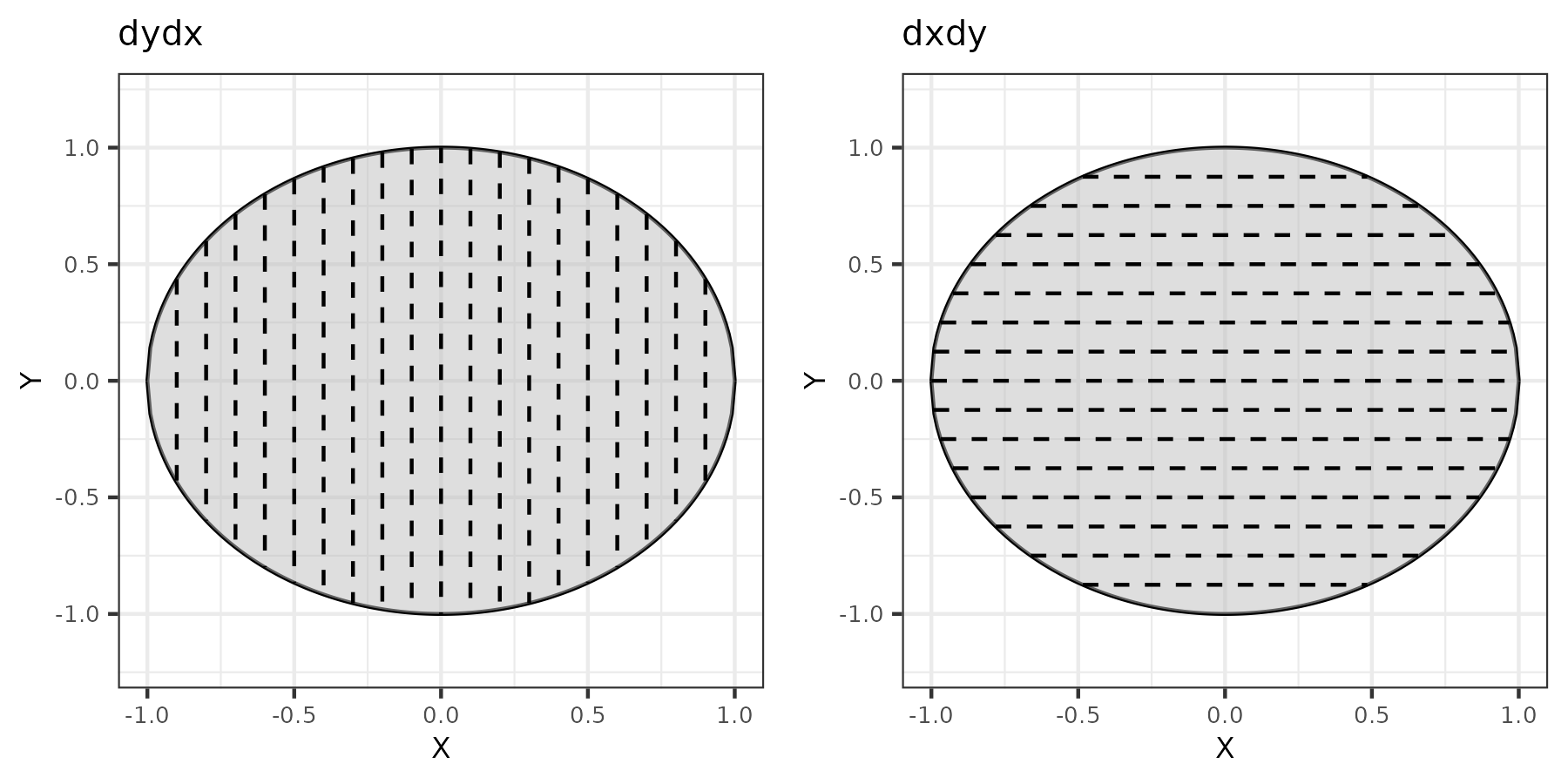
The new integral is $\int_{-1}^1\int_{-\sqrt{1-x^2}}^{\sqrt{1-x^2}} y \,dydx$, and the value is 0.
1. Identify the Region
The original integral is $\int_{-1}^1\int_{-\sqrt{1-y^2}}^{\sqrt{1-y^2}} y \,dxdy$. The limits describe the unit disk centered at the origin:
2. Change the Order of Integration
To write this as a Type I region ($dydx$), we express the same disk with $x$ as the outer variable. The description is symmetric:
Evaluate the inner integral with respect to $y$. $$ \int_{-\sqrt{1-x^2}}^{\sqrt{1-x^2}} y \,dy = \left[ \frac{1}{2}y^2 \right]_{y=-\sqrt{1-x^2}}^{y=\sqrt{1-x^2}} = \frac{1}{2} \left( (\sqrt{1-x^2})^2 - (-\sqrt{1-x^2})^2 \right) $$ $$ = \frac{1}{2} \left( (1-x^2) - (1-x^2) \right) = \frac{1}{2}(0) = 0 $$ Now evaluate the outer integral: $$ \int_{-1}^1 0 \, dx = 0 $$ The value of the integral is 0.
The original integral is $\int_{-1}^1\int_{-\sqrt{1-y^2}}^{\sqrt{1-y^2}} y \,dxdy$. The limits describe the unit disk centered at the origin:
- $-1 \le y \le 1$
- $-\sqrt{1-y^2} \le x \le \sqrt{1-y^2}$
2. Change the Order of Integration
To write this as a Type I region ($dydx$), we express the same disk with $x$ as the outer variable. The description is symmetric:
- $-1 \le x \le 1$
- $-\sqrt{1-x^2} \le y \le \sqrt{1-x^2}$
Evaluate the inner integral with respect to $y$. $$ \int_{-\sqrt{1-x^2}}^{\sqrt{1-x^2}} y \,dy = \left[ \frac{1}{2}y^2 \right]_{y=-\sqrt{1-x^2}}^{y=\sqrt{1-x^2}} = \frac{1}{2} \left( (\sqrt{1-x^2})^2 - (-\sqrt{1-x^2})^2 \right) $$ $$ = \frac{1}{2} \left( (1-x^2) - (1-x^2) \right) = \frac{1}{2}(0) = 0 $$ Now evaluate the outer integral: $$ \int_{-1}^1 0 \, dx = 0 $$ The value of the integral is 0.
Question 9: Consider the iterated integral $\int_0^1 \int_0^{x^2} \int_0^{y^2} f(x,y,z) \, dz\,dy\,dx$. The order of integration here is first with respect to z, then y, and then x. Express this integral by changing the order of integration to be first with respect to $x$, then $z$, and then $y$. Verify that the value of the integral is the same if we let $f(x,y,z) = xyz$.
Analyze the inequalities that define the region: $0 \le x \le 1$, $0 \le y \le x^2$, and $0 \le z \le y^2$. To change the order to $dx\,dz\,dy$, you must re-express these inequalities to make $y$ the outermost variable, then $z$, then $x$. This means finding the absolute range of $y$, then the range of $z$ for a given $y$, and finally the range of $x$ for a given $y$ and $z$.
The integral with the order of integration changed to $dx\,dz\,dy$ is:
$$ \int_0^1 \int_0^{y^2} \int_{\sqrt{y}}^1 xyz \, dx \, dz \, dy $$
Evaluation of this integral gives $\frac{1}{168}$.
1. Determine the New Limits of Integration
The region of integration is defined by the inequalities:
2. Evaluate with $f(x,y,z) = xyz$
$$ \int_0^1 \int_0^{y^2} \int_{\sqrt{y}}^1 xyz \, dx \, dz \, dy $$ Innermost integral (w.r.t $x$): $$ \int_{\sqrt{y}}^1 xyz \, dx = yz \left[ \frac{1}{2}x^2 \right]_{\sqrt{y}}^1 = \frac{yz}{2} (1^2 - (\sqrt{y})^2) = \frac{yz}{2}(1-y) $$ Middle integral (w.r.t $z$): $$ \int_0^{y^2} \frac{y(1-y)}{2} z \, dz = \frac{y(1-y)}{2} \left[ \frac{1}{2}z^2 \right]_0^{y^2} = \frac{y-y^2}{4} ( (y^2)^2 - 0 ) = \frac{y^5 - y^6}{4} $$ Outermost integral (w.r.t $y$): $$ \int_0^1 \frac{y^5 - y^6}{4} \, dy = \frac{1}{4} \left[ \frac{y^6}{6} - \frac{y^7}{7} \right]_0^1 = \frac{1}{4} \left( (\frac{1}{6} - \frac{1}{7}) - 0 \right) = \frac{1}{4} \left( \frac{7-6}{42} \right) = \frac{1}{4} \left( \frac{1}{42} \right) = \frac{1}{168} $$
The region of integration is defined by the inequalities:
- $0 \le x \le 1$
- $0 \le y \le x^2$
- $0 \le z \le y^2$
- Bounds for y (outermost): From (1) and (2), $y \le x^2 \le 1^2 = 1$. So, the full range for $y$ is $0 \le y \le 1$.
- Bounds for z (middle): The relationship between $z$ and $y$ is given directly by (3): $0 \le z \le y^2$.
- Bounds for x (innermost): From (2), since $y \le x^2$ and $x \ge 0$, we have $x \ge \sqrt{y}$. Combined with (1), $x \le 1$, we get the bounds for $x$: $\sqrt{y} \le x \le 1$.
2. Evaluate with $f(x,y,z) = xyz$
$$ \int_0^1 \int_0^{y^2} \int_{\sqrt{y}}^1 xyz \, dx \, dz \, dy $$ Innermost integral (w.r.t $x$): $$ \int_{\sqrt{y}}^1 xyz \, dx = yz \left[ \frac{1}{2}x^2 \right]_{\sqrt{y}}^1 = \frac{yz}{2} (1^2 - (\sqrt{y})^2) = \frac{yz}{2}(1-y) $$ Middle integral (w.r.t $z$): $$ \int_0^{y^2} \frac{y(1-y)}{2} z \, dz = \frac{y(1-y)}{2} \left[ \frac{1}{2}z^2 \right]_0^{y^2} = \frac{y-y^2}{4} ( (y^2)^2 - 0 ) = \frac{y^5 - y^6}{4} $$ Outermost integral (w.r.t $y$): $$ \int_0^1 \frac{y^5 - y^6}{4} \, dy = \frac{1}{4} \left[ \frac{y^6}{6} - \frac{y^7}{7} \right]_0^1 = \frac{1}{4} \left( (\frac{1}{6} - \frac{1}{7}) - 0 \right) = \frac{1}{4} \left( \frac{7-6}{42} \right) = \frac{1}{4} \left( \frac{1}{42} \right) = \frac{1}{168} $$