
Set Theory: Learning Objectives 4, 5, 6
Question 1: Let the sets $A$ and $B$ be defined as:
$$ A = \{\text{red, blue, green, yellow} \}, \hspace{0.5em} B = \{\text{blue, orange, purple, red} \}$$
List the elements in each of the following sets:
- $A \cup B$
- $A \cap B$
- $A - B$
- $B - A$
Union ($A \cup B$) includes all unique elements from both sets. Intersection ($A \cap B$) includes only elements present in both sets. Difference ($A - B$) includes elements in A but not in B.
- $\{\text{red, blue, green, yellow, orange, purple}\}$
- $\{\text{red, blue}\}$
- $\{\text{green, yellow}\}$
- $\{\text{orange, purple}\}$
- Union ($A \cup B$): We combine all elements from both sets, ensuring not to list duplicates. The elements are red, blue, green, yellow, orange, and purple. So, $A \cup B = \{\text{red, blue, green, yellow, orange, purple}\}$.
- Intersection ($A \cap B$): We find the elements that appear in both set A and set B. The common elements are red and blue. So, $A \cap B = \{\text{red, blue}\}$.
- Difference ($A - B$): We list the elements that are in set A but not in set B. 'green' and 'yellow' are in A but not B. So, $A - B = \{\text{green, yellow}\}$.
- Difference ($B - A$): We list the elements that are in set B but not in set A. 'orange' and 'purple' are in B but not A. So, $B - A = \{\text{orange, purple}\}$.
Question 2: $X$ and $Y$ are two sets such that $X$ has 20 elements, $Y$ has 30 elements, and their union ($X \cup Y$) has 45 elements. Find the number of elements in their intersection ($X \cap Y$).
Think about what happens when you add the number of elements in set X and set Y. The elements that are in both sets (the intersection) get counted twice. How can you use this idea with the total number of unique elements in the union to find the size of the intersection?
5
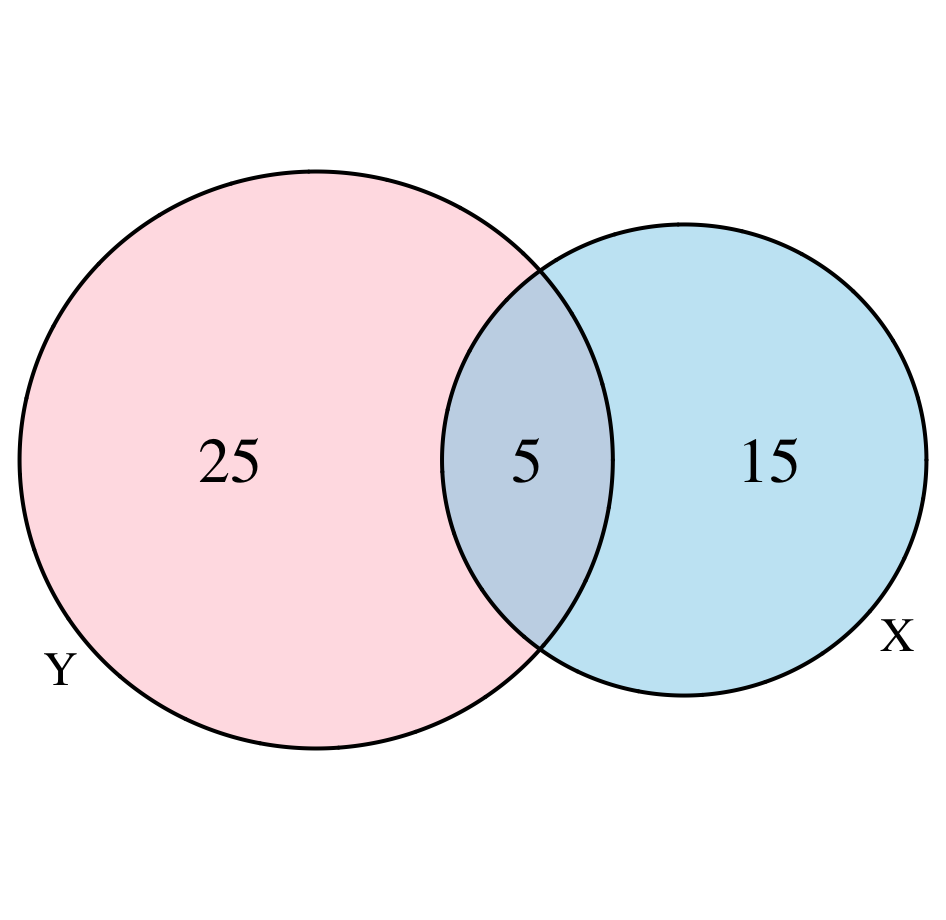
Let's think about the elements step-by-step.
Set X has 20 elements.
Set Y has 30 elements.
If we simply add the number of elements together ($20 + 30 = 50$), we are counting every element in X once and every element in Y once. This means that any element that is in both sets (the intersection) has been counted twice in this sum.
We are told that the total number of unique elements when the sets are combined (the union) is 45.
The difference between our simple sum (50) and the actual number of unique elements (45) is because of this double-counting.
The number of elements that were double-counted is the size of the intersection.
Number of elements in intersection = (Elements in X + Elements in Y) - (Elements in the union)
Number of elements in intersection = $50 - 45 = 5$.
So, the intersection of X and Y has 5 elements.
Question 3: In a community health survey of 30 individuals, 18 respondents reported receiving a flu vaccine, and 8 reported receiving both a flu vaccine and a COVID-19 vaccine. Every individual received at least one of these two vaccines.
- How many individuals received the COVID-19 vaccine in total?
- How many individuals received only the COVID-19 vaccine?
Let's use a step-by-step approach. You know the total number of people, the number who got the flu shot, and the number who got both. For part (a), think about how the total number of people is composed of three groups: "only flu", "only COVID", and "both". For part (b), once you know the total number who got the COVID vaccine, how do you find the number who only got that vaccine?
- 20
- 12
Let's break down the survey results:
Total individuals surveyed = 30.
Number who received a flu vaccine = 18.
Number who received both vaccines = 8.
First, let's find the number of people who received *only* the flu vaccine. The group of 18 flu-vaccine recipients includes those who got both.
Number with only flu = (Total with flu) - (Number with both) = $18 - 8 = 10$.
Since every person received at least one vaccine, the total of 30 people is made up of three distinct groups: those with only the flu vaccine, those with only the COVID-19 vaccine, and those with both.
Total = (Only Flu) + (Only COVID) + (Both)
$30 = 10 + (\text{Only COVID}) + 8$
$30 = 18 + (\text{Only COVID})$
Number with only COVID = $30 - 18 = 12$.
Now we can answer the questions:
Total individuals surveyed = 30.
Number who received a flu vaccine = 18.
Number who received both vaccines = 8.
First, let's find the number of people who received *only* the flu vaccine. The group of 18 flu-vaccine recipients includes those who got both.
Number with only flu = (Total with flu) - (Number with both) = $18 - 8 = 10$.
Since every person received at least one vaccine, the total of 30 people is made up of three distinct groups: those with only the flu vaccine, those with only the COVID-19 vaccine, and those with both.
Total = (Only Flu) + (Only COVID) + (Both)
$30 = 10 + (\text{Only COVID}) + 8$
$30 = 18 + (\text{Only COVID})$
Number with only COVID = $30 - 18 = 12$.
Now we can answer the questions:
- How many individuals received the COVID-19 vaccine in total?
This is the sum of people who received *only* the COVID-19 vaccine and those who received *both* vaccines.
Total with COVID = (Only COVID) + (Both) = $12 + 8 = 20$.
So, 20 individuals received the COVID-19 vaccine. - How many individuals received only the COVID-19 vaccine?
We calculated this value above.
So, 12 individuals received only the COVID-19 vaccine.
Question 4: Consider the following sets of integers:
$$ A = \{1, 2 , 3, 4, 5, 6, 7, 8, 9,10 \}, \hspace{0.5em} B = \{1, 3, 5, 7, 9\}$$
Give a set operation involving $A$ and/or $B$ that could have been used to produce each of the following sets. Express your answer using standard set notation (e.g., union, intersection, difference). There may be more than one correct answer.
- $\{1,3,5,7, 9\}$
- $\{1,2,3, 4, 5, 6, 7, 8,9, 10\}$
- $\{2,4, 6, 8, 10\}$
- $\emptyset$
Think about what each operation does. Intersection finds common elements. Union combines all unique elements. Difference removes elements of one set from another. The empty set contains no elements.
- $A \cap B$ (or just $B$)
- $A \cup B$ (or just $A$)
- $A - B$
- $B - A$
- The set $\{1,3,5,7, 9\}$ contains all the elements of set B. These are also the elements that are common to both A and B. Therefore, this set is the intersection of A and B, written as $A \cap B$. Since B is a subset of A, this is also just set B.
- The set $\{1,2,3, 4, 5, 6, 7, 8,9, 10\}$ contains all the elements of set A. It also contains all the unique elements from both A and B combined. Therefore, this set is the union of A and B, written as $A \cup B$. Since B is a subset of A, this is also just set A.
- The set $\{2,4, 6, 8, 10\}$ contains the elements that are in set A but are not in set B. This is the set difference, written as $A - B$.
- The set $\emptyset$ (the empty set) contains no elements. This can be formed by taking the elements that are in set B but not in set A. Since all elements of B are in A, this results in the empty set. This is the set difference, written as $B - A$. (Other valid answers include $A-A$ or $A \cap \emptyset$).
Question 5: The universal set is the set that contains all elements under consideration for a particular context. Suppose the universal set $A$ includes all whole numbers from 0 to 100:
$$ A = \{n \in \mathbb{Z} \mid 0 \leq n \leq 100 \} $$
Let $P$ be the set of prime numbers in $A$, let $E$ be the even numbers in $A$, and let $F = \{1,2,3,5,8,13,21,34,55,89\}$. Describe the following sets using set notation and with words.
- $E^c$
- $P \cap F$
- $P \cap E$
- $(F \cap E) \cup (F \cap E^c)$
- $F \cup F^c$
The complement ($E^c$) means "everything in the universal set A that is NOT in E". Intersection ($\cap$) means "what do they have in common?". Union ($\cup$) means "everything from both sets combined".
- $E^c = \{n \in A \mid n \text{ is odd}\}$. This is the set of all odd whole numbers from 0 to 100.
- $P \cap F = \{2,3,5,13,89\}$. This is the set of numbers in F that are also prime.
- $P \cap E = \{2\}$. This is the set of numbers that are both prime and even.
- $(F \cap E) \cup (F \cap E^c) = F$. This is the set F itself.
- $F \cup F^c = A$. This is the universal set A.
- $E^c$: The set $E$ contains all even whole numbers in A. The complement, $E^c$, contains all elements in the universal set A that are not in E. Therefore, $E^c$ is the set of all odd whole numbers from 0 to 100. In set notation: $E^c = \{n \in A \mid n \text{ is odd}\}$.
- $P \cap F$: This is the intersection of the set of prime numbers ($P$) and the set $F$. We need to find which elements of $F$ are prime. The elements of $F$ are $\{1,2,3,5,8,13,21,34,55,89\}$. The prime numbers in this list are 2, 3, 5, 13, and 89. So, $P \cap F = \{2,3,5,13,89\}$.
- $P \cap E$: This is the intersection of the set of prime numbers and the set of even numbers. The only number that is both prime and even is 2. So, $P \cap E = \{2\}$.
- $(F \cap E) \cup (F \cap E^c)$: This expression represents the union of two sets: (1) the even numbers in F and (2) the odd numbers in F. Combining all the even numbers in F and all the odd numbers in F gives us back the entire set F. This is an example of the identity $X = (X \cap Y) \cup (X \cap Y^c)$. So, the result is $F = \{1,2,3,5,8,13,21,34,55,89\}$.
- $F \cup F^c$: This is the union of a set and its complement. By definition, this operation always results in the universal set. So, $F \cup F^c = A = \{n \in \mathbb{Z} \mid 0 \leq n \leq 100 \}$.
Question 6: Prove that $A \cap (B \cup C) = (A \cap B) \cup (A \cap C)$.
This is the distributive law of intersection over union. To prove two sets are equal, you must show they are subsets of each other. First, show that any element in $A \cap (B \cup C)$ must also be in $(A \cap B) \cup (A \cap C)$. Second, show the reverse.
The statement is a fundamental property of sets known as the distributive law. The proof below establishes its validity by showing mutual inclusion.
Part 1: Show $A \cap (B \cup C) \subseteq (A \cap B) \cup (A \cap C)$.
Let $x$ be an arbitrary element in $A \cap (B \cup C)$.
By definition of intersection, this means $x \in A$ and $x \in (B \cup C)$.
Since $x \in (B \cup C)$, by definition of union, it means $x \in B$ or $x \in C$.
We can now consider two cases:
Case 1: If $x \in B$, then since we already know $x \in A$, we have $x \in (A \cap B)$.
Case 2: If $x \in C$, then since we already know $x \in A$, we have $x \in (A \cap C)$.
Since at least one of these cases must be true, $x$ must be in $(A \cap B)$ or in $(A \cap C)$. By the definition of union, this means $x \in (A \cap B) \cup (A \cap C)$.
Therefore, any element of $A \cap (B \cup C)$ is also an element of $(A \cap B) \cup (A \cap C)$.
Part 2: Show $(A \cap B) \cup (A \cap C) \subseteq A \cap (B \cup C)$.
Let $x$ be an arbitrary element in $(A \cap B) \cup (A \cap C)$.
By definition of union, this means $x \in (A \cap B)$ or $x \in (A \cap C)$.
We can again consider two cases:
Case 1: If $x \in (A \cap B)$, then by definition of intersection, $x \in A$ and $x \in B$.
Case 2: If $x \in (A \cap C)$, then by definition of intersection, $x \in A$ and $x \in C$.
In both cases, it is true that $x \in A$. Also, from the cases, we know that $x \in B$ or $x \in C$, which means $x \in (B \cup C)$.
Since we have shown that $x \in A$ and $x \in (B \cup C)$, we can conclude by the definition of intersection that $x \in A \cap (B \cup C)$.
Therefore, any element of $(A \cap B) \cup (A \cap C)$ is also an element of $A \cap (B \cup C)$.
Since we have shown mutual inclusion, the sets are equal.
Let $x$ be an arbitrary element in $A \cap (B \cup C)$.
By definition of intersection, this means $x \in A$ and $x \in (B \cup C)$.
Since $x \in (B \cup C)$, by definition of union, it means $x \in B$ or $x \in C$.
We can now consider two cases:
Case 1: If $x \in B$, then since we already know $x \in A$, we have $x \in (A \cap B)$.
Case 2: If $x \in C$, then since we already know $x \in A$, we have $x \in (A \cap C)$.
Since at least one of these cases must be true, $x$ must be in $(A \cap B)$ or in $(A \cap C)$. By the definition of union, this means $x \in (A \cap B) \cup (A \cap C)$.
Therefore, any element of $A \cap (B \cup C)$ is also an element of $(A \cap B) \cup (A \cap C)$.
Part 2: Show $(A \cap B) \cup (A \cap C) \subseteq A \cap (B \cup C)$.
Let $x$ be an arbitrary element in $(A \cap B) \cup (A \cap C)$.
By definition of union, this means $x \in (A \cap B)$ or $x \in (A \cap C)$.
We can again consider two cases:
Case 1: If $x \in (A \cap B)$, then by definition of intersection, $x \in A$ and $x \in B$.
Case 2: If $x \in (A \cap C)$, then by definition of intersection, $x \in A$ and $x \in C$.
In both cases, it is true that $x \in A$. Also, from the cases, we know that $x \in B$ or $x \in C$, which means $x \in (B \cup C)$.
Since we have shown that $x \in A$ and $x \in (B \cup C)$, we can conclude by the definition of intersection that $x \in A \cap (B \cup C)$.
Therefore, any element of $(A \cap B) \cup (A \cap C)$ is also an element of $A \cap (B \cup C)$.
Since we have shown mutual inclusion, the sets are equal.
Question 7: Prove that $(A \cup B)^c = A^c \cap B^c$.
This is one of De Morgan's Laws. To prove it, you must show that $(A \cup B)^c \subseteq A^c \cap B^c$ and that $A^c \cap B^c \subseteq (A \cup B)^c$. Use the definitions of complement, union, and intersection to walk through the logic.
The statement is one of De Morgan's Laws, a fundamental theorem in set theory. The proof below establishes its validity by showing mutual inclusion.
Part 1: Show $(A \cup B)^c \subseteq A^c \cap B^c$.
Let $x$ be an arbitrary element in $(A \cup B)^c$.
By the definition of a complement, this means $x \notin (A \cup B)$.
If $x$ is not in the union of A and B, it means that $x$ is not in A AND $x$ is not in B. (If it were in either, it would be in their union).
Since $x \notin A$, by definition of complement, $x \in A^c$.
Since $x \notin B$, by definition of complement, $x \in B^c$.
Because $x \in A^c$ and $x \in B^c$, by the definition of intersection, it must be that $x \in A^c \cap B^c$.
Thus, any element of $(A \cup B)^c$ is also an element of $A^c \cap B^c$.
Part 2: Show $A^c \cap B^c \subseteq (A \cup B)^c$.
Let $x$ be an arbitrary element in $A^c \cap B^c$.
By the definition of intersection, this means $x \in A^c$ and $x \in B^c$.
By the definition of complement, $x \notin A$ and $x \notin B$.
Since $x$ is in neither A nor B, it cannot be in their union. Therefore, $x \notin (A \cup B)$.
By the definition of complement, if $x \notin (A \cup B)$, then $x \in (A \cup B)^c$.
Thus, any element of $A^c \cap B^c$ is also an element of $(A \cup B)^c$.
Since we have shown mutual inclusion, the sets are equal.
Let $x$ be an arbitrary element in $(A \cup B)^c$.
By the definition of a complement, this means $x \notin (A \cup B)$.
If $x$ is not in the union of A and B, it means that $x$ is not in A AND $x$ is not in B. (If it were in either, it would be in their union).
Since $x \notin A$, by definition of complement, $x \in A^c$.
Since $x \notin B$, by definition of complement, $x \in B^c$.
Because $x \in A^c$ and $x \in B^c$, by the definition of intersection, it must be that $x \in A^c \cap B^c$.
Thus, any element of $(A \cup B)^c$ is also an element of $A^c \cap B^c$.
Part 2: Show $A^c \cap B^c \subseteq (A \cup B)^c$.
Let $x$ be an arbitrary element in $A^c \cap B^c$.
By the definition of intersection, this means $x \in A^c$ and $x \in B^c$.
By the definition of complement, $x \notin A$ and $x \notin B$.
Since $x$ is in neither A nor B, it cannot be in their union. Therefore, $x \notin (A \cup B)$.
By the definition of complement, if $x \notin (A \cup B)$, then $x \in (A \cup B)^c$.
Thus, any element of $A^c \cap B^c$ is also an element of $(A \cup B)^c$.
Since we have shown mutual inclusion, the sets are equal.