
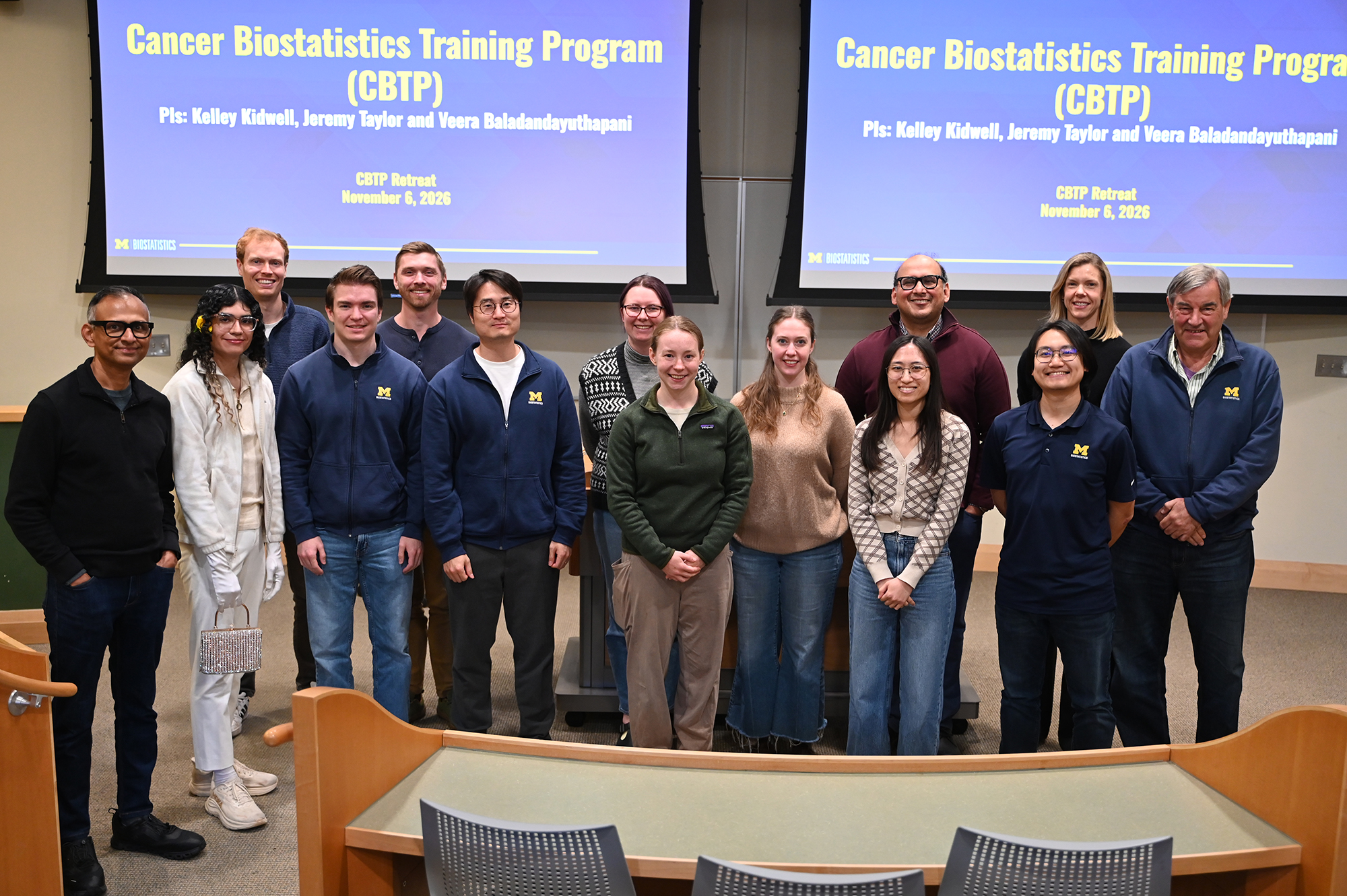
The University of Michigan’s Cancer Biostatistics Training Program prepares PhD students to develop and apply statistical methods for cancer research. Based in the Department of Biostatistics at Michigan Public Health, the program is funded by the National Cancer Institute (NCI).
Explore training and how to join
Inside the training program
Typically, 6–12 PhD students are involved in cancer biostatistics training at any one time. Some work as graduate student assistants on specific research projects, and others are supported by the NCI training grant. Most grant-supported trainees are in Biostatistics. PhD students in Epidemiology can also receive grant support.
- Coursework builds a foundation in cancer biology, epidemiology and the statistical methods used to study cancer.
- Seminars and journal clubs bring students and faculty together to discuss new research and the choices that shape its findings.
- Working groups and research meetings give students experience applying those methods on cancer research teams.
Cancer research across Michigan
The Department of Biostatistics is nationally ranked and includes 47 primary faculty and more than 170 graduate students. Its faculty bring expertise in survival analysis, missing data, longitudinal data analysis, causal inference, and statistical genetics and genomics. The department has close ties to Statistics and Bioinformatics and collaborates with Michigan Medicine, including the nearby Rogel Cancer Center.
The Rogel Cancer Center is an NCI-designated comprehensive cancer center with more than $120 million a year in direct research support. Its investigators study cancers including breast, prostate, and head and neck cancers. Their work spans basic science, clinical research, cancer prevention and epidemiology, with tools that include imaging, genomics and proteomics.
Why cancer research needs biostatisticians
Nearly 2 in 5 people in the United States will be diagnosed with cancer in their lifetime, the National Cancer Institute estimates. Cancer encompasses many diseases, and risk, treatment response and outcomes can vary across cancer types and patient populations. Research helps us ask who might benefit from earlier screening, which treatments improve survival or quality of life, and for whom.
Biostatisticians help answer those questions from the start. They design studies with cancer researchers, decide what to measure, and develop methods for problems like incomplete follow-up. They also help teams interpret results, quantify uncertainty and understand how well findings apply to other patients.