
Prospective Students
How do we design a trial for a new cancer treatment? What can tumor data tell us about how the disease progresses? At Michigan, you can explore questions like these during your PhD, working with cancer researchers and learning to develop the statistical methods their studies need.
- Who it’s for · Incoming and early-stage U-M PhD students in Biostatistics or Epidemiology
- What you bring · Curiosity about cancer research. You can learn the cancer science during your training.
- Grant support · National Cancer Institute funding for eligible U.S. citizens and permanent residents
What your training could look like
You’ll build on your PhD coursework with cancer-focused classes, faculty mentoring and hands-on research. Based in Michigan Public Health’s Department of Biostatistics, the program connects you with cancer investigators across campus, including at the Rogel Cancer Center.
Meet trainees and see what they study
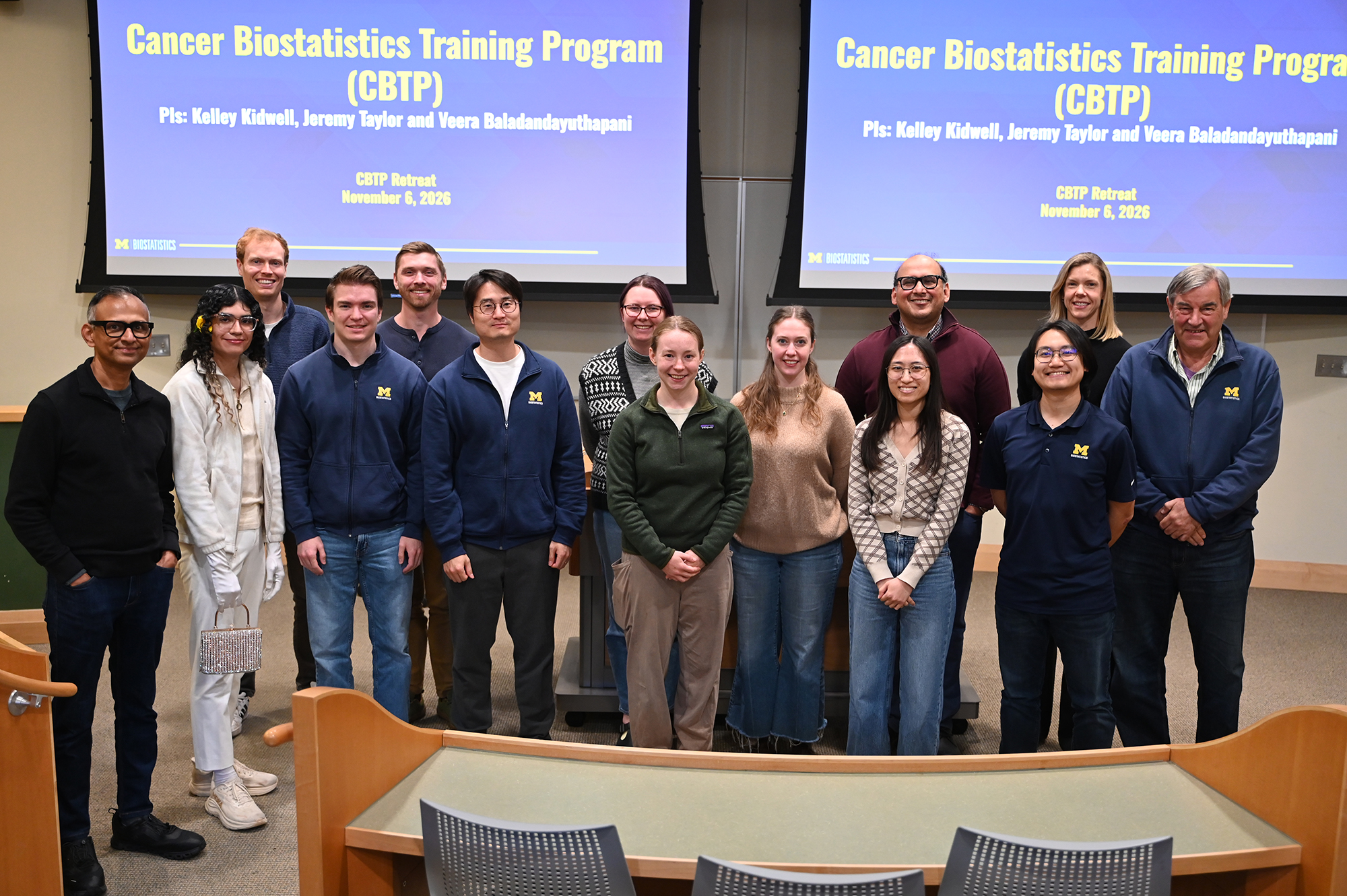
Meet all current trainees · Explore training faculty
Research examples
Former trainees have gone on to faculty roles, research positions at national laboratories and statistical careers in clinical research and pharmaceuticals.
Browse trainee publications · See where past trainees have worked
What you’ll study
Alongside your PhD requirements, you’ll study the biology and epidemiology of cancer and learn how to apply statistical methods to cancer research.
Required coursework
- BIOSTAT 803 · Biostatistics in Cancer seminar
- BIOSTAT 810 · Approaches to the Responsible Practice of Biostatistics
- EPID 621 · Cancer Epidemiology
- The Biology of Cancer · Online course through Coursera
Additional coursework in cancer biology, molecular biology or genetics depends on your background and interests. Epidemiology trainees are expected to complete biostatistics and statistics coursework equivalent to a master’s degree in scope.
Electives to explore
Examples include Clinical Trials (BIOSTAT 619), Survival Analysis (BIOSTAT 675) and Genomics in Epidemiology (EPID 516).
See the full course list · Review responsible conduct of research training
Eligibility and funding
Who can participate?
The program considers incoming and early-stage University of Michigan PhD students in Biostatistics or Epidemiology. An interest in cancer research is expected. Prior cancer coursework or research experience is optional.
Students who are ineligible for National Cancer Institute grant funding can still participate. Ask the training team about participation and discuss funding options with your PhD department.
What does the grant cover?
U.S. citizens and permanent residents are eligible for National Cancer Institute training grant support. For trainees who receive an award, support may last two or three years and covers full tuition for two semesters per funded year, a 12-month stipend each funded year and travel support toward a scientific meeting.
How to join the training program
-
Choose and apply to your PhD pathway
If you’re applying to Michigan, follow the Biostatistics PhD application instructions or the Epidemiologic Science PhD application instructions for your department’s requirements and deadlines.
-
Contact the training program
Whether you’re applying to Michigan or already early in your PhD, contact the Center for Cancer Biostatistics to connect with the training team and confirm how and when to submit your materials. If you’re applying to Michigan, complete this step alongside your departmental application.
-
Tell us what draws you to cancer research
Include a statement about why you’re interested in the training program. You can incorporate it into your personal statement. Consider a question you’d like to investigate or a kind of data you’d like to work with, and explain what you hope to learn.
Questions about training?
Email the Center for Cancer Biostatistics or call 734-764-5450.