
Biostatistics and Related Fields
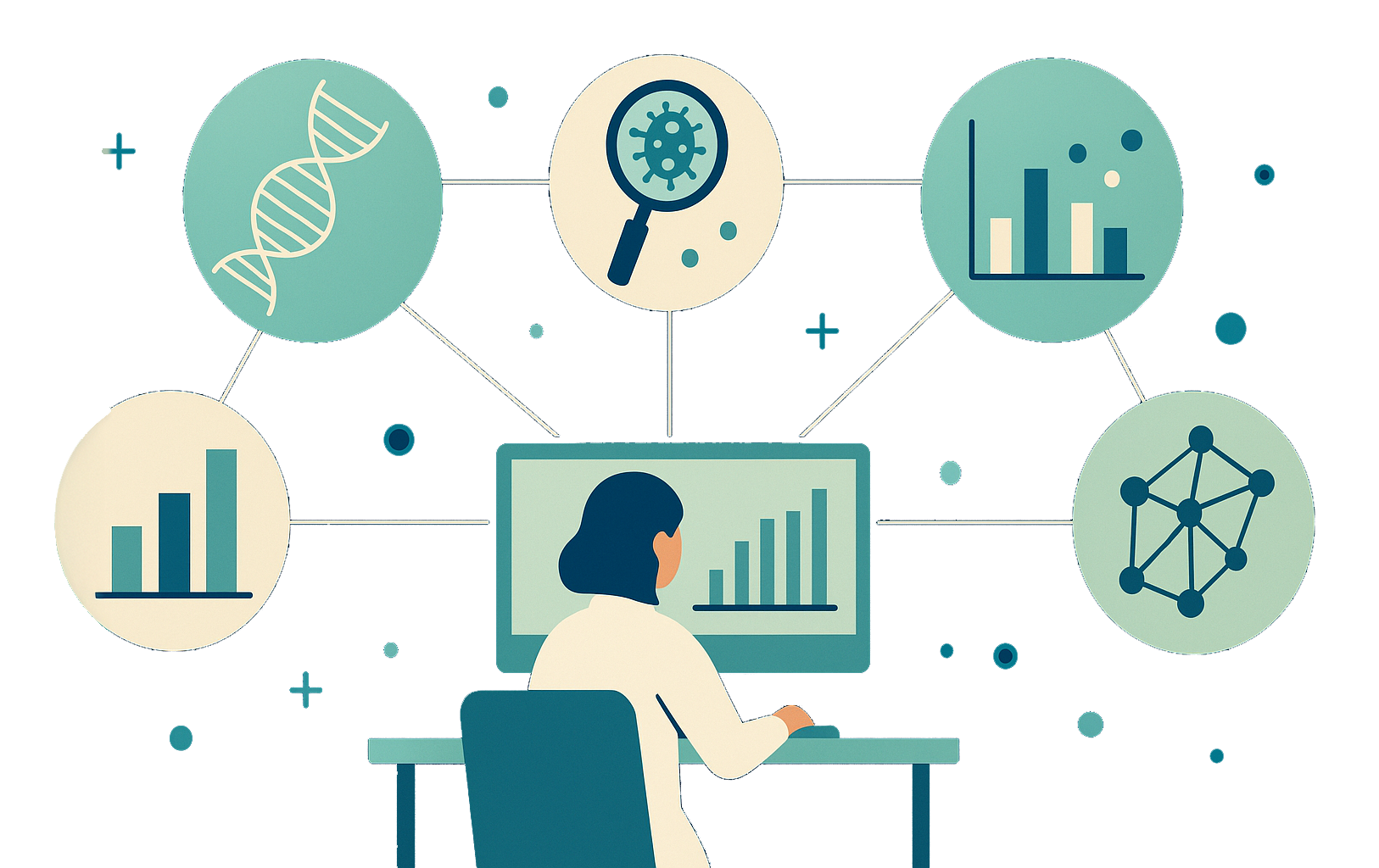
Biostatistics is the science of learning from biomedical and public health data. It combines statistical theory, computational methods, and a passion for improving human health. Biostatisticians don’t just crunch numbers—they design studies, develop new methods, and translate evidence into insights that save lives.
But how does Biostatistics compare to related fields you may be considering?
One of the best things about studying biostatistics at the University of Michigan is that you can learn a range of skills and knowledge that overlap with many related fields, including:
- Statistics and mathematics
- Bioinformatics
- Data Science
- Computational Biology
- Epidemiology
- and more
Choosing Biostatistics means gaining the full power of statistical training while applying it to the most meaningful questions in health and medicine. At Michigan, our curriculum begins with the same mathematical and computational foundations you’d find in a statistics program—probability, inference, linear models—but quickly extends into specialized areas where health data present unique challenges. Courses in survival analysis, longitudinal data, and clinical trial design give students tools built specifically for biomedical and public health research, ensuring their training has both rigor and direct application.
What makes Biostatistics distinctive is its ability to overlap with—and enhance—the work of other disciplines.
- Like data science, our students gain skills in programming, statistical computing, and machine learning, but the Michigan approach grounds these methods in study design and inference so that results are trustworthy in clinical and policy settings.
- Like bioinformatics and computational biology, Biostatistics trains students to analyze high-dimensional genomic and molecular data, but also connects those discoveries to population health through epidemiological methods.
- And like epidemiology, Biostatistics examines patterns of disease, yet focuses on the quantitative tools that ensure those patterns are measured accurately and interpreted correctly.
Together, these disciplines form a powerful ecosystem. Biostatistics integrates elements of all the above—study design, population focus, statistical rigor, and computational techniques—ensuring results are valid, interpretable, and actionable. This is what makes Biostatistics such a uniquely valuable field for solving real-world health problems.
This breadth is matched by depth: students don’t just use existing methods, they learn to adapt and develop new ones. Michigan’s curriculum emphasizes causal inference, experimental design, and the evaluation of public health interventions—skills that make graduates indispensable collaborators across medicine, biology, and public health. Through applied projects in cancer, genetics, infectious disease, and health policy, students see their work not only overlap with other fields, but also provide the analytical backbone that makes discoveries reliable.
In short, Biostatistics gives students the versatility of a data scientist, the biological insight of a bioinformatician, and the population focus of an epidemiologist—combined with the rigor of advanced statistical training. It’s a discipline that offers both breadth and depth, preparing graduates to contribute across domains while maintaining a unique identity as the field that turns health data into knowledge that saves lives.