Balancing service, science and student leadership
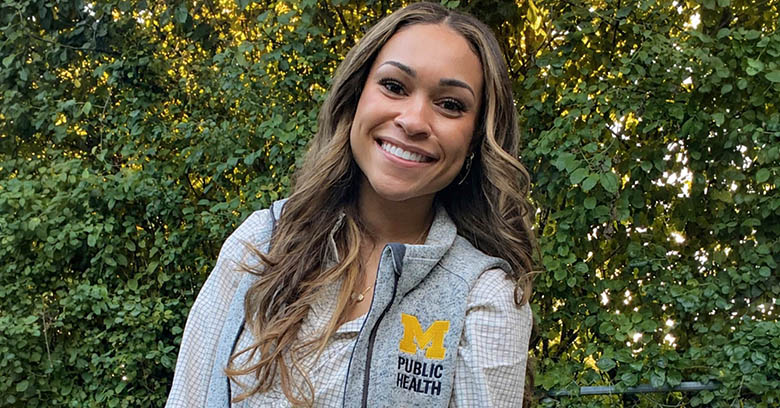
Juliana Taylor, president of PHSA
Population and Health Sciences Online MPH Program
By Bob Cunningham
Juliana Taylor didn’t always know the words “public health.” But she knew what it felt like to help someone who needed her.
Taylor grew up in the metro Detroit suburb of Southfield. She went to the Academy of the Sacred Heart in Bloomfield Hills. The school’s mission shaped her early on. Students were taught to “study and learn, help those who need us, and be a friend to all.” Every Thursday, students did service work in the community.
In high school, that service work took Taylor to Beaumont Hospital, where she and her friends became what she calls “caring companions.” They walked from room to room, talking with patients, playing games and simply being present with people during difficult times.
“I feel like I sought after health opportunities and tried to access resources to help others,” Taylor said. “That kind of cultivated where I needed to go and what I had passion for.”
That passion followed her to John Carroll University, a small Jesuit school outside of Cleveland. Taylor majored in Biology and minored in Spanish. Her father had deep roots in Ohio—he grew up in and attended St. John’s Jesuit High School in Toledo before going to the University of Toledo. Family ties, combined with the university’s values, made the choice feel natural.
“I knew I could be far away from home and have some freedom, but also have family all around,” Taylor said.
Biology taught me about diseases. But now public health actually allows me to learn about the experiences that individuals have, and the systems themselves.”
At John Carroll, Taylor continued the service work she’d started in high school. She went on medical mission trips to Honduras and worked with the Kino Border Initiative, a shelter that helps people migrating to the United States from Mexico. She also served as a resident assistant, gaining early experience in leadership.
After graduating, Taylor knew she wanted a career that combined her love of science with her desire to work directly with people. She took a job as a lab technician at Michigan Medicine, but she found her interest in connecting with patients was missing.
That realization pushed her toward clinical research, where she could interact directly with patients while still working in a scientific setting. Today, Taylor works as a clinical researcher for the Department of Urology Oncology at Michigan Medicine. Her job involves pre-screening patients in clinics to see if they qualify for research trials related to prostate, kidney and bladder cancer. If a patient is eligible, Taylor talks with the physician, sits in on the appointment and later explains the trial to the patient. If they agree to participate, she passes their information along to the lead coordinators.
“I'm kind of that second line of defense after the doctor,” she said.
This hands-on work in cancer care, paired with her research into diseases from her biology background, sparked a bigger question for Taylor: What about the bigger picture? What about the systems and experiences surrounding patient care, not just the diseases themselves?
“Biology taught me about diseases,” Taylor said. “But now public health actually allows me to learn about the experiences that individuals have, and the systems themselves.”
That question led her to the University of Michigan School of Public Health, where she’s now pursuing a Master of Public Health degree in Population and Health Sciences through the school’s online program.
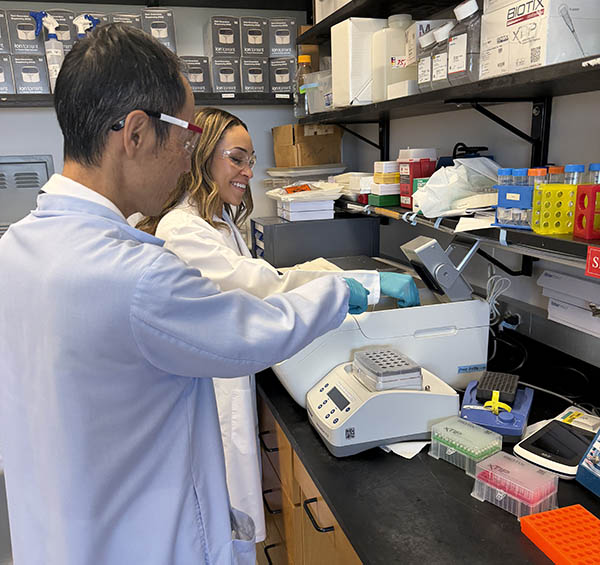
Choosing an online program wasn’t just about convenience—it was about building a life that worked. Taylor continues to hold down her full-time job at the cancer center, located about a 20-minute walk from Michigan Public Health.
“I work from 9 to 5, and then I’m able to hop on Zoom at 7,” she said. “I can eat dinner, I work out, I’m able to do the things that I need to do.”
For Taylor, this flexibility isn’t just a nice bonus—it’s essential. After finishing her MPH, she plans to apply to physician assistant (PA) school. The online program has given her room to complete prerequisite courses while continuing to gain real-world experience in her current job.
“I’d say definitely take a look at it and consider it as a great opportunity to allow you to balance your current life with that program,” Taylor said, offering advice to anyone considering the same path. “You’re able to watch the modules, attend the classes at the prescribed time, but that type of duality is very useful.”
Still, juggling a full-time job, graduate school, and leadership responsibilities hasn’t always been easy.
“My professional path isn’t perfectly linear,” Taylor said. “I have full-time work, I have a grad program, and now I’m president of a leadership group, and I'm also trying to get into PA school. So, I have all of these different things in the air."
I work from 9 to 5, and then I’m able to hop on Zoom at 7. I can eat dinner, I work out, I’m able to do the things that I need to do.”
Learning to manage her time better has been one of her biggest challenges—but also one of her greatest sources of growth. Taylor, who said her father often quotes the Stoic philosopher Marcus Aurelius and martial artist Bruce Lee, has taken that mindset to heart.
“With chaos comes opportunity,” she said, echoing one of her father’s favorite quotes. “With all of these challenges, I’m able to grow from it.”
Despite being an online student, Taylor hasn't let distance keep her from campus life. She currently serves as president of the Public Health Student Assembly (PHSA), a role she pursued in part because of her past leadership experience.
“This is my perfect opportunity to be involved on campus,” she said.
As PHSA president, Taylor represents students across many different public health programs, from doctoral candidates to undergraduates. The role has given her insight into parts of the school she wouldn’t otherwise see as an online student.
“I’m able to hear different voices, which is nice,” she said. “From just the online program, I only see the Population and Health Sciences side, but here I’m able to learn what Epidemiology students do on campus, what the Environmental Health Sciences students are doing, and so on.”
Taylor said her current job and her studies feed into each other in surprising ways. She regularly interacts with doctors, nurse practitioners, physician assistants and fellow researchers. She even attended a urology conference in Lansing with her boss. Throughout these experiences, she brings a public health perspective to conversations that might otherwise focus purely on clinical details.
“Even when we’re having these group conversations at conferences, I think more about the public health side of things,” she said. “I’m bringing in all the new information that I’ve learned.”