Student Leader of the Year came to Michigan to change health from the inside
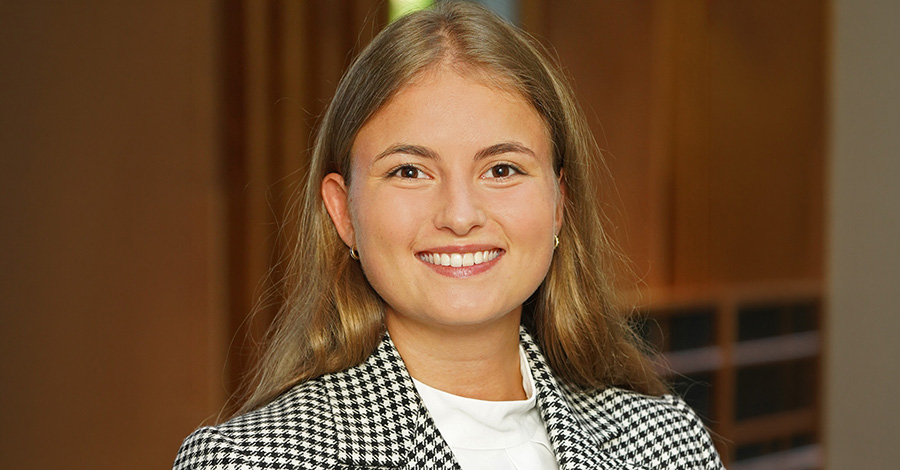
Julidè Mayer, MPH ’26
Health Management and Policy
By Bob Cunningham
The village sits somewhere in the mountains of Turkey, far enough from the nearest town that a doctor visiting for a few hours counts as good healthcare. It is the kind of place where, if your insulin runs out, you don’t simply call the pharmacy.
Julidè Mayer, MPH ’26, grew up in Luxembourg, one of the wealthiest countries in the world, where healthcare access is constant. But every time her family traveled to that Turkish village—where her grandparents had been born and where some relatives still lived—she saw something different.
She saw her grandmother’s diabetes medications packed carefully into suitcases, two months’ worth of prescriptions cleared through airport security, every pill counted and accounted for, because no one could be sure what would be available once they arrived.
“You have to take everything from France ahead of time,” Mayer said, “because you’re not necessarily going to be able to get them in Turkey in time.”
She was a child then, but she was paying attention, and those trips influenced how she later understood the gap between policy on paper and care in practice.
Two degrees and a detour
By the time she arrived in Ann Arbor, Mayer had already completed two degrees and gained experience in healthcare consulting. She came to the University of Michigan School of Public Health “to learn how to change European health systems from the inside out.”
She already had earned a law degree from the Sorbonne Law School in Paris—with the intention of becoming a medical lawyer—and a Bachelor of Science in Biomedical Science from the University of the West of England in Bristol.
Then, a gap year offered a revelation.
During that year, Mayer worked at PwC, the global consulting firm, doing healthcare consulting with a focus on European health policy. The internship exposed her to the interdisciplinary nature of health policy work, where legal questions intersect with economics, governance and clinical practice.
“The cases you get as a medical lawyer are often quite specific,” she said. “In consulting, I began to see how law fits into the broader policy landscape. That experience shifted my interests toward health policy, where I could engage with legal issues alongside other dimensions of health systems.
“Consulting gave me a valuable perspective on how organizations approach problem-solving and reform. I learned a lot from the teams I worked with and the clients who trusted us with complex problems. At the same time, I became increasingly interested in being more directly involved in implementation and decision-making—working within systems rather than advising them from the outside.”
She wanted to be on the other side of that relationship entirely. Contributing from within public and health institutions, helping drive policy not only in theory, but in practice.
She returned to Bristol and decided to study public health and health policy—not as a side interest, but as a career.
Michigan Public Health’s Health Management and Policy program offered something Mayer hadn’t found elsewhere: a required summer internship, a capstone project, two full years of study, and—perhaps most important—the ability to take classes across the entire university.
“I really liked that the program was so diverse,” she said. “I came out of this program with knowledge in finance, economy, policy and business. Being able to attend classes at the Ross School of Business and see how they think about healthcare, and classes at the Ford School of Public Policy—the interests of these people all intersect, but the way to get there is very different. I thought it was very interesting to be able to witness that.”
I really liked that the program was so diverse. I came out of this program with knowledge in finance, economy, policy and business. Being able to attend classes at the Ross School of Business and see how they think about healthcare, and classes at the Ford School of Public Policy—the interests of these people all intersect, but the way to get there is very different. I thought it was very interesting to be able to witness that.”
— Julidè Mayer, MPH ’26, on the Health Management and Policy program
Three months in London
If there is one experience that seems to have crystallized everything for Mayer, it’s the summer she spent in London as a visiting researcher with City St. George’s, University of London.
Supported by the Gelman Global and Health Management and Policy scholarships, she spent three months working alongside professors in law and international political science, as well as her Michigan faculty advisor, Scott Greer, the Richard Carl Jelinek Professor of Health Services Management and Policy.
Mayer joined a broader research effort on how the European Union negotiates health-related agreements with countries outside its borders. The project was dense and complicated, and it matched her growing interest in the politics of European health systems. The work also raised new questions for her about accountability, power and solidarity in European health governance—questions she hopes to explore further in her doctoral studies.
“It was really a work of thinking and trying to understand what is happening in these relationships and why,” she said. “I found that to be really gratifying.”
The resulting paper is being peer-reviewed before publication, and Mayer is waiting to see it in print.
London gave her something else, too. Because she arrived during the university's summer break, the campus was quiet and social opportunities were scarce. She joined a local rowing club, which became both a way to meet people and a new discipline she has carried back to Ann Arbor and plans to continue in Linz, Austria, where she is headed next.
The most memorable moment of those three months in London had nothing to do with rowing. It happened at an event hosted at University College London, where Mayer attended a lecture by Sir Michael Marmot, whose work on social determinants of health changed how the world thinks about why some people get sick, and others do not.
“Hearing him speak in person about the links between social conditions and health outcomes was deeply influential for me,” she said. “It reinforced my conviction that health policy has to be grounded in everyday realities, like those I saw in my grandparents’ village, and in the structural factors that shape people’s lives.”
The Michigan difference
While her London summer captured the imagination, Mayer’s work in Michigan was just as substantive.
In her final semester, she joined a four-student team working with the Detroit Health Department on a policy analysis project related to midwifery and doula care. The team collaborated with local public health staff to better understand how patient transfers from community settings to hospitals are managed and what kinds of policy changes could support smoother, more patient-centered transitions.
For Mayer, this was a chance to listen to practitioners’ experiences and see how legislative proposals intersect with everyday realities in maternal and newborn care.
She also served as president of the Health Policy Student Association, leading a board of 11, grew membership to 93, and helped raise more than $20,000 over the course of the year. The organization hosted over 20 events featuring health policy professionals, alumni and faculty, and socials, keynote speeches, panel discussions, professional development sessions and advocacy opportunities such as the Lansing Student Advocacy Day.
What she is most proud of, though, is what happened with the undergraduates.
For the first time in the organization’s history, undergraduate members outnumbered graduate students. Mayer and her board saw it as a chance to create a dedicated undergraduate chapter—launching in Fall 2026 with its own leadership—which will allow students in their early studies to engage with health policy and co-lead selected events and initiatives with support from graduate student mentors.
“I’m really looking forward to how this relationship between both roles evolves,” she said.
In the spring, Mayer was named Student Leader of the Year during the Public Health Honors celebration.
She accepted the recognition gracefully but was quick to share the credit.
“I wasn't alone,” she said. “The reason it worked so well was because the people I was working with were really amazing.”
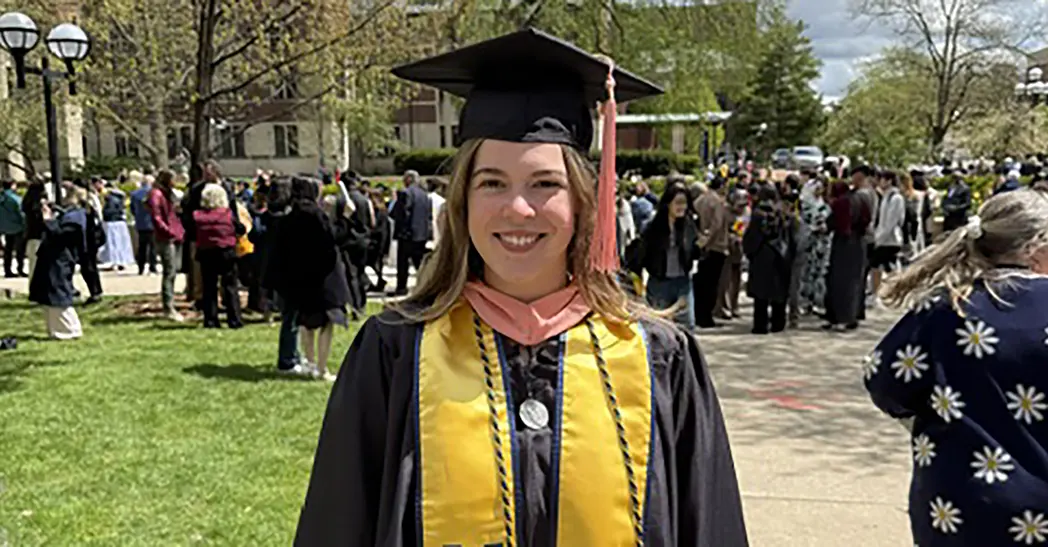
Mayer graduated in April 2026 with her Master of Public Health in Health Management and Policy, a global health track, and a certificate in Science, Technology, and Public Policy from the Ford School.
She has been accepted into a four-year PhD program at Johannes Kepler University in Linz, Austria, where she will study the politics of health security in the European Union, with Greer serving as one of her supervisors. Mayer will split her time between the university’s Political Science Institute and the LIFT_C, an innovative interdisciplinary research institute focused on transformative change, working alongside researchers across different disciplinary fields.
Long-term, she is focused on international institutions such as the World Health Organization and the European Union, where decisions are complex, and the distance between policy and people can feel enormous.
Mayer hopes to contribute to shrinking that distance, one project and partnership at a time: “I want to help change the system from the inside, together with others who care about equity.”