From Kuwait to the UN: Changing public health systems
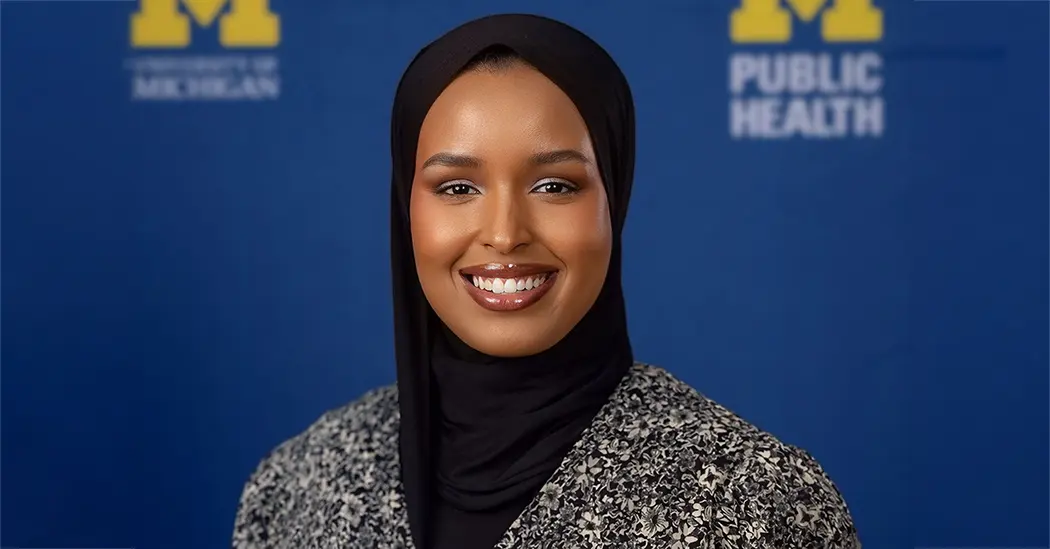
Farhia Ahmed Mohamed, MPH ’26
Nutritional Sciences
By Bob Cunningham
When most graduate students were settling into their first semester of coursework, Farhia Ahmed Mohamed was preparing for the floor of the United Nations.
Accepted into one of the most competitive internship programs in the world—offered to just 3% of applicants—the University of Michigan School of Public Health student traveled to New York to work inside the UN Headquarters as an evaluation intern with the Office of Internal Oversight Services. There, she contributed to methodological guidance, analyzed data from stakeholders around the world, and helped develop resources that inform decision-making across UN agencies.
But the technical work was only part of the experience.
“I had the opportunity to observe high-level global discussions — from attending meetings at the General Assembly and Security Council to gaining insight into how policies and programs are designed and evaluated at scale,” Mohamed said.
During the high-level segment of the 80th session of the United Nations General Assembly, she volunteered alongside world leaders and international delegations, watching global cooperation unfold in real time. The experience reinforced something she had believed for a long time; that lasting change in public health requires more than treating one patient. It requires changing systems.
Today, she continues to build on that work as a youth delegate and advisor with the UN, carrying forward a commitment to global health that began long before she ever stepped onto the Ann Arbor campus.
PROSPECTIVE STUDENT? Learn more about Michigan Public Health.
A journey rooted in Kuwait
Mohamed grew up in Kuwait, a small but culturally rich nation on the Arabian Gulf. She describes her home country with warmth—known for its food, hospitality and the deep sense of community woven into daily life.
“Growing up there shaped my perspective on community, generosity and the importance of food—not just as nourishment, but as a central part of identity and connection,” she said.
After earning her Bachelor of Science in Nutrition Science with distinction honors from Kuwait University, Mohamed trained across clinical and community settings before taking a full-time position at the Kuwait Cancer Control Center. As a clinical dietitian, she provided medical nutrition therapy for some of the most critically ill patients—those battling cancer in ICU and CCU settings.
The work was profound and difficult. Over time, Mohamed began to notice a pattern in what her patients said.
“I would often hear patients reflect on their journeys, saying things like, ‘I wish I had known,’ or ‘I wish I had done things differently,’ or ‘I wish there had been something in place to prevent this,’” she recalled. “Those words stayed with me.”
Those conversations pushed her to ask bigger questions. What does prevention actually look like? How do we help people stay healthy before disease takes hold? During her breaks, she started researching public health—and found her answer.
“I realized that my purpose goes beyond caring for one patient at a time,” she said. “I wanted to contribute to systems that reach larger communities, expand access to knowledge, and create meaningful, lasting impact.”
I realized that my purpose goes beyond caring for one patient at a time. I wanted to contribute to systems that reach larger communities, expand access to knowledge, and create meaningful, lasting impact.”
— Farhia Ahmed Mohamed
Michigan was a perfect fit
When Mohamed decided to pursue a Master of Public Health, she was accepted into some of the most prestigious programs in the world, including Harvard University, Johns Hopkins University, the University of California Berkeley, University College London, and the London School of Hygiene & Tropical Medicine, as well as Michigan Public Health.
She chose Michigan.
“Michigan offered the balance I was looking for—academic rigor, impactful research and a genuine sense of community,” Mohamed said. “As someone moving away from what felt familiar, it was important for me to be in an environment where I felt supported, seen and encouraged to grow.”
At Michigan Public Health, she is completing a Master of Public Health in Nutritional Sciences with a certificate in Social Epidemiology. Her coursework is deliberately built around understanding how social and structural factors—like poverty, food access and living conditions—drive health outcomes across different populations.
Mohamed speaks especially highly of the Nutritional Sciences program’s tight-knit community. She said it has been one of the most meaningful parts of her experience.
“It's not just an academic program; it’s a community that makes you feel seen, supported and motivated to grow,” she said.
She credits her academic advisor, Kate Bauer, associate professor of Nutritional Sciences, along with program coordinators Carole Durgy and Keegan Gramza, for creating an environment where students feel genuinely supported.
“Farhia is extremely mature and insightful, always thinking about her career trajectory and the steps she needs to take to set herself up for success,” Bauer said. “She is one of the kindest, caring and most personally engaging students I’ve advised. Whenever I pass her in the hallway, she gives me a big smile—and often a hug—and asks how my family is doing.
“I am in awe of everything Farhia has accomplished during her two years at the School of Public Health and look forward to seeing all her future successes.”
READ MORE about faculty, students, alumni and staff.
I am in awe of everything Farhia has accomplished during her two years at the School of Public Health and look forward to seeing all her future successes.”
— Kate Bauer, associate professor of Nutritional Sciences
Research across borders
Mohamed’s work extends well beyond the classroom. As a research fellow with the Global Health System Empowerment Network, she collaborated with researchers from the Duke Global Health Institute and the Tanzanian Ministry of Health on two major projects—one focused on reducing hypertension across Sub-Saharan Africa, and another exploring how bilingualism can improve health communication and equity in underserved communities.
At the University of Michigan, she is part of what may be the first interdisciplinary AI working group of its kind at the institution, established through the Rackham Student AI initiative. The group brings together graduate researchers from across disciplines to examine how artificial intelligence intersects with human health and well-being. Mohamed is contributing to a policy analysis focused on ethical and equitable AI governance in higher education.
“Being part of this inaugural and highly collaborative effort has allowed me to engage in interdisciplinary research at the forefront of AI and public health,” she said.
Before beginning her MPH, she also gained hands-on public health experience in the United States. At Nationwide Children's Hospital in Columbus, Ohio, Mohamed worked as a community health outreach specialist, conducting social determinants of health assessments and helping hundreds of families navigate access to care. She later returned to the hospital as a research and public health intern focused on maternal and child health outcomes through the Ohio Better Birth Outcomes program.
“Farhia’s unique experience as a clinical dietitian caring for cancer patients and perspectives on global public health not only fueled her success in graduate studies in Nutritional Sciences, but also positioned her to be an inspirational leader who can catalyze the broad systems change she envisions,” said Karen Peterson, the Stanley M. Garn Collegiate Professor and Chair for the Department of Nutritional Sciences.
Farhia’s unique experience as a clinical dietitian caring for cancer patients and perspectives on global public health not only fueled her success in graduate studies in Nutritional Sciences, but also positioned her to be an inspirational leader who can catalyze the broad systems change she envisions.”
— Karen Peterson, the Stanley M. Garn Collegiate Professor and Chair for the Department of Nutritional Sciences
Overcoming challenge of starting over
One of the most consistent themes in Mohamed’s story is adaptability. Having grown up across different countries and cultures, and speaking multiple languages, she has had to rebuild her life more than once—new environments, new systems, new expectations.
“That experience came with uncertainty, but it also taught me resilience,” she said. “I learned how to adapt quickly, navigate unfamiliar situations, and find my footing even when things felt unstable.”
Ironically, she said, those challenges turned out to be excellent preparation for a career in public health—a field where ambiguity is common and solutions are rarely handed to you.
“I’ve become comfortable with uncertainty,” she said. “I’ve learned to approach challenges with flexibility, persistence and a willingness to learn.”
Her journey has also been supported by an impressive list of scholarships and fellowships, including the Gelman Global Scholarship Fund, Gutsy Broad Fund through CEW+, Margaret Dow Towsley Scholar Award, Maxine Moore Forsyth Scholarship, and NSF International Global Scholar Award, among others. These opportunities allowed Mohamed to attend conferences and pursue experiences in cities like Boston and Washington, DC, broadening her exposure to public health practice at every level.
As she prepares to graduate, Mohamed is clear about the kind of work she wants to do. She is drawn to the intersection of data, policy and strategy, using evidence to design solutions that improve health at a large scale, while staying grounded in the real lives of the communities she serves.
“What excites me most about public health is the ability to combine data with human stories,” Mohamed said. “Behind every number is a lived experience. That balance is what makes the work both impactful and meaningful to me.”
SUPPORT research and engaged learning at Michigan Public Health.