On a fast track to environmental health leadership
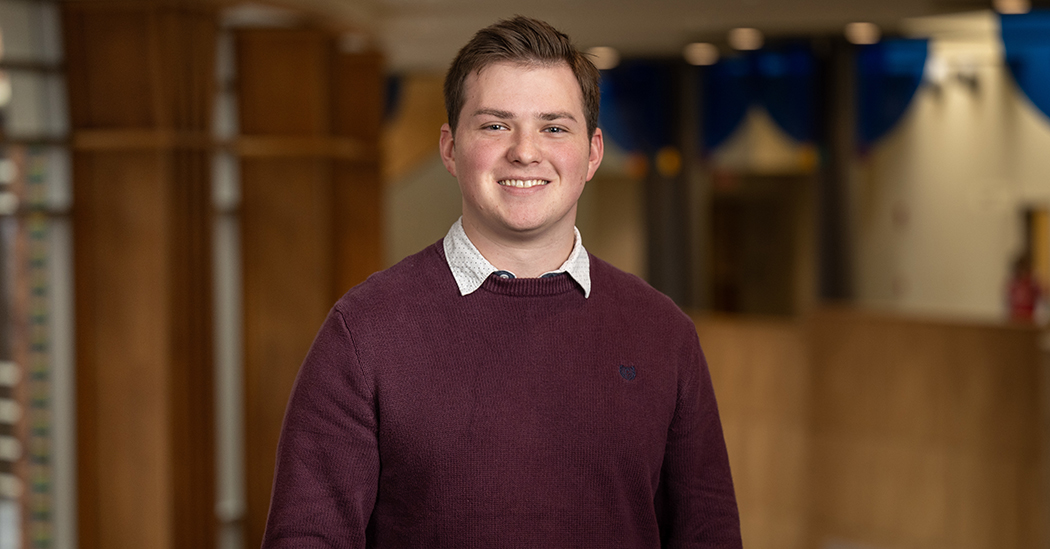
Andrew Hoover, BS ’24, MS ’25
Public Health Sciences and Environmental Health Sciences
By Bob Cunningham
Andrew Hoover, BS ’24, MS ’25, laughs now when he thinks back to the moment he pivoted to public health.
“I remember vividly trying to stitch up a hot dog, which was the very basic thing to test out what stitching an injury would be like, and I couldn't do it,” Hoover said of his experience at Kettering University’s “Doctor for a Day” program near his hometown, where students receive hands-on experience with medical procedures. “I just kind of knew at that moment: OK, I don't think this aspect of patient-facing medicine is really where I want to be.”
That humble moment with a hot dog marked the start of a journey that would bring the Michigan native from Grand Blanc—just outside of Flint—into the world of public health, one he’s now helping shape.
While the Flint water crisis unfolded in his backyard, it left a lasting impression on the young student that would shape his entire career path.
“I was still pretty young when the Flint water crisis happened, but it really lingered long-term,” said Hoover, whose mother worked as a Head Start teacher in Flint.
He saw firsthand how environmental problems didn’t affect everyone equally. These early experiences planted a seed that would eventually grow into dedicating his career to understanding how our environment affects our health, especially for communities that often get overlooked.
“I became more and more interested in understanding not only the disparities in public health infrastructure, but also how there are disproportionate effects of chemical exposures,” Hoover said. “I saw how certain communities are really disproportionately exposed to environmental chemicals.”
Hoover arrived at the University of Michigan in Fall 2020, in the middle of the COVID-19 pandemic. Suddenly, public health wasn’t just something he was learning about in textbooks—it was happening all around him.
“COVID really put public health front and center,” he said. “To me, it had been a little bit of an abstract idea before. But then the pandemic happened, and it really showcased what everyday public health looks like—people working together to protect each other. In this case, it was through masking recommendations and vaccinations.”
Looking back, Hoover realizes the pandemic confirmed he had chosen the right path.
“I really do want to make this a larger-scale impact beyond that of a physician working individually,” he said.
Through his undergraduate courses, Hoover learned about air pollution, water quality and how environmental factors create health inequalities. The more he learned, the more passionate he became about addressing these issues.
PROSPECTIVE STUDENT? Learn more about Michigan Public Health.
I was still pretty young when the Flint water crisis happened, but it really lingered long-term. I became more and more interested in understanding not only the disparities in public health infrastructure, but also how there are disproportionate effects of chemical exposures. I saw how certain communities are really disproportionately exposed to environmental chemicals.”
Accelerating his education
During his junior year, Hoover decided to apply to the School of Public Health’s Accelerated Master of Science Degree (AMD) program in Environmental Health Sciences. It allowed him to earn a bachelor’s degree and a master’s degree in five years while still having time for research, leadership roles and meaningful mentorships.
In the AMD program, students start taking some graduate-level courses during their senior year. About 15 credits can count toward both degrees, meaning required courses for one degree can fulfill elective requirements for the other. This efficient structure makes earning both degrees more affordable and accessible while maintaining the same rigorous academic standards.
“One of the things I really liked about it is you get to take classes that are finishing up your undergrad courses, but you also get to take classes that are prerequisites for the master’s,” Hoover said. “You kind of take requirements for one degree and count them as electives toward the other degree.”
He was accepted into the program and graduated with his bachelor’s degree in 2024 and his master’s degree in 2025.
The accelerated timeline didn’t stop him from staying involved on campus, though. In fact, he packed his schedule with activities that enriched his education and connected him with other students.
READ MORE about faculty, students, alumni and staff.
Leading beyond the classroom
During his senior year, Hoover served as president of the Public Health Association, a student organization dedicated to introducing people to the field of public health. He knows from experience that many students interested in health careers don’t know public health exists as an option.
“I think there are so many people interested in health who kind of go down this traditional path, but they’re not really aware of public health,” Hoover said. “I remember always hearing professors say, ‘I didn’t know what public health was when I was an undergrad.’”
The organization worked to show students that public health is everywhere—from getting your flu shot to using an air filter in your home. It’s not just about fighting infectious diseases, though it is integral; public health also includes people working in healthcare consulting, policymaking and management, he said.
The following year, while completing his master’s degree, Hoover became president of the Environmental Health Student Association. This group brought together graduate students studying different aspects of environmental health—from scientists working in labs studying how chemicals affect cells to researchers installing air quality monitors around neighborhoods.
“Even environmental health is really broad,” Hoover said. “One of our main goals was creating an environment where everyone could learn about other parts of environmental health and get to know one another.”
He also discovered he loved teaching by working as a research assistant and serving as a graduate teaching assistant for two semesters. Watching students grow and succeed reminded him of how his mother made a difference as a teacher.
Hoover wants other students to know about the accelerated master’s program.
“It’s definitely a big step, but it’s a good stepping stone, especially if you’re interested in getting hands-on with the field right away,” he said. “You have a lot of flexibility in terms of what types of classes you can take.”
Despite completing his master’s degree in just one year, Hoover still had time for research, student organizations and teaching.
“It really is ‘choose your own project’ and cater your education to it,” he said.
Now an alumnus with a Bachelor of Science in Public Health Sciences and a Master of Science in Environmental Health Sciences, Hoover wants future students—especially those weighing their options in health, science and policy—to see that public health can be their path too.
SUPPORT research and engaged learning at Michigan Public Health.
I really cannot emphasize enough the opportunities and directions you can go with public health. There are so many avenues—healthcare policy, research, academics.”
The power of mentorship
None of Hoover’s success would have been possible without strong mentors. He gives special credit to two faculty who guided him throughout his time at Michigan: Grace Noppert and Sung Kyun Park.
Noppert is a research assistant professor at the Survey Research Center within the Institute for Social Research. She got Hoover interested in understanding how social environments affect disease transmission—a perfect blend of his interests in epidemiology and environmental health.
“She really got me interested in how we think about complex social issues relating to infectious diseases,” Hoover said. “Understanding how neighborhoods influence disease transmission was fascinating to me.”
Sung Kyun Park, professor of Epidemiology and Environmental Health Sciences, served as Hoover's thesis advisor.
“His guidance was essential in making sure everything was going well with my thesis,” he said. “He was constantly checking up on me and making sure I was doing well as I went through the program.”
Hoover worked with both mentors starting in his sophomore year, maintaining those relationships for four years. Even now, from his new home in Seattle, where he is pursuing a PhD in Epidemiology from the University of Washington School of Public Health, he stays in touch with them. Their mentorship wasn’t limited to research but also included life advice.
“Both of them, their help and support—constantly being there for my numerous questions to late-night emails—has helped me get to where I am now,” he said.
Currently, Hoover’s research looks at environmental justice issues, examining who gets exposed to harmful chemicals and pollutants and how those exposures can lead to cancer and other diseases. He’s interested in several environmental exposures, including toxic chemicals, wildfire smoke and neighborhood structures, which are major public health concerns in Washington state that reminded him of the environmental concerns he studied at Michigan.
Hoover’s long-term goal is to work in academia, teaching the next generation of public health professionals. His experience as a teaching assistant showed him how rewarding education can be.
“It was always so rewarding to see students really excel in the classroom,” he said. “I really cannot emphasize enough the opportunities and directions you can go with public health. There are so many avenues—healthcare policy, research, academics.”