The unexpected epidemiologist: Evolving from neuroscience to respiratory virus research
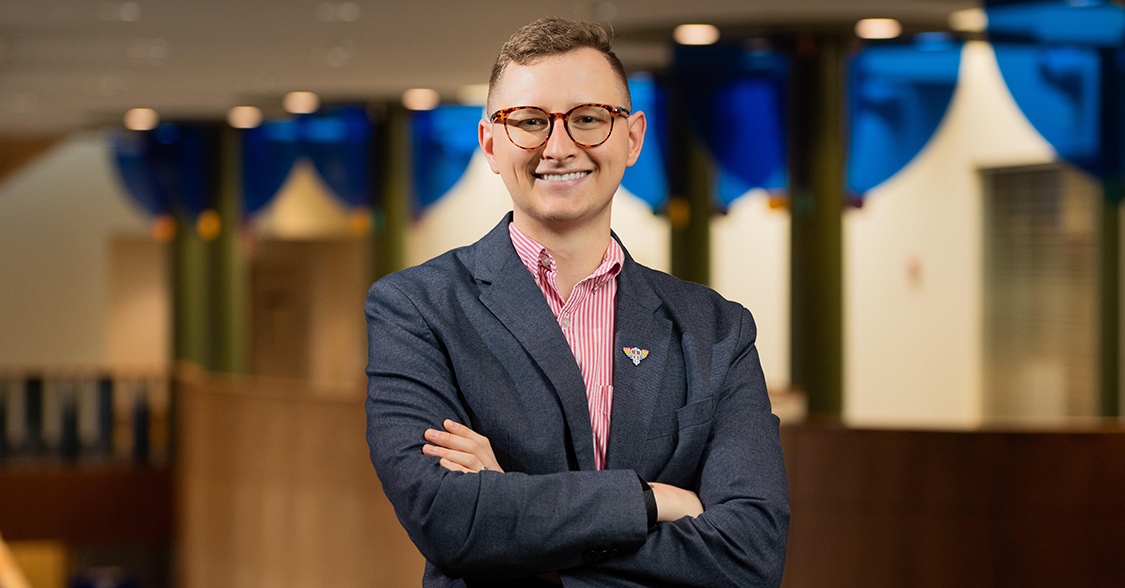
Joshua Foster-Tucker, MPH ’21
Epidemiology PhD student
By Isaac Vineburg
When Joshua Foster-Tucker’s wife suggested he apply to the University of Michigan School of Public Health instead of attending medical school, neither could have predicted it would launch a passion for understanding infectious diseases.
“I wasn’t sure if I wanted to go to medical school,” said Foster-Tucker, MPH ’21. “So, at the last second, my wife suggested the master’s program at Michigan Public Health.”
That spontaneous decision in late 2018 would completely reshape his career trajectory, leading him from neuroscience to infectious disease epidemiology and into the labs of two titans in the field.
Born with a fascination for the brain, Foster-Tucker earned his bachelor’s degree in Biopsychology, Cognition, and Neuroscience from the University of Michigan College of Literature, Science, and the Arts in 2017. He was particularly drawn to ADHD research because he has the condition and had initially planned to become a psychiatrist.
But medical school felt daunting.
“Going to medical school, man, it can be really intense,” Foster-Tucker said. “And you spend a lot of the remainder of your youth just really stressed.”
Instead, he heeded the advice of his better half and enrolled in the Master of Public Health program in Environmental Health Sciences at Michigan Public Health. It was a decision that opened his eyes to an entirely different side of health.
“Public health kind of opened the door to this whole entire other side of medicine that I didn’t know about,” Foster-Tucker said. “We didn’t talk about epidemiology in my bachelor’s degree studies at all.”
The COVID-19 pandemic would prove to be another pivotal moment, shifting everything toward infectious disease work.
“The pandemic kind of changed everything for me, personally,” Foster-Tucker said. “It gave me direction.”
The pandemic kind of changed everything for me, personally. It gave me direction.”
A disease detective
Through connections made while pursuing his master’s degree, Foster-Tucker began working with Emily Martin and Arnold Monto, two internationally-recognized figures in epidemiology and infectious disease research, and professors at Michigan Public Health.
Martin hired Foster-Tucker as a data analyst for the Household Influenza Vaccine Evaluation (HIVE) study in May 2022. When he began his PhD in Epidemiological Sciences in August 2023, Foster-Tucker transitioned from data analyst to doctoral researcher. The dual perspective—having worked both as an analyst and as a student under Martin’s guidance—provided him with unique insights.
“Getting to know our studies and our data beforehand allowed me to view the work that we do with a greater degree of nuance,” Foster-Tucker said.
Now his research focuses on human parainfluenza viruses, which are a major cause of croup and hospitalize tens of thousands of people, particularly infants and young children, annually. But his interests extend beyond respiratory viruses to the biology of aging itself.
Foster-Tucker is particularly fascinated by immunosenescence—the process by which infections age our immune systems over time. This research has profound implications for understanding why people age at different rates and how we might intervene earlier in the process.
“More protection against infections might help our immune system age more slowly. So, I’m looking at what we can do to interrupt those immuno-aging processes,” Foster-Tucker said, emphasizing the importance of vaccination in potentially slowing the aging process.
Foster-Tucker was recently selected as a 2025–2027 predoctoral trainee for Michigan Public Health’s Interdisciplinary Research Training in Health & Aging (IRTHA) program, which is designed to prepare students for careers in interdisciplinary aging-related scientific research.
“Being selected is both an honor and a significant professional milestone,” Foster-Tucker said. These awards are highly competitive, reserved for promising early-career scientists poised to make meaningful contributions to their fields.
I kind of think of Arnold [Monto] like he’s like my scientific grandfather. Not everybody gets to have somebody like Arnold as a co-mentor. It really is an immense blessing.”
A special bond
Working with Martin and Monto has been transformative, both professionally and personally, for Foster-Tucker.
“This is a blessing that I could have never, ever foreseen happening,” he said.
His relationship with Monto, who has been conducting groundbreaking infectious disease research since the 1960s, is particularly special.
“I kind of think of Arnold like he’s like my scientific grandfather,” Foster-Tucker said. “Not everybody gets to have somebody like Arnold as a co-mentor. It really is an immense blessing.”
This mentorship became even more crucial when Foster-Tucker developed complex regional pain syndrome type 2 (CRPS-II), a rare and debilitating neurological condition, during a critical juncture in his career. The flexibility and compassion shown by both Martin and Monto have proved to be invaluable.
“My life would have been incredibly different if I were not in this program at the same time I’ve been sick,” Foster-Tucker said. “There was no question about what was most important.”
Beyond his research, Foster-Tucker has been actively involved in university life. As president of the Sexual and Gender Diversity in Public Health (SGDPH) student group as a master’s student, he helped lead the effort to rename a space in the School of Public Health after Dr. Paul B. Cornely, the first Black person to earn a doctorate in public health in the United States—from the University of Michigan in 1934.
The project, undertaken in partnership with other student organizations in the wake of George Floyd’s murder, aimed to honor a previously underrecognized voice in the school’s history.
“We wanted to tell a story of Black students and Black faculty, Black scientists, Black staff at the School of Public Health,” Foster-Tucker said.
Foster-Tucker’s passion for Michigan Public Health runs deep.
“I’m kind of obsessed with it,” he said. “It’s given me everything. It’s given me my life’s direction. It’s given me my education and training, and it’s given me incredible colleagues.”
Looking ahead, Foster-Tucker envisions a career that balances cutting-edge research with mentorship. His long-term goal is to follow in the footsteps of his mentors.
“I want to be a professor,” he said, “teaching that passion to the next generation who can take what we know now and add to it.”