CDC Scholar combines microbiology and public health through leadership

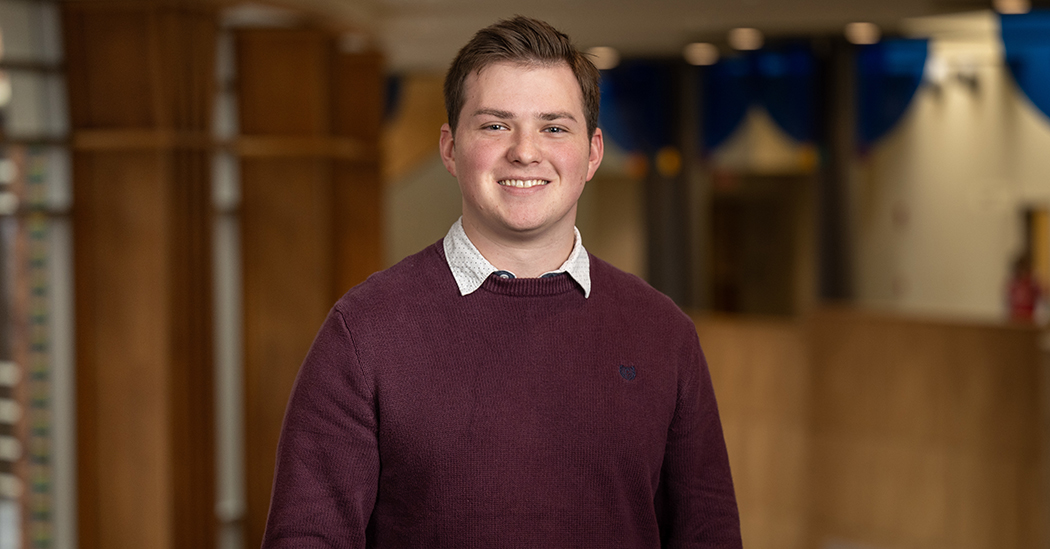
Owen Chun, BS ’26
Public Health Sciences and Microbiology
By Bob Cunningham
Owen Chun was working at a food bank in San Jose during the COVID-19 pandemic when he first understood what public health really meant. As a high school student handing out groceries to families struggling to make ends meet, he started asking questions that would shape his collegiate path.
“I recognized the social determinants of health,” Chun said. “I learned a lot about how family and jobs aren’t the only way that people face food insecurity. The experience made me want to study something that could solve this because I don't like seeing all these people go hungry.”
That experience led Chun across the country to the University of Michigan School of Pubic Health, where he’s earning two Bachelor of Science degrees—one in Public Health Sciences from the School of Public Health and one in Microbiology from the College of Literature, Science, and the Arts.
But he hasn’t stopped at academics.
As a CDC John R. Lewis Scholar, president of a 70-member public health advocacy organization, undergraduate research assistant, and yes, even president of the Star Wars Fan Club, Chun has built an impressive resume focused on leadership.
His path shows how curiosity, community engagement and a willingness to teach yourself new skills can open doors you didn’t know existed.
PROSPECTIVE STUDENT? Learn more about Michigan Public Health.
Finding his way
Coming to Michigan from California’s diverse South Bay area brought unexpected adjustments for Chun, a third-generation Asian American.
“I oddly experienced feeling like a minority for the first time in my life,” Chun said. “People assumed I was a first-generation or international student.”
Despite the initial culture shock, Chun quickly found his community through Public Health 200 and student organizations such as CURIS - Public Health Advocacy.
“It really confirmed for me that public health is the right thing for me,” he said. “I really care about helping people, and public health is a way to do it.”
The dual degree came together after a conversation with a health department director back home who showed him an organizational chart. He introduced me to the role of public health microbiologist.
“Since I had really enjoyed biology in high school, I realized it was a perfect way to combine both fields,” Chun said.
The two fields complement each other in ways that aren't immediately obvious.
“With my microbiology degree, I get really in-depth knowledge of the different pathogens, the bacteria, the viruses, the molecular mechanisms,” Chun said. “From the public health standpoint, I get the transmission dynamics and population-level determinants of health. Both of those degrees I can kind of mesh together.”
DIY solutions
This past summer, Chun was selected as a CDC John R. Lewis Scholars —a highly competitive program with an acceptance rate of about 5%—through the University of Michigan Future Public Health Leaders Program (FPHLP). The program placed him with Vivent Health in Detroit, an organization working to prevent HIV and STIs.
His main project involved building a comprehensive database of resources across Michigan from STD testing locations to HIV support programs, food pantries, mental health services and shelters. The challenge? Chun had never built a database before.
But there was one complication: Chun had no prior database experience.
“When they told me they needed a resource guide, I suggested a database would work better,” Chun said. “I used online resources to teach myself coding with Microsoft Access and VBA, and incorporated SQL for the search functions.”
VBA (Visual Basic for Applications) is a programming language used to automate tasks in Microsoft programs, while SQL (Structured Query Language) allows users to search and organize data in databases. Together, these tools enabled Chun to create a system where hotline staff could quickly filter resources by location and need—a significant improvement over searching through spreadsheets.
His self-taught solution impressed his supervisors. Vivent Health operates Michigan’s HIV state hotline, and the database allows staff to quickly search resources by zip code, county or specific need when callers request help.
“When I was leaving, my mentor was in the process of working with IT to get it set up for the entire state,” Chun says. “They were talking to the state of Michigan and their other locations across the US about potentially adopting something similar."
What started as a summer project might now help people across multiple states access life-saving resources faster.
READ MORE about faculty, students, alumni and staff.
With my microbiology degree, I get really in-depth knowledge of the different pathogens, the bacteria, the viruses, the molecular mechanisms. From the public health standpoint, I get the transmission dynamics and population-level determinants of health. Both of those degrees I can kind of mesh together.”
Leading through service
Back on campus, Chun serves as president of CURIS - Public Health Advocacy, a student organization he joined as a sophomore. This year, the organization partnered with Washtenaw Health Initiative, Maize and Blue Cupboard, Institute for Firearm Injury Prevention, Region 9: Perinatal Quality Collaborative, Clubhouse Michigan, Community Action Network, Ozone House, and Washtenaw Face Addiction Now.
“I personally feel like we’re one of the few public health orgs on campus that actually does work with community partners here in the Washtenaw area,” Chun said.
Under his leadership, he said the organization has grown to 70-80 active members working on projects across Washtenaw County. Teams have created culturally competent recipe guides for the food pantry, conducted Narcan training, and drafted white papers on various health topics.
His first project with the organization focused on making the Maize and Blue Cupboard more accessible.
“We built recipes for them so that clients who went to the Maize and Blue Cupboard had things that they could make out of the ingredients that were kind of more diverse than just plain beans and rice or things like that,” he said.
The work connects back to his original inspiration—that high school food bank where he first recognized how complex food insecurity really is.
SUPPORT research and engaged learning at Michigan Public Health.
In the lab
Chun also works as an undergraduate research assistant in an emergency medicine lab at Michigan Medicine under Dr. Scott Van Epps, associate professor of Emergency Medicine. The lab seeks to advance new diagnostic and therapeutic strategies for life-threatening infection using innovative biological, engineering and computational approaches. It leverages cross-cutting techniques and approaches to evaluate multiple topics in the field of life-threatening infection, which includes sepsis studies.
“Recently, I have been evaluating multiple surface-modified nanoparticles and their effects on bacterial biofilms,” Chun said. “Through transcriptomic analysis of RNA extractions we are able to examine their antibacterial/antibiofilm abilities.”
In the Winter semester, he is starting a new project testing the biofilm abilities, antibiotic susceptibility, and virulence factors of MRSA. It’s hard science with real-world applications—exactly where he wants to be.
It’s a really fun opportunity for me to kind of de-stress, engage with people, talk about nerdy stuff like ‘Star Wars.’ It’s just a great opportunity to connect with others outside of my public health and my homework.”
Making time for fun
With all his academic and leadership commitments, Chun still makes room for something completely different: the Star Wars Fan Club. He joined as a freshman and immediately became president when the previous board graduated.
“I basically built the club from scratch at that point,” Chun says. “We have lightsabers that the club owns. We have watch parties, we do game nights, and we meet once or twice a week.”
Recent activities have included a “Spaceballs” watch party and regular lightsaber battles.
“It’s a really fun opportunity for me to kind of de-stress, engage with people, talk about nerdy stuff like ‘Star Wars,’” he said. “It’s just a great opportunity to connect with others outside of my public health and my homework.”
Future plans
As graduation approaches in May, Chun has clear plans. He’s applying to graduate programs for his Master of Public Health in Epidemiology or Infectious Disease, with a focus on laboratory-based infectious disease work.
After that, he’s pursuing certification as a public health microbiologist in California—a specialized role that combines his two degrees.
“I’m looking to do some work in the public sphere, especially related to public health disease surveillance and genomic epidemiology—things like that,” Chun said.
A PhD might come later, but for now, he’s focused on getting into the field.
His message to other students—“strong public health is built by the community for the community”—comes from his experience working with a local health department for two years on SNAP-Ed, focusing on food insecurity.
“It really taught me the importance of cultural community engagement and cultural humility,” Chun said. “There's community—we need to make sure we get their input on everything that we do as public health practitioners.”
Even when working with hard data and laboratory science, he said, “It’s still important to center community voices and make sure that’s really heard in our work and shown through the data we visualize or the papers we publish.”
May The Force of public health be with Chun throughout his leadership journey.