Applying public health principles to financial education
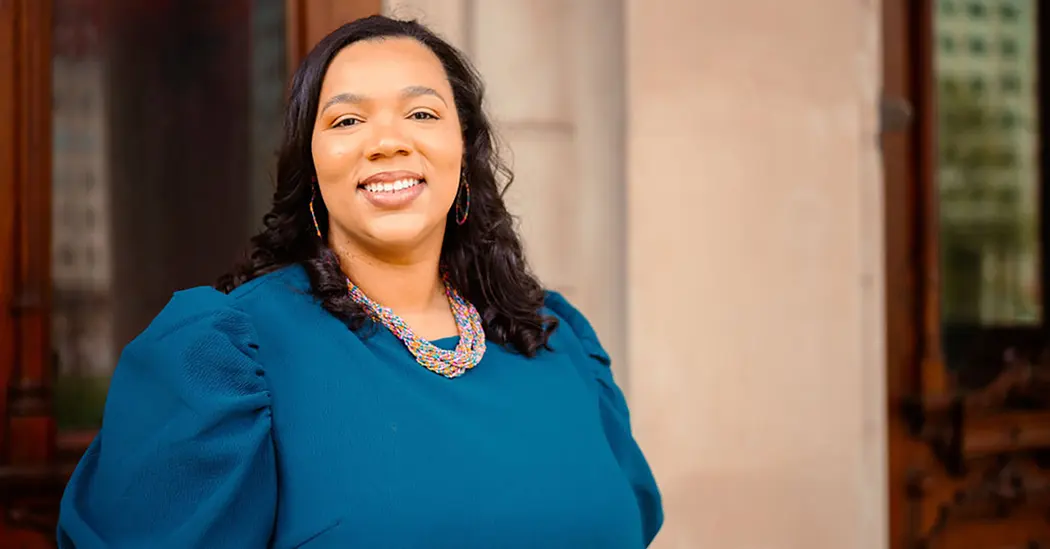
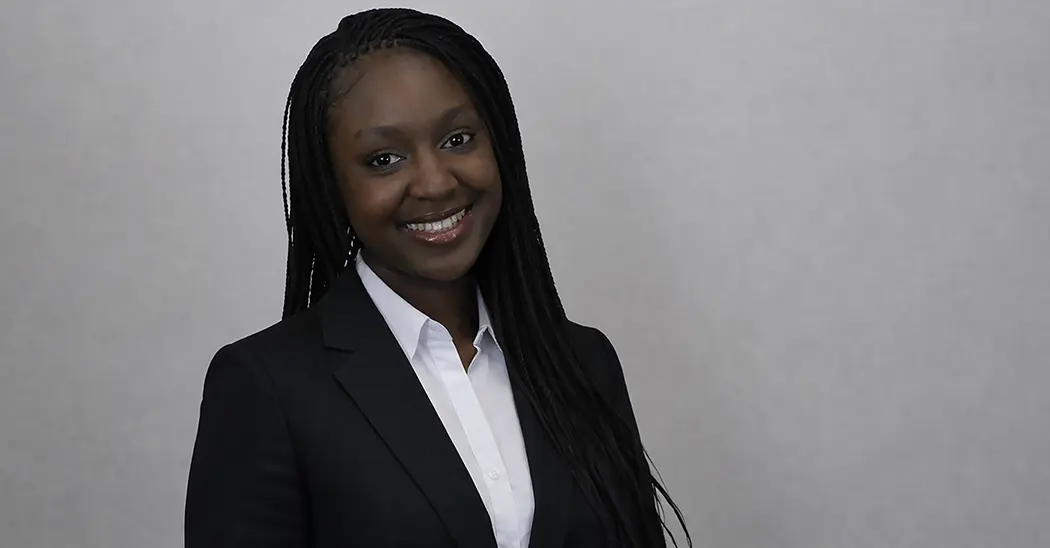
Darla Bishop, MPH ’09
Health Behavior and Health Education
By Bob Cunningham
Growing up in Detroit, Darla Bishop experienced how money—or the lack of it—affected every aspect of her family’s health and well-being.
From housing struggles to food insecurity, Bishop noticed how many of her family’s problems could have been solved with better financial resources.
“The people around me were actually very resourceful and very good with the money they had,” she said. “They just didn't have enough.”
That childhood realization would eventually shape her career in ways she never expected when she first arrived at the University of Michigan.
Like many ambitious students, Bishop started college with a clear plan: She wanted to become a doctor. As a smart Black student from Detroit, she said she felt the familiar pressure to pursue medicine, law or engineering—the traditional paths to success. But then came organic chemistry.
“There was a particularly difficult day that had me questioning my entire life—maybe I'm just not cut out for this,” Bishop said.
Walking across the Diag, she spotted a table set up by the Public Health Student Association. Honestly, she was just interested in the triangle highlighters they were giving away. But to avoid being rude, she asked what public health was all about.
“They told me that doctors help individuals and families, but in public health, you can actually shape the health of entire communities, neighborhoods, or even the whole country,” Bishop said.
PROSPECTIVE STUDENT? Learn more about Michigan Public Health.
A new understanding of public health
As Bishop learned more about public health, memories from her childhood suddenly made sense in a new way.
She remembered going to the public health department for immunizations when her family couldn’t get a doctor’s appointment. She thought about her cousin living with AIDS, and how a new medication gave him 10 more years of life.
“A lot of the things that mattered to me actually were public health,” she said.
Bishop earned her bachelor’s degrees in Biopsychology and Linguistics and minored in Spanish in 2007 from the College of Literature, Science, and the Arts. She went straight into the Master of Public Health program in Health Behavior and Health Education (now Health Behavior and Health Equity) at the School of Public Health, graduating in 2009. Later, in 2022, she received a DrPH in Health Policy from George Washington University.
For Bishop, choosing the Health Behavior and Health Education department was a natural fit because she was fascinated by human behavior. The department’s approach, applying behavioral science to improve health, made perfect sense.
What made the experience even richer was the diversity of her classmates’ interests. Some wanted to address AIDS in Africa. Others focused on maternal health and breastfeeding. Some cared about mental health, while others wanted to work in local government.
“Because my classmates had such varied interests, when we did group projects, sometimes I was working on something I had no idea about until I was working on it,” Bishop said. “But I was like, ‘Oh, this is interesting. I’m glad we did this project.’”
That exposure to different perspectives and public health applications would prove invaluable throughout her career.
After graduation, Bishop’s career took an unexpected turn when she became a military spouse. Just about every three years, the US Army has moved her family to a new location, often without much notice.
This presents serious challenges. Bishop said military spouses face a 20% unemployment rate and only 19% work full-time. Even among those who are employed full-time, many aren’t working in their desired fields or using their education and training.
But Bishop has managed to do what most military spouses cannot by maintaining a career with increasing responsibility and compensation through multiple moves.
“I really credit my public health education for that,” she said.
READ MORE about faculty, students, alumni and staff.
If I can get a Medicaid population who is very savvy about navigating their benefits, but maybe not so much about what’s happening in their bodies, to do these things so their health can be better—all because I know how to frame it in a way that feels relatable and doable—that was a great feeling.”
Building a career through constant change
Bishop’s career has taken her from the University of Michigan’s Center for Managing Chronic Disease to former US Sen. Debbie Stabenow’s Washington, DC, office. She worked there during the longest government shutdown in history at that time, caused by debates over the Affordable Care Act.
“Because I had expertise and training in public health, I got to do a lot of work for the senator, including writing speeches, making comments, and prepping her for press interviews during a really intense time,” Bishop said.
From there, she moved to the private sector, joining AmeriHealth Caritas in a communications role, utilizing print materials, radio ads, flyers and handbooks to educate the community about public health.
“If I can get a Medicaid population who is very savvy about navigating their benefits, but maybe not so much about what’s happening in their bodies, to do these things so their health can be better—all because I know how to frame it in a way that feels relatable and doable—that was a great feeling,” she said.
Under a forward-thinking leader, Bishop built award-winning public health programs for the health plan, focusing on preventing expensive health problems before they occurred. She later worked for Priority Health in West Michigan before returning to AmeriHealth in another stint in DC.
Throughout her career moves, Bishop kept returning to that childhood realization that money matters for health. Our zip code—largely determined by how much rent we can afford—determines our access to healthy food, safe environments, quality schools, healthcare and transportation.
“When you’re financially well, you have a much better shot at being well in all the other aspects—physical wellness, mental wellness,” said Bishop, who currently resides in Lansing. “If nothing else, because you have less stress, but also because you might be in an environment that isn’t as toxic.”
While at Michigan, Bishop started reading books about personal finance and developing systems to manage money effectively. Her classmates noticed she always seemed to have money while they struggled. She began teaching them what she’d learned.
Over time, those informal lessons turned into workshops, then a system, and eventually her first book, “How to Afford Everything,” self-published in 2023. Bishop also founded her own company, FinanSis, focused on financial wellness education.
SUPPORT research and engaged learning at Michigan Public Health.
When you’re financially well, you have a much better shot at being well in all the other aspects—physical wellness, mental wellness. If nothing else, because you have less stress, but also because you might be in an environment that isn’t as toxic.”
Her most innovative program applies classic public health strategies to financial education. Her Piggy Bank Pathways program teaches children about money—and the idea came from her daughter.
"My 6-year-old—she’s 7 now—said, ‘Mommy, I want to write a book,’” Bishop said. “And so we wrote a children’s book together.”
While waiting for the illustrations, Bishop had a revelation. In public health, major societal changes often started by teaching children: seat belt safety, anti-drug programs like D.A.R.E., railroad safety, tobacco prevention and hygiene education.
“When we teach kids in schools about public health, they go home and take those lessons with them, and they end up being the enforcers,” she said. “That week after they learn about something, they become the carriers of this new norm at home.”
By teaching children the basics of financial literacy—how to earn, save, give, and spend money wisely—Bishop said she reaches their parents too. Adults who never received financial education get introduced to these concepts in a safe, fun environment.
Looking back at her varied career—from university research to Capitol Hill, from health insurance companies to financial education—Bishop sees one common thread: public health principles.
“The fact that I can apply public health principles to pretty much anything, create a framework, communicate it well, break it down into digestible pieces, and help shift people’s behavior,” she said, “whether it’s specifically health-related or not—that’s what’s allowed me to keep advancing.”