Undergraduate student honors legacy at 40th MLK Symposium
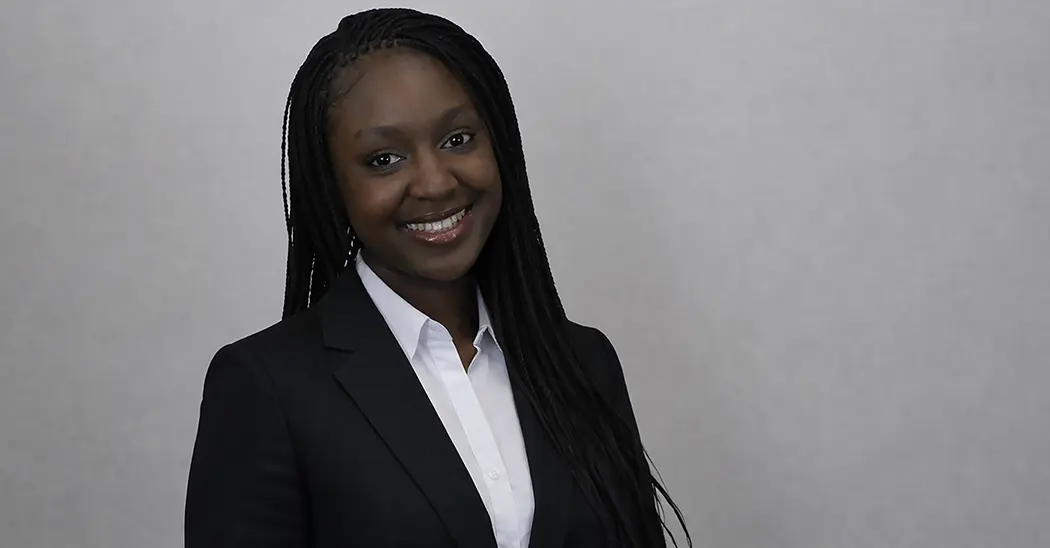
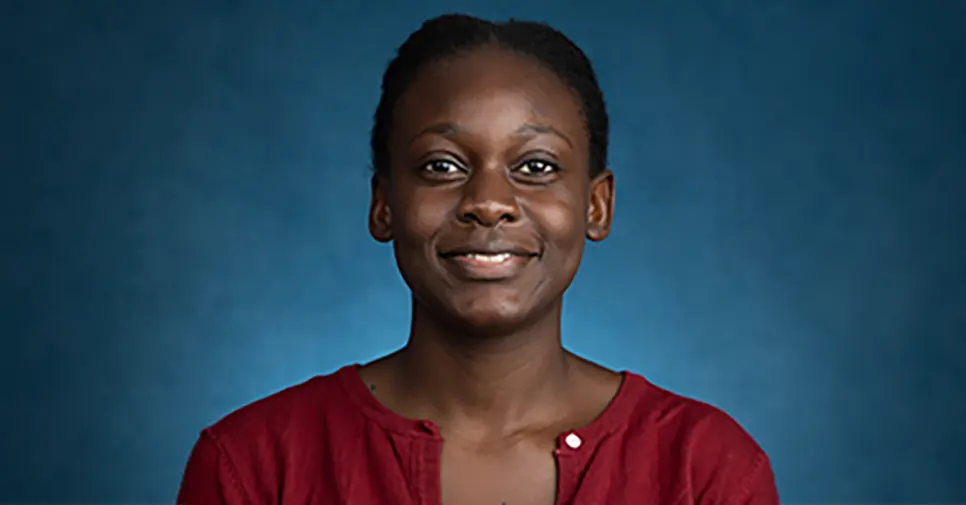
Yacine Lo, BS
Public Health Sciences
By Bob Cunningham
Before a packed crowd at the University of Michigan’s historic Hill Auditorium, Yacine Lo introduced the keynote speakers for the 40th annual MLK Symposium. It was an opportunity to honor a legacy she now helps carry forward.
“It was an honor to be able to go up there and speak to the legacy and tradition of the symposium and of the Black Student Union,” Lo said. “I really tried to highlight the key part that student activism played.”
The Black Student Union, which Lo leads as its speaker, was founded right after Martin Luther King Jr.’s assassination in 1968. During the Black Action Movement III protests, Lo said, one of the Black Student Union’s demands was for the university to create a symposium honoring King.
“We use the term speaker to pay homage to our history,” said Lo, a junior majoring in Public Health Sciences from the School of Public Health. “A president presides over a community, but a speaker is supposed to speak life into that community and speak for people.”
The 2026 Keynote Memorial Lecture featured a conversation between Donzaleigh Abernathy, a civil rights activist, actress, writer and the godchild of Martin Luther King Jr., and Derrick Johnson, the 19th president and CEO of the NAACP.
In addition to her duties at the symposium, Lo did an Instagram takeover for the Black Student Union, documenting a full schedule: a provost breakfast; the symposium itself; a student engagement luncheon with the panelists; a private conversation with a speaker from the Department of Afro-American and African Studies and his father, who was a Freedom Rider; and, finally, a Black Student Union movie night showing “Our Friend Martin” and “Selma.”
"It was a very packed day, but very exciting to be able to honor the legacy of Martin Luther King and be in the community and have some key conversations,” Lo said.
PROSPECTIVE STUDENT? Learn more about Michigan Public Health.
Connected to two worlds
Her journey to this leadership role began in Kalamazoo, Michigan, where she was born and raised. Her parents immigrated to Michigan from Senegal in the early 2000s, both becoming nurses after attending college back home and completing nursing school in the United States.
“I have three younger siblings, and we’ve all lived in Michigan our whole lives,” Lo said. “Honestly, it was a big deal when I moved to Ann Arbor, because that was the farthest that my immediate family had been away from each other since I was born.”
Growing up in an immigrant household meant navigating two cultures.
“There were so many things I grew up doing or saying that weren’t typical American things, and there were typical American things that just weren’t part of my childhood,” she said. “I remember in middle school and elementary school, there were so many movies everyone had seen, and I’d be like, ‘I’ve seriously never seen that.’ Learning to take pride in who I am and all the differences in my life has been something I’ve worked on.”
Her parents’ healthcare careers surrounded Lo with medical conversations from an early age. But it was the COVID-19 pandemic that crystallized her interest in public health.
Because of the Kalamazoo Promise I knew I was going to get free tuition to any school in Michigan—so I wanted to go to the best school. That was my goal since freshman year of high school to go to the University of Michigan.”
Finding purpose during the pandemic
During the pandemic, Lo also developed a passion for social justice and advocacy.
“Combining my interests for everything that was going on medically and everything that was going on socially, public health seemed like a natural intersection,” she said.
A trip to Senegal in the summer of 2022 after her junior year of high school deepened her commitment. She had lost both grandparents during that timeframe—not from COVID—and seeing Senegal’s healthcare system firsthand was eye-opening.
“I saw how the health infrastructure there had led to so many people dying who didn’t need to die,” Lo said. “It really made me think about how important healthcare access was, and that pushed me deeper into the public health side.”
As a first-generation college student, she had to figure out the American university system largely on her own. Her parents had attended college in Senegal but didn't know how the US system worked.
Lo, however, had the significant advantage of the Kalamazoo Promise, which provides free tuition to university in Michigan for Kalamazoo students.
“Because of the Kalamazoo Promise I knew I was going to get free tuition to any school in Michigan—so I wanted to go to the best school,” said Lo, who also is majoring in Biomolecular Science from the College of Literature, Science, and the Arts (LSA). “That was my goal since freshman year of high school to go to the University of Michigan.”
READ MORE about faculty, students, alumni and staff.
Building community on campus
Once in Ann Arbor, Lo threw herself into building community. She joined Phi Delta Epsilon, a pre-medical fraternity, which helped clarify her pre-med path, and the First-Generation Pre-Health Association’s executive board at the end of freshman year as secretary.
“I wanted to be around people and give back to people who didn’t have others to guide them,” she said. “There are a lot of people on this campus who come from higher tiers of society, whose parents and grandparents all went to college. Sometimes, there’s a knowledge gap, and I wanted to help students fill it.”
As a resident advisor in the Global Scholars Program in LSA, Lo lives among students with a diversity-first mindset.
“Just recently, I was talking with a foreign exchange student from Singapore,” Lo said. “It’s been a great experience talking with people with totally different lived experiences.”
She also works with Ginger Shultz, the Arthur F. Thurnau Professor of Chemistry, in her chemistry education research lab, studying how lack of institutional support for graduate student instructors affects their classroom effectiveness and chemistry education overall. The research team recently published one paper and is working on a second.
In another example of her Life-Changing Education at Michigan, last semester Lo joined the Student Advisory Council for Robert Ernst, the chief health officer of the university.
“That was really cool to gain information about what’s happening health-wise on campus on a university level and then be able to give that information back out to the student population,” she said.
I hope to pair public health with what hopefully becomes my medical training and use it to have the proper lens to view healthcare. Even when I’m providing care to an individual person, that person can reflect greater systemic changes and infrastructural issues.”
Leading the Black Student Union
But her most meaningful involvement has been with the Black Student Union. Last year, as Community Outreach co-chair, she organized service projects including a Black Girls Mentorship group at Slauson Middle School in Ann Arbor.
This year as speaker, she has more front-facing representation roles for the Black community.
“Serving as speaker has honestly been one of my greatest joys on campus,” Lo said. “Just the amount of work we’re able to do for the community and the output we're able to have.”
Her connection to Black Student Union advisor Elizabeth James has been particularly important.
“She's in the Department of Afroamerican and African Studies, and she's been such a mentor—socially, personally and spiritually on campus,” she said. “She really is the heart of the Black Student Union.”
SUPPORT research and engaged learning at Michigan Public Health.
The public health lens
What draws Lo to public health is its multi-level approach to problems.
“Public health provides the foundation for a lot of things,” she said. “Having that public health mindset allows for sustainable work. There are other fields that help people, but public health allows that work to be sustained.”
She appreciates how public health addresses problems in different contexts.
“Public health’s ability to think about things on multiple levels and think about the intersection of people’s identities,” Lo said, “I've always enjoyed that part.”
She plans to attend medical school and pursue emergency medicine, but she’ll carry her public health training with her.
“I hope to pair public health with what hopefully becomes my medical training and use it to have the proper lens to view healthcare,” Lo said. “Even when I’m providing care to an individual person, that person can reflect greater systemic changes and infrastructural issues.”
She also wants to combine public health with advocacy and policy work, both in the US and globally.
“I want to go back to Senegal and advocate for people there, doing the work to get better healthcare infrastructure,” Lo said. “Public health gives you the tools and ways to talk about these things in the medical and healthcare world.”