Curiosity fuels a winding public health career

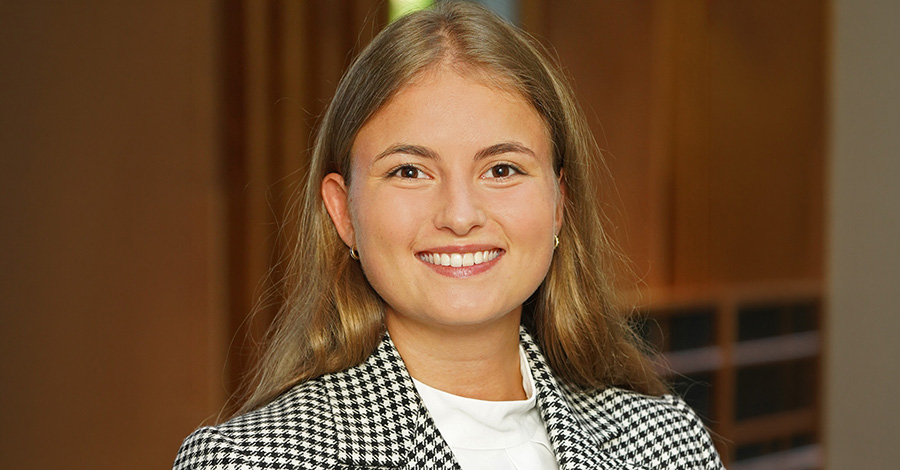
Nicolle Marinec, MPH ’04
Health Behavior and Health Education
By Bob Cunningham
When Nicolle Marinec, MPH ’04, walked into the University of Michigan School of Public Health in 2002, her plan was to focus on reproductive and women's health.
More than two decades later, her career has taken her from international telehealth projects to the Department of Veterans Affairs and now back to business school. Through it all, Marinec said, one lesson has stayed constant: Public health rewards people who stay curious.
“With a Health Behavior and Health Equity degree, you can do just about anything,” she said, reflecting on how her degree opened doors she never expected.
Marinec grew up in Frankfort, Illinois, a suburb of Chicago, and earned her bachelor’s degree in Community Health Education from the University of Illinois Urbana-Champaign. While there, she interned with the Red Cross and Planned Parenthood—experiences that convinced her she wanted a career focused on population-level health, not just individual care.
“I liked the idea that public health was broad enough to allow me to explore all different elements of health,” she said.
That search for the right graduate program led her to Michigan Public Health. Marinec was drawn by Health Behavior and Health Education’s strength in community-based health work and reproductive health, and by faculty members in the department now known as Health Behavior and Health Equity like Barbara Israel and Edith Parker, who were doing hands-on research with real communities.
“There was just such a depth of community-based work,” Marinec said. “Michigan was a clear first choice for me.”
“With a Health Behavior and Health Equity degree, you can do just about anything.”
— Nicolle Marinec, MPH ’04
Graduate school wasn’t just about classes for Marinec. She spent a year working at the school’s Prevention Research Center on youth violence prevention, then moved into a role at the University Health Service (UHS), where she helped build a peer health education program (PULSE) for students.
The program borrowed its core idea from Malcolm Gladwell’s book “The Tipping Point.” Instead of recruiting the usual student leaders, Marinec and her team looked for the ‘flippers,’ people their peers already turned to—the ones who always knew where to find a tutor, or who could support a friend or classmate struggling with a health issue and help them connect with UHS services. They trained those students in PULSE about health education, peer advocacy and promoting physical and mental well-being, enabling them to spread health information across campus, working with residence halls and Greek life.
“It was in real time, implementing a program that was having a direct impact on students,” she said.
That project became her calling card. After presenting it at a national public health conference, she landed her first full-time job as director for Sexual Health Education at Michigan State University, where she ran an HIV testing center, led a peer theater troupe, and trained new peer health educators. She calls it one of her favorite jobs to this day.
After a few years at Michigan State, Marinec realized she wanted stronger research skills if she hoped to keep making an impact. That brought her back to the University of Michigan in 2006 to work with John Piette on early clinical trials monitoring heart failure patients between doctor visits.
The idea was simple but powerful: Check in with patients regularly by using automated telephone calls to monitor their symptoms and promote self-management skills so care teams could catch warning signs before someone ended up in the emergency room. That early project grew into nearly two decades of work spanning heart failure, diabetes, suicide prevention, and depression care—always asking the same question: How do you effectively support patients and their caregivers with cost-effective and scalable technology, not just treat a diagnosis?
“Nicolle Marinec is one of those rare people who develops deep content expertise about whatever topic she’s focusing on, while also having the sophisticated technical skills that make her an asset to computer scientists, researchers and policy-makers,” said Piette, professor emeritus of Health Behavior and Health Equity and VA senior career scientist.
One memory from that early work still stays with Marinec. While following up with a patient after a three-month heart failure trial, she called from a blocked university number. The man picked up and said, “Hey, Nicolle!” before she’d said a word.
“I said, ‘I just have to ask—how did you know it was me?’” Marinec recalled. “He said, ‘Well, Nicolle, you and your system—you’re the only ones who ever call me.’”
That moment, she said, revealed something research papers couldn’t fully capture: Connection, even in the form of a simple automated phone call, could ease someone’s loneliness and remind them that someone was paying attention.
“That was a tipping point for me,” she said, “in terms of the work that we were doing and the impact we could have.”
In 2011, Marinec moved to San Francisco, and she kept working for the University of Michigan and the VA remotely.
Her work expanded well beyond the United States. Alongside Piette, she helped run international telehealth projects in Bolivia, Colombia, Honduras and Mexico, often working with University of Michigan students on long-term research projects. In places with little existing technology infrastructure, the team had to get creative by building low-cost systems from scratch to deliver care remotely.
“We had to be super creative,” she said. “Where there are challenges, we’re able to say— we can still do the work, and we can still be impactful. But it’s not maybe the way we would have done it at home.”
Over time, that hands-on experimentation pulled her toward technology itself. For the past decade, Marinec has focused on building digital health platforms—text-message programs, automated phone check-ins, and now artificial intelligence tools—all while navigating government data security rules and funding requirements.
“I kind of got the bug for building,” she said, “and being more and more involved in that.”
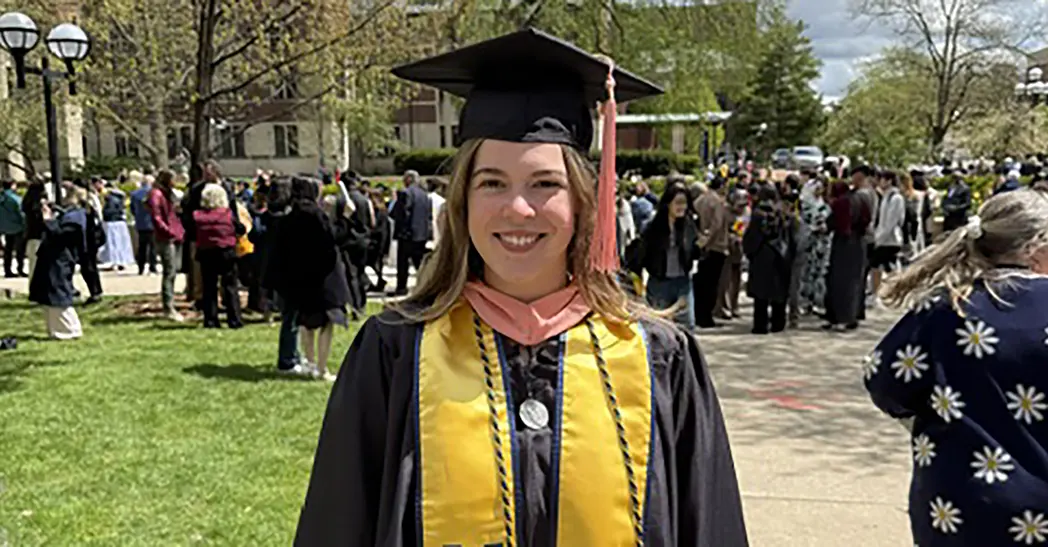
That interest in building things eventually led her back to the classroom. Marinec is in her second year of Michigan’s Executive MBA program at the Ross School of Business, leveraging her two decades of research and creating partnerships to focus on entrepreneurship and designing tools that reach patients.
“I want to help be part of the solution,” she said. “How do we become more organizationally sound, and take things back to kind of the root build, and make a difference to help people's lives?”
She's now exploring a venture of her own in reproductive and women's health—a full-circle moment that echoes where her Michigan journey began.
Looking back, Marinec credits much of her career's direction to the mentors she found at Michigan Public Health, not just in the classroom, but through internships and informal conversations with faculty who were willing to make time for students.
“Education is something I would never say no to,” she said, “for people that are looking for enlightenment and exposure and meeting people and changing the trajectory of their life.”
Nicolle Marinec is one of those rare people who develops deep content expertise about whatever topic she’s focusing on, while also having the sophisticated technical skills that make her an asset to computer scientists, researchers and policy-makers.”
— John Piette, professor emeritus of Health Behavior and Health Equity and VA senior career scientist