What happens before care: Bridging public health equity and medicine
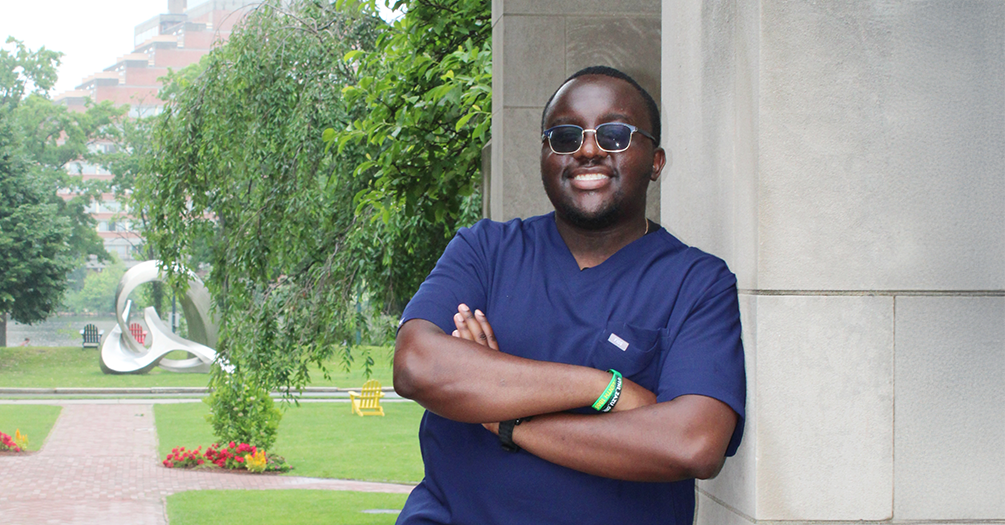
Anthony Dongfack, MPH ’26
Online MPH in Population and Health Sciences
By Crissy Zamarron
Anthony Dongfack’s path to public health has been transformed by his own experiences—across countries, communities and healthcare systems—and by a thoughtful curiosity about what happens before a patient ever enters a clinic.
Originally born in Maryland to a family from Cameroon and raised in Delaware, Dongfack has spent most of his life on the East Coast. But his worldview has been influenced by far more than geography. From visiting family in Cameroon to studying abroad in France, he has seen how differently healthcare systems operate and how those differences profoundly affect patient experiences and outcomes.
“In the United States, you’re treated first and billed later,” Dongfack said. “In Cameroon, it’s the opposite—you have to pay before you receive care, regardless of how serious your condition is.”
Witnessing realities like family members paying daily for an elder’s oxygen therapy left a lasting impression and deepened his interest in understanding greater structures in healthcare beyond individual treatment decisions.
While he always knew he wanted to become a physician, hands-on work in healthcare and clinical research broadened his perspective. He became increasingly interested in the social, political and economic factors that impact if and how people access care.
“What happens before someone gets to the hospital?” Dongfack said. “Those socioeconomic and structural conditions often determine how a patient presents and what outcomes are possible.”
PROSPECTIVE STUDENT? Learn more about Michigan Public Health.
When Black Americans make up more than 13% of the US population but represent less than 3% of participants in major cardiovascular clinical trials, that’s a problem.”
Today, he is a clinical research coordinator at Beth Israel Deaconess Medical Center where he works on bladder cancer trials, examining survival and recurrence across surgical, chemotherapeutic and surveillance interventions. Previously, he worked on clinical trials investigating effects of now-approved drug interventions for chronic kidney disease and Alzheimer’s disease. Across all of this work, the lack of diversity in clinical research has emerged as a particularly striking concern for him.
“When Black Americans make up more than 13% of the US population but represent less than 3% of participants in major cardiovascular clinical trials, that’s a problem,” Dongfack said. “If interventions aren’t tested on diverse populations, they won’t work equitably for everyone.”
This commitment to equity, and a longheld desire to become a physician who understands the full context of patient care, led Dongfack to pursue an MPH at the University of Michigan School of Public Health. As a second-year student in the Online MPH in Population & Health Sciences, he’s immersed himself in areas like applied epidemiology and focused on gaining skills for developing equitable health research.
For him, the online format was an essential element to continue his professional growth.
“I couldn’t imagine stopping work for two years,” he said. “Working with patients is my favorite part of my job, and that experience is critical for someone who wants to go into medicine.”
The flexibility of Michigan’s Online MPH allowed him to continue building clinical experience while advancing his education and without relocating from the East Coast.
Despite having no ties to Michigan, Dongfack said the program quickly felt like home.
“The faculty’s focus on equity, advocacy and public health leadership really stood out,” he said. “It felt like a place where I could add to my story.”
Throughout the program, Dongfack has found that public health training has transformed how he engages with research. Courses in epidemiology and biostatistics helped demystify medical literature and turn what once felt like “a foreign language” into a practical framework.
“Now I can critically evaluate studies and scientific articles, understand what the numbers actually mean, and decide whether evidence is strong or just preliminary,” he said. “It changes how you practice, how you think and how you advocate.”
That knowledge is already showing up naturally in his day-to-day work.
Dongfack recalled discussing research findings with a physician colleague and realizing how concepts from class naturally flowed into workplace discourse on how incredibly central evidence-based data is to clinical decision-making.
“It made everything feel more real,” he said. “The numbers aren’t abstract; they’re directly connected to patient care.”
READ MORE about faculty, students, alumni and staff.
Public health helps you make holistic decisions... it’s about understanding people, systems and equity. That’s the kind of physician I want to be.”
As he approaches the culmination of the program, Dongfack is now completing his capstone Applied Practice Experience (APEx) project, focused on increasing the inclusion of community health centers in sustainably leading clinical research efforts. His project examines how under-resourced health centers, which often serve marginalized communities, can build the infrastructure needed to participate in trials and improve diversity in research through intentional partnerships, strategic staffing, culturally tailored recruitment strategies, and robust IRB support.
Looking ahead, Dongfack plans to continue working in research management professionally while pursuing further academic training in biostatistics after graduation, applying data-driven insights while preparing for medical school. Long term, he envisions himself as a physician-leader who bridges clinical care and public health advocacy.
“Public health helps you make holistic decisions,” he said. “It’s not just about treatment; it’s about understanding people, systems and equity. That’s the kind of physician I want to be.”