Understanding rural America’s health crisis
Health policy researcher shares journey to public health, where he sees hope for the future
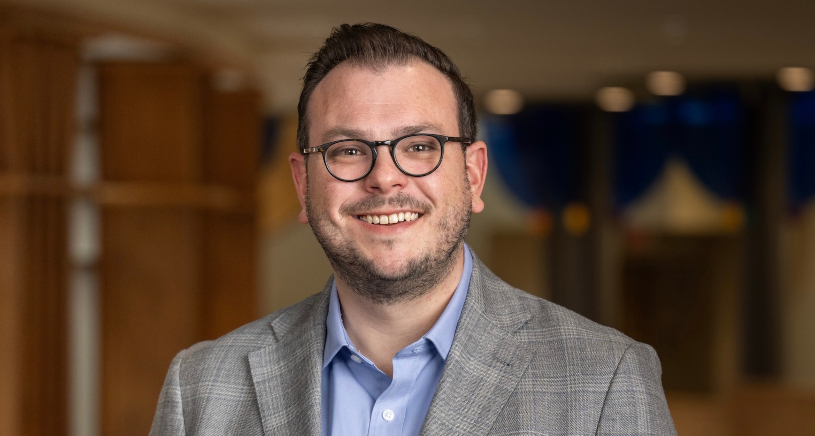
Michael Shepherd never planned to become a public health researcher.
Growing up outside Bardstown, Kentucky, a small town famous for its bourbon distilleries, he dreamed of becoming a high school history teacher.
Shepherd spent his childhood mornings watching the news with his grandfather, dressed up as US presidents for Halloween, and even watched C-SPAN for fun. Politics fascinated him from an early age.
But life had other plans.
As Shepherd came of age in the 2000s, he watched the opioid epidemic tear through the rural communities surrounding his hometown. Friends and neighbors struggled with addiction while—in his view—the nation’s political leaders were indifferent.
“I saw communities and knew people who struggled with drug addiction and felt like the national political and policy environment had been silent on this important problem,” Shepherd said.
That silence troubled him deeply and planted a question in his mind that would follow him for years: Why do some problems capture the attention of lawmakers while others are ignored? That question eventually led Shepherd away from a career in politics and into academia.
Today, he is an assistant professor of Health Management and Policy at the University of Michigan School of Public Health, where he studies how health policy shapes—and often fails—rural communities across the country.
Shepherd’s path to Michigan was not easy. He was the first in his family to navigate the complexities of college. He didn’t have an email address before starting school. He didn’t know that used textbooks existed. He applied to only one university, the cheapest one that offered him a partial scholarship. Predictably, he struggled during his first year.
A turning point came when a professor pulled him aside after Shepherd failed a midterm exam.
“That conversation changed my academic trajectory,” he said.
Shepherd went on to earn a bachelor’s degree in Political Science from Murray State University, a Master of Applied Politics from the University of Akron, and master’s and doctoral degrees in political science from Vanderbilt University.
I saw communities and knew people who struggled with drug addiction and felt like the national political and policy environment had been silent on this important problem.”
Before joining Michigan Public Health’s faculty, Shepherd taught at the University of Texas at Austin, where he researched rural hospital closures and health insurance gaps in Texas communities. That experience gave him a front-row seat to some of the most severe rural health challenges in the country, and it continues to influence how he thinks about Michigan’s own rural struggles, from workforce shortages to the closure of hospitals like the one in Sturgis.
Now settled in Ann Arbor, Shepherd studies how hospital closures, Medicaid policy and shifting political winds affect the health and attitudes of rural Americans. In this Q&A, he discusses his research, the challenges facing rural healthcare, and where he sees hope for the future.
What parts of public health interest you most?
I’m particularly drawn to rural health. I grew up in a rural area, and rural populations are underserved by private medicine while facing significant health challenges. Rural residents also tend to distrust the medical system more and hold more negative views toward health policy. I stay energized by both documenting these challenges and searching for ways to fix them.
Why does the health gap between rural and urban America keep widening?
There are demographic, economic and policy reasons. Rural populations tend to be older, poorer, less educated and less likely to have insurance—all factors linked to worse health. Economically, rural areas have fewer patients and rely more heavily on Medicaid and Medicare, which pay providers less than private insurance. That makes rural healthcare less profitable, so fewer providers set up shop there. Health policies around Medicaid, Medicare and the Affordable Care Act often don’t address rural needs well, which makes things worse. Interestingly, cities often have more variation in health outcomes between neighborhoods than rural areas do, but rural regions still look worse on average.
What does losing a rural hospital mean for a community?
Most people assume farming is rural America’s main industry, but far more rural residents work in healthcare. When a hospital closes, huge numbers of people lose their jobs, and often there’s nowhere else nearby to find similar work. That leads to falling incomes and rising unemployment. Losing a hospital can be the economic death blow for a small town.
How can you tell if a hospital is at risk of closing?
One of the clearest warning signs is a hospital’s operating margin. Hospitals running negative margins for a long time—especially below negative 10%—face a much higher risk of closure, particularly if they’re independent rather than part of a larger system. Another red flag is when service lines get cut or moved elsewhere. A hospital closing its labor and delivery unit, for example, often signals deeper trouble.
Where do you see hope for rural healthcare?
I’m encouraged that rural health finally gets attention from the media and policymakers. Ten or 15 years ago, that wasn’t the case, and many problems went unnoticed. I also see promise in mobile health units and telehealth, which are helping providers reach rural patients in creative new ways. Both approaches have limits, but they give me real reason for optimism.
What worries you most about the next 5-10 years?
Predicting the future is always risky, but if current trends hold, I have serious concerns. The Affordable Care Act’s Medicaid expansion acted like a financial Band-Aid for rural hospitals by reducing the number of uninsured patients. But recent changes to Medicaid and the end of enhanced ACA subsidies are expected to sharply increase the number of uninsured Americans, even in states that expanded Medicaid. I expect a new wave of hospital closures over the next decade, including in places that had been faring better. Combined with cuts to food assistance programs, I worry we’ll see real declines in rural health. Turning that around will require major changes to how Medicare and Medicaid reimburse rural providers, along with renewed efforts to expand insurance and food access in rural communities.
More from Michael Shepherd:
- On the Population Healthy podcast: How Medicaid policy shapes the future of rural communities
- Read: What proposed Medicaid cuts could mean for rural communities, hospital access
Written by Bob Cunningham
Media Contact
Destiny Cook
PR and Communications ManagerUniversity of Michigan School of Public Health734-647-8650