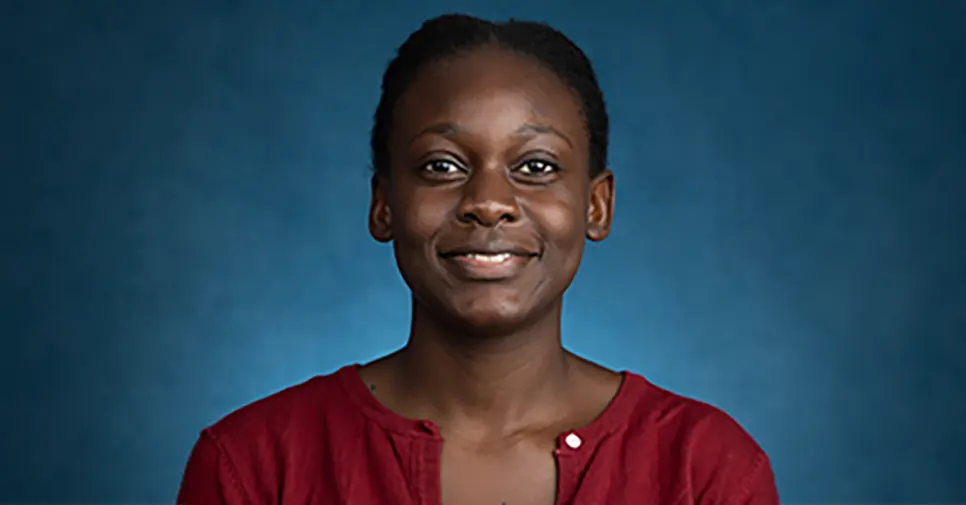
First-generation student finds purpose, community in public health
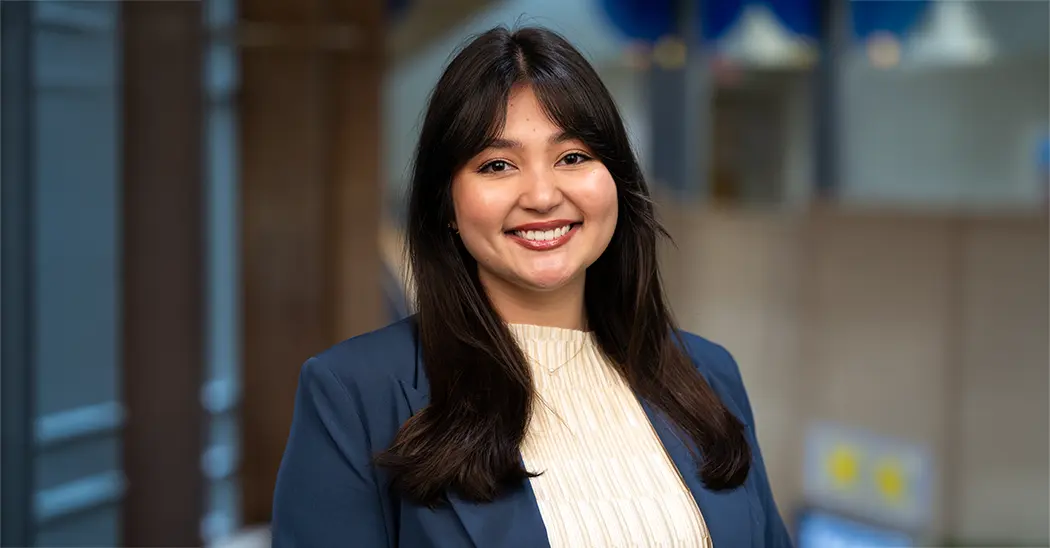
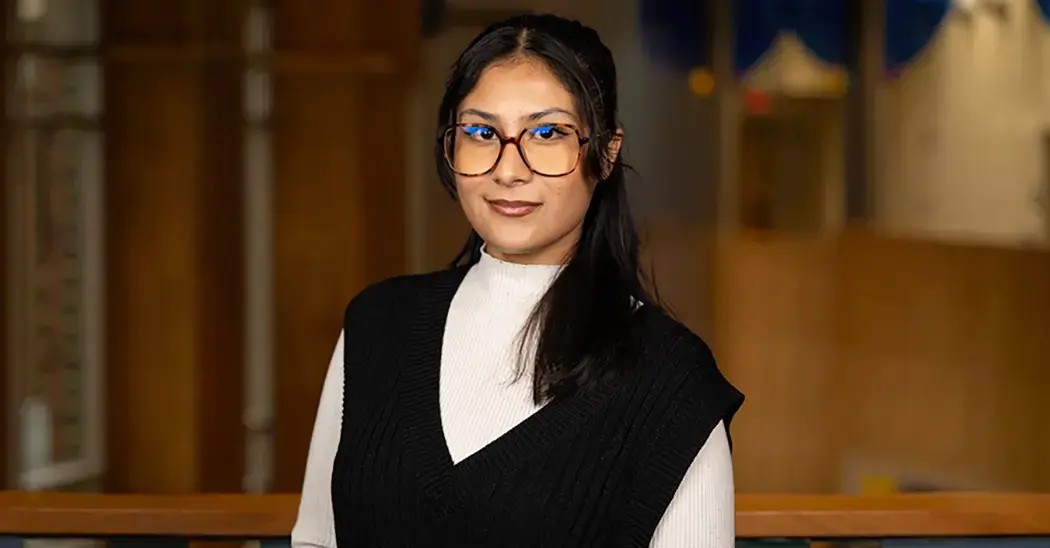
Chloe Thach, MPH ’26
Environmental Health Sciences
By Bob Cunningham
As the oldest daughter in a family of nurses and a first-generation college student from Cleveland, Chloe Thach initially thought she would become a doctor for underserved communities.
But during her time at Miami University in southern Ohio, an internship at a federally qualified healthcare center opened her eyes to something bigger than individual patient care.
“We were learning about social determinants of health and what leads to food insecurity,” Thach said. “Being able to put a name to the things I was observing—social determinants of health—I had never heard of that before, but it makes sense.”
That realization sparked a shift in her academic focus. While she was excelling in her biology and neuroscience classes, she felt something was missing.
“I wasn't satisfied anymore in my physiology classes,” Thach said. “Knowing that there were things all around us also impacting our health that we weren’t learning about in biology and my other classes.”
PROSPECTIVE STUDENT? Learn more about Michigan Public Health.
Finding home at Michigan
Her introduction to the University of Michigan School of Public Health began with a summer internship through the CDC John R. Lewis Scholars Program, known as FPHLP (Future Public Health Leaders Program). Not only did she become familiar with the university through that transformative summer experience, but it also shaped the trajectory of her entire graduate education.
“I spent a summer here, and it just felt like home,” Thach said. “I felt like Cleveland was a lot more similar to Detroit and this area of Michigan than southern Ohio was.”
Now graduating with her Master of Public Health in Environmental Health Sciences—with a concentration in Environmental Health Promotion and Policy and a graduate certificate in Social Epidemiology—Thach has made the most of her time at Michigan.
She credits FPHLP with opening countless doors.
“It really changed my life,” she said. "It was such an immersive program, set up to prepare a diverse workforce committed to health equity."
The connections she made through FPHLP remain some of her strongest to date.
“I would say my three best friends in EHS are all from FPHLP,” Thach said.
I really appreciate how interdisciplinary public health is. It’s fascinating how you can study the same question about community health from a lot of different lenses, whether you want to go at a social science approach or a toxicology approach.”
— Chloe Thach, on working on the RESPIRAR project
Research across continents
Thach’s research experiences have been as diverse as her interests. She spent time working with former faculty member Bambarendage Pinithi “Pini” Perera. Together, they examined how lead exposure during development affects the epigenome, conducting bench work with mice and mentoring undergraduate students along the way.
From Perera, Thach learned the qualities that make a good mentor and put them into practice by co-mentoring undergraduate students in Perera’s lab.
“I really like being on the teaching side of things,” Thach said of her mentoring experience, which gave her a glimpse into the educational side of public health.
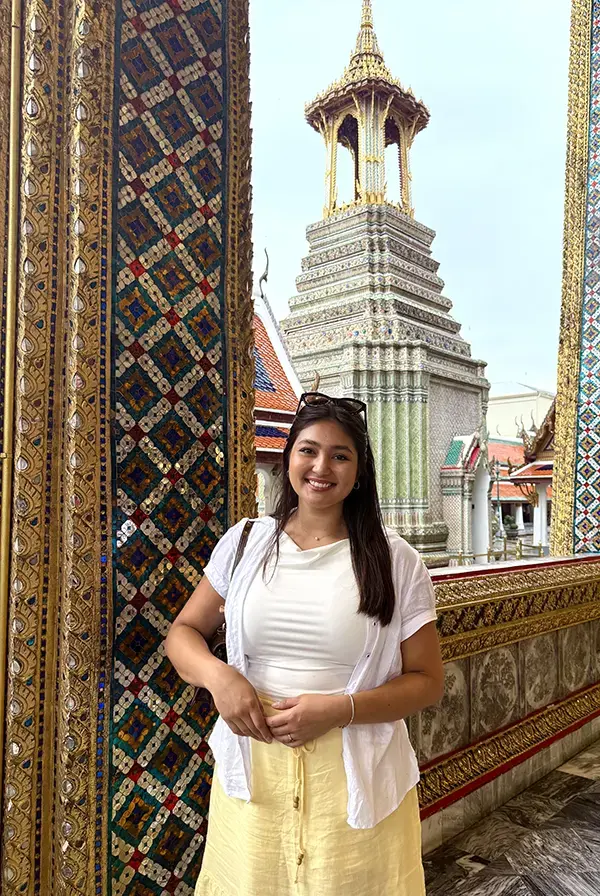
But perhaps her most transformative research experience came through the Minority Health and Health Disparities Research Training (MHRT) Program, which took her to northern Thailand for 10 weeks with fellow Environmental Health Sciences student Kenedi Clinton. There, Thach investigated barriers to cervical cancer screening among Indigenous populations.
The experience was both professionally enriching and personally meaningful.
“I’d never been to Asia before, even though my grandparents are from Southeast Asia,” Thach said. “It was amazing to experience some of the things that they would tell stories about.”
The trip also gave her perspective on different healthcare systems. When she needed medical care during her stay, she was shocked by the low cost of her care—about $5 for a doctor’s visit, tests and prescription, even as an outsider without local insurance.
“I was blown away by that, and kind of critiquing our own healthcare system, and thinking, what can we do better for our populations?” she said.
READ MORE about faculty, students, alumni and staff.
Connecting research to community
More recently, Thach has worked with Devon Payne-Sturges, professor of Environmental Health Sciences, on the RESPIRAR project, which seeks to understand the complexity of the agricultural labor system and its relation to worker health.
As part of a project focusing on the housing conditions of migrant seasonal farmworkers in Maryland, Payne-Sturges filed a Public Information Act request with Maryland’s Department of Labor to obtain housing inspection records dating back to 2018. She then paired Thach with Health Behavior & Health Equity student Camille Ingram to make sense of what came back.
The challenge was significant. The Department of Labor had responded to the request, but none of the records were digitized. Instead, Thach and Ingram were handed 188 scanned documents—the majority of them handwritten inspection reports—and tasked with making sense of it all. Rather than being overwhelmed, Thach and Ingram first had to figure out how to digitize the handwritten information before they could even begin to analyze it. From there, they developed a systematic framework for reviewing and classifying each report, capturing everything from structural deficiencies like cracked foundations and broken windows to more alarming conditions like non-functioning toilets and rodent infestations.
The results of their work had real-world impact far beyond the classroom. When the Maryland General Assembly’s Economic Matters Committee was exploring potential legislation to improve farmworker housing conditions, it invited Payne-Sturges to deliver a briefing in January. Thach and Ingram helped prepare her for that presentation as their analysis allowed Payne-Sturges to compare what inspectors had officially documented against what her team was observing firsthand in the field, painting a fuller, more compelling picture of the conditions these workers face every day.
“Chloe has this ability to think through problems in a very detailed way and come up with a strategy,” Payne-Sturges said. “I was just super impressed by how thorough she was in taking on a messy task.
“All that information wouldn’t have been available to me if it hadn’t been for Chloe and Camille’s work. Their analysis became very instrumental in the briefing I gave to the Maryland General Assembly’s Economic Matters Committee.”
“I really appreciate how interdisciplinary public health is,” Thach said about working on the RESPIRAR project. “It’s fascinating how you can study the same question about community health from a lot of different lenses, whether you want to go at a social science approach or a toxicology approach.”
Her FPHLP internship with the Washtenaw County Health Department further demonstrated the importance of community connection. Working with Kimberly Collom on emergency preparedness, Thach helped develop a best practice guide for reaching underserved populations during emergencies, drawing lessons from the COVID-19 pandemic.
“I learned that a lot of emergency preparedness involves community trust, and it requires public health practitioners to be present in the community that they’re serving,” she said.
"Chloe has this ability to think through problems in a very detailed way and come up with a strategy. I was just super impressed by how thorough she was in taking on a messy task. All that information wouldn’t have been available to me if it hadn’t been for Chloe and Camille’s work. Their analysis became very instrumental in the briefing I gave to the Maryland General Assembly’s Economic Matters Committee.”
— Devon Payne-Sturges, on Chloe Thach and Camille Ingram
Breaking new ground
As a first-generation college student, Thach has navigated her educational journey with determination and independence. Rather than viewing this as purely a challenge, she sees it as having shaped her in positive ways.
“I was always in a situation where I needed to find money for rent,” she said. “That pushed me to apply to a bunch of internships where I got paid, so it ended up working out for me.”
Thach is also supported by the Rudy Richardson Scholarship Fund.
Her success has created a ripple effect in her family. As the oldest sister, she now helps her younger siblings with college and scholarship applications.
“It’s great to see them be successful, too,” she said, noting that her youngest sister was recently accepted into a dental assistant program.
While Thach still has to explain to her family of nurses and healthcare workers exactly what public health is, they’ve become her biggest supporters.
“Once I explain it to them, they’re like, ‘Oh yeah, that makes sense—the environment does affect your health,’” she said.
As graduation approaches, Thach has a clear vision about her goals.
“I really see myself working in research,” she said. “It’s what I’m good at and what I enjoy.”
But not just any research. She envisions herself working directly alongside communities in what she calls “collecting evidence for action,” or research that leads to concrete policy changes or interventions for healthier environments.
Thach was admitted into Michigan Public Health’s PhD program in the Department of Environmental Health Sciences and will return in the fall. She will also be mentored by Payne-Sturges for her research.
She’s also found community through the Environmental Health Student Association, where she serves on the executive board.
“Environmental Health Sciences is a really collaborative field and department,” Thach said. “I really found my people.”
SUPPORT research and engaged learning at Michigan Public Health.