Online MPH degree opening doors that were once closed
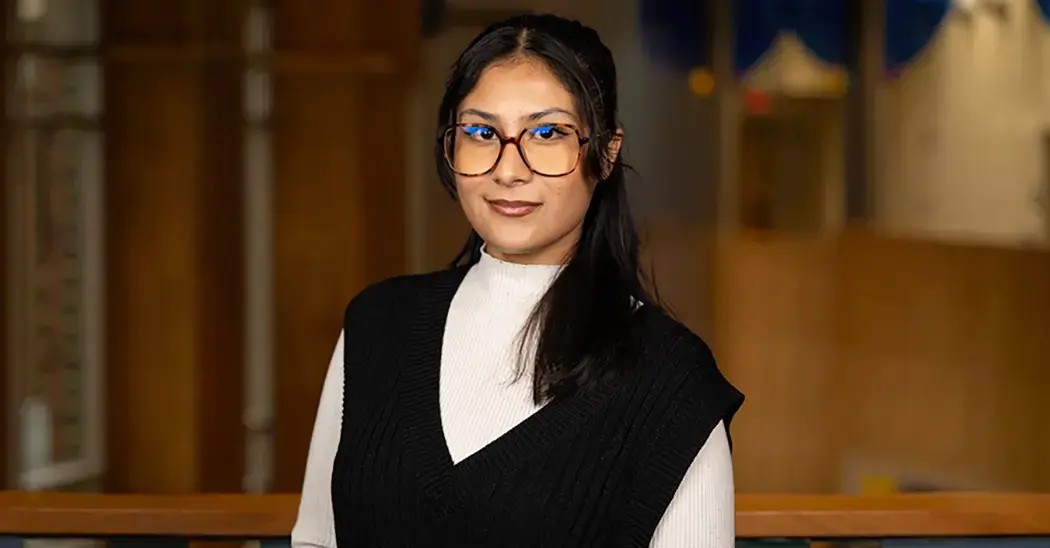
Lady Pérez, MPH ’26
Online MPH in Population and Health Sciences
By Bob Cunningham
In her home state of Florida, Lady Pérez was turned away from college after college. The reason was always the same: her criminal record.
“In my own state, I was being told, ‘You’re a felon; you can’t be here,’” she said. “The University of Michigan didn’t see me as a felon. They saw me as a human.”
That difference changed everything for Pérez.
This spring, she will graduate with a Master of Public Health degree from the University of Michigan School of Public Health’s Online MPH Program in Population and Health Sciences.
Her path has wound through prison, probation, health crises and closed doors. And it was paved with hard work, fierce advocacy and a refusal to give up.
Pérez was born in Colombia but grew up in Queens, New York, where she attended private school from kindergarten through high school. Her family eventually settled in Florida, and she followed them there. She led a privileged life: Her parents ran their own business, and she had opportunities many people never get.
But Pérez was carrying a secret weight. She is a survivor of childhood sexual abuse—a trauma she said she never properly dealt with. That unaddressed pain influenced her choices in ways she didn’t fully understand at the time.
“I had trauma that I didn’t work on,” she said. “It was ‘shh, don't talk about it.’”
Before things fell apart, Pérez was working as a surgical trauma assistant—a skilled medical job. But toxic relationships, disordered eating and harmful money habits began to take over her life. Eventually, those choices led to a conviction. She served time in a Florida state prison.
“I hurt a lot of people due to my choices,” she said. “Not physically, but probably emotionally.”
The University of Michigan didn’t see me as a felon. They saw me as a human.”
— Lady Pérez
Finding purpose behind bars
Prison, Pérez said, was the turning point she didn’t know she needed.
“I don’t have any regrets in the sense of going to prison,” she said. “It was a shift in my life that I needed to do.”
Inside, Pérez met women whose stories looked a lot like hers—people affected by trauma who had never been given the tools to heal. When she was released, she faced 13 years of probation, which kept her in Florida.
She couldn’t leave the state, but she could fight to change it.
She started knocking on doors. She walked into meetings with politicians and visited universities, asking for a chance to go back to school. Most said no. Florida law gives colleges and universities the right to ban people on probation from their campuses. Pérez was turned away again and again—sometimes even by schools that had invited her to speak about her own story.
“Ironically, I have gone to these schools to talk about mental health and advocacy,” she said, “and they were like, ‘Yeah, come and talk.’ But then they would tell me, ‘No, you cannot be here as a student.’”
Finally, a community college gave her a chance. She earned her undergraduate degree in psychology and addiction studies from Palm Beach State College, and she graduated with honors.
Michigan said yes
When Pérez was ready to pursue a master’s degree, the rejections started again. Schools would accept her based on her transcripts, then pull the offer after seeing her background check. A mentor pushed her to think bigger.
“Look for the schools that are aligned with your values,” the mentor told her. “Don’t limit yourself. Use what people see as your weakness as your strength.”
She applied to the University of Michigan School of Social Work and to Columbia University. Both accepted her.
Michigan won her over.
There was still one obstacle: She was on probation and could not travel to Ann Arbor. But Michigan had a solution. The School of Social Work was launching its very first online cohort, and Pérez was invited to be part of it.
She said yes—but first, she made something clear to admissions.
“I said, ‘This is my story, and I want to be able to continue bringing awareness,’” she recalled. “And they allowed me to.”
She earned her Master of Social Work from Michigan, then continued on to the Online MPH Program at Michigan Public Health. She also became one of the first licensed mental health therapists in Florida to receive that credential after incarceration.
Today, Pérez is a working psychotherapist with a schedule that spans continents. She has worked with the United Kingdom’s prison system, conducting an independent study on indefinite sentences and human rights. She serves on a board for a University of Central Florida program that brings college education inside Florida prisons. And, soon, she will teach a mental health course inside the very prisons where she was once incarcerated.
“It’s a blessing in disguise,” she said.
Pérez continues to collaborate with the School of Social Work through ENGAGE, a program focused on community advocacy, and through the Employment Equity Learning and Action Collaborative, known as EELAC, which works to create pathways of success for people who have historically been shut out of opportunities.
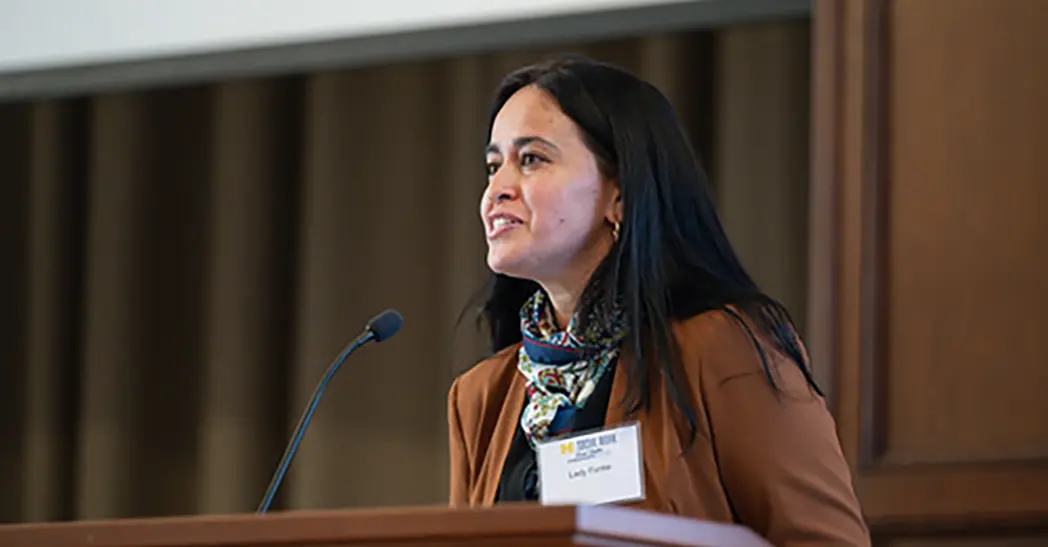
She also speaks at re-entry summits, criminal justice events, and university classrooms across the country, including once a year in a class at Michigan Public Health taught by Michael Shepherd, assistant professor of Health Management and Policy.
“Dr. Shepherd has provided amazing support,” she said.
“My students have benefited tremendously from Lady,” Shepherd said. “Her experiences and perspectives have helped my students see that people often learn how to be policy advocates from first advocating for themselves when facing difficult circumstances and that a core goal of public health advocacy is to amplify the voices of communities and people who haven’t been given the voice that they or their problems deserve.”
Getting through the Online MPH Program was not without struggle. Pérez lives with diabetes and a mixed connective tissue autoimmune disorder. During her degree program, her health created serious challenges. She credits faculty and staff, including Lisa Garber, program manager, for working with her to find a path forward.
“The professors said, ‘How can we work together so you could still accomplish your goals?’” Pérez said. “There was a lot of support and flexibility.”
My students have benefited tremendously from Lady. Her experiences and perspectives have helped my students see that people often learn how to be policy advocates from first advocating for themselves when facing difficult circumstances and that a core goal of public health advocacy is to amplify the voices of communities and people who haven’t been given the voice that they or their problems deserve.”
— Michael Shepherd, assistant professor of Health Management and Policy
The bigger picture
For Pérez, the degree is another tool in her fight for the people who have been overlooked.
As a Latina woman born in Colombia, she is especially focused right now on the mental health of Latino communities navigating fear and uncertainty related to immigration policy. She calls it “Latino guilt”—the emotional and physical burden that comes from wondering whether coming to this country was the right choice, and what might happen next.
“Those patterns still affect your health,” she said. “It’s affecting older generations of our community and the younger generation.”
She sees mental health and public health as inseparable. Untreated trauma, she said, doesn’t just hurt people emotionally. It shows up in the body—in blood pressure, heart disease, diabetes and more.
“Mental health is part of public health,” Pérez said. “Why don't we look at the roots?”
Pérez said she hopes to continue doing research, partnering with organizations, and one day contributing to policy that addresses those roots before they grow into crises. A PhD remains a dream—though for now, no fully remote doctoral programs fit her situation.
But she is not slowing down.
“Look to your right, look to your left,” Pérez said. “Those eyes you see, or the person you see, always has a story. We could make so much change by just learning to listen.”
Her own story, she is quick to point out, is not the point. It is the door.
“I am not about my story,” Pérez said. “I am about bringing awareness that my story could be somebody else's story.”