Bridging cultures, communities and nutrition one rotation at a time
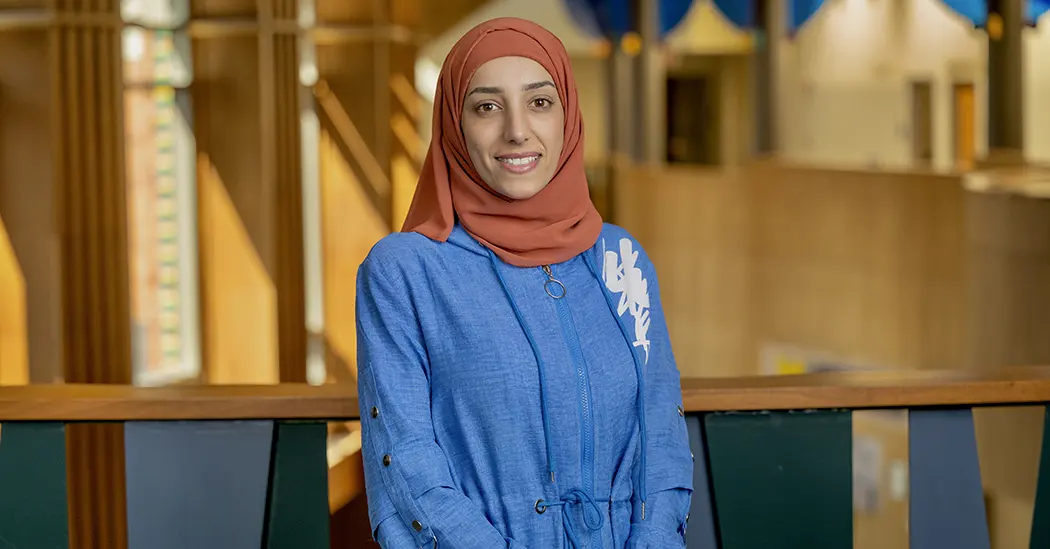
Takreed Ali, MPH ’26
Nutritional Sciences
By Bob Cunningham
Takreed Ali did not arrive at the University of Michigan School of Public Health by a straight road. Her path wound through two countries, two languages and two very different ideas of what healthcare could be.
This spring, Ali is graduating with a Master of Public Health degree in Nutritional Sciences with a concentration in Dietetics. Ali also is finishing the supervised practice hours required to become a Registered Dietitian Nutritionist (RDN), a credential that takes years of hands-on clinical training to earn.
Ali is living proof that resilience, purpose and the right support system can carry a person further than they ever imagined.
PROSPECTIVE STUDENT? Learn more about Michigan Public Health.
Two worlds, one purpose
Growing up, she split her childhood between the United States and Yemen.
Those two environments could not have been more different, she said. Yemen introduced her to close-knit communities, limited medical resources and a set of health challenges that many Americans never see.
The United States showed her a more advanced healthcare system, but also one with deep and visible health inequalities.
“Living in two very different environments helped me understand how social, economic and cultural factors influence health,” Ali said.
That early experience planted a seed. She began to see that health was not simply about individual choices. It was also influenced by systems—by where you lived, how much money your family had, what language you spoke, and whether healthcare providers looked or sounded like you.
She carried those observations with her to Eastern Michigan University, where she earned her undergraduate degree with three concentrations: Natural Sciences, Pre-Dietetics and General Sciences. It was a self-designed academic path built around preparing for a career in nutrition.
But somewhere along the way, a bigger question took hold. Why treat illness when you could prevent it?
“I realized that I wanted to expand beyond individual nutrition counseling and pursue public health, where I could address prevention and health disparities at a broader level,” Ali said.
That realization brought her to Ann Arbor.
Health is not a privilege reserved for a few. It is something that can be learned, supported and achieved through education, empowerment and structural change.”
— Takreed Ali
Building skills across settings
At Michigan Public Health, Ali went to work outside the classroom. Her internship rotations took her across southeast Michigan, placing her in some of the most challenging and meaningful healthcare environments a nutrition student can enter.
At PACE Southeast Michigan, she worked with elderly patients managing chronic diseases, providing one-on-one nutrition counseling. At Henry Ford Health, Ali trained inside both surgical and non-surgical weight management programs, learning how to support patients through the long and emotionally complex journey of obesity care. She spent time at Taylor Lodge in long-term care, sharpening her clinical skills in elderly nutrition and malnutrition prevention.
At Michigan Medicine, Ali developed motivational interviewing techniques—a method used to help patients find their own reasons to make health changes—during a bariatric rotation. At Ypsilanti High School, she stepped into the world of food service management, overseeing meal production and learning how school nutrition programs either support or fall short for young people.
Perhaps the most innovative stop on her rotation schedule is her current placement with the Hurley FoodFARMacy program in Flint, Michigan, where food is literally prescribed to patients like medicine. The program connects healthcare directly to food access—handing patients nutritious foods as part of their medical treatment plan.
“This innovative model expanded my understanding of food insecurity as both a medical and public health issue,” Ali said.
READ MORE about faculty, students, alumni and staff.
Serving her own community
One of Ali’s most powerful experiences came during her WIC rotation in Dearborn, where she served a predominantly Arabic-speaking community. Being bilingual, she was able to speak directly with families in their native language, a rare and valuable skill in any healthcare setting.
Language barriers in healthcare are not a small problem. They can mean the difference between a patient understanding their treatment and walking away confused. For Ali, that rotation was a reminder of exactly why representation matters in the dietetics field.
She also spent approximately two years working with ACCESS, a Detroit-area organization serving immigrant and underserved populations. That experience, she said, deepened her commitment to culturally competent care, nutrition counseling that does not just follow a clinical checklist but connects with the person sitting across the table.
While completing all her clinical training, Ali has also been conducting an independent research project unlikely to be found in a nutrition program. Working with Dave Bridges, associate professor of Nutritional Sciences, she is exploring the connections between Quranic references to nutrition and what modern science has discovered about food and health.
“Takreed brings a wealth of compassion and insight from her lived experiences to her studies in nutrition,” Bridges said. “Observing how she connects what she learns in the classroom and connecting that to serving her community is truly inspiring.”
“Dr. Bridges has been instrumental in my research development,” she said. “He guided me in strengthening my research methodology and critical thinking skills.”
The project is exactly the kind of interdisciplinary work that Ali believes public health needs more of: research that takes cultural and spiritual context seriously rather than treating it as an obstacle to evidence-based practice.
“This research connects faith, science and culture,” she said.
“It has been fascinating to work with Takreed in evaluating the intersections between Quranic principles and rigorous modern science,” Bridges said. “In these conversations, we have both learned a great deal about the context in which nutritional science is generated and how it can be meaningfully received by people of faith.”
None of this has been easy. Ali is a single mother and the sole caregiver for her child. She has been raising a child while managing graduate coursework, internship rotations spread across multiple healthcare systems and an independent research project—simultaneously.
There were moments, she said, when the pressure became almost too much to bear.
What kept her going was a combination of family support, faculty mentors and a program called CEW+ (the University of Michigan’s Center for the Education of Women) that supports students who are balancing caregiving responsibilities with academic goals. As a CEW+ Irma M. Wyman Scholar, Ali received financial support, mentorship and—perhaps most importantly—a community of people who understood her reality.
“CEW+ provided not only financial support but also mentorship, encouragement and a community that truly understood the realities of balancing caregiving and academic ambition,” she said. “It strengthened my confidence and reminded me that leadership can grow through resilience.”
She also received the DIM x Diversify Dietetics Dairy Scholarship, support from the Michigan Public Health Internship Transition Fund, and awards connected to the Academy of Nutrition and Dietetics. Each one, she said, reinforced her sense of purpose and helped ease the financial pressure that comes with intensive unpaid internship rotations.
Takreed brings a wealth of compassion and insight from her lived experiences to her studies in nutrition. Observing how she connects what she learns in the classroom and connecting that to serving her community is truly inspiring.”
— Dave Bridges, associate professor of Nutritional Sciences
Purpose for what comes next
As Ali prepares to graduate this spring, her vision for the future is clear and ambitious. She wants to work at the intersection of clinical care, community health and research—specifically with immigrant, minority and underserved populations. She hopes to design nutrition programs that are culturally responsive, grounded in evidence and connected to real improvements in food access.
She also wants to keep doing research that bridges science with culture, faith and lived experience.
Most of all, she wants the people she serves to believe something she has believed for a long time: that good health is not something reserved for people with money, privilege or access to the best hospitals.
“Health is not a privilege reserved for a few,” she said. “It is something that can be learned, supported and achieved through education, empowerment and structural change.”
SUPPORT research and engaged learning at Michigan Public Health.