Campus leadership paves way for impactful healthcare role
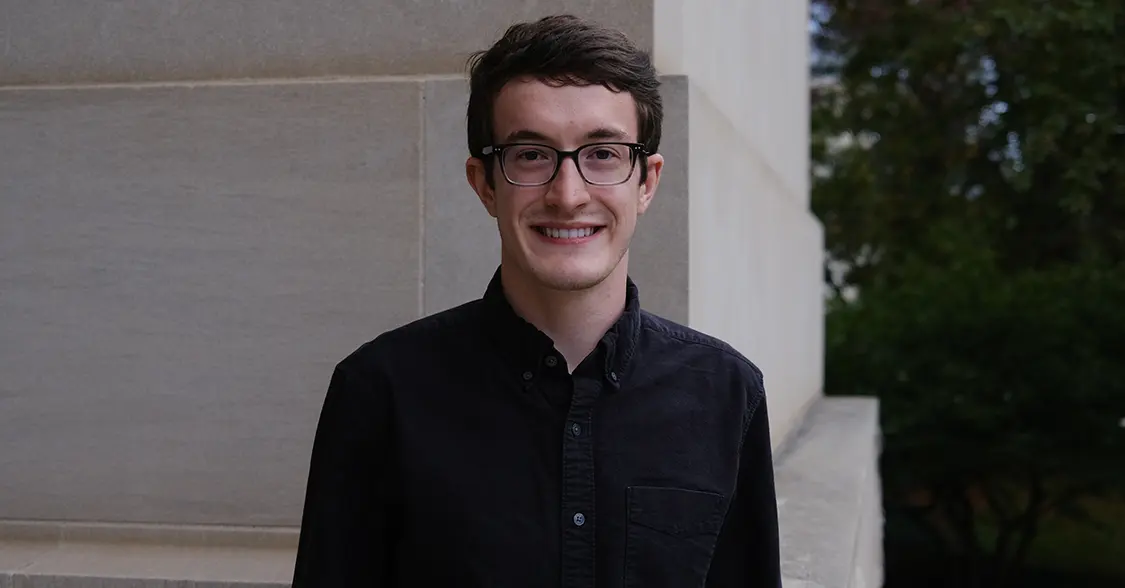
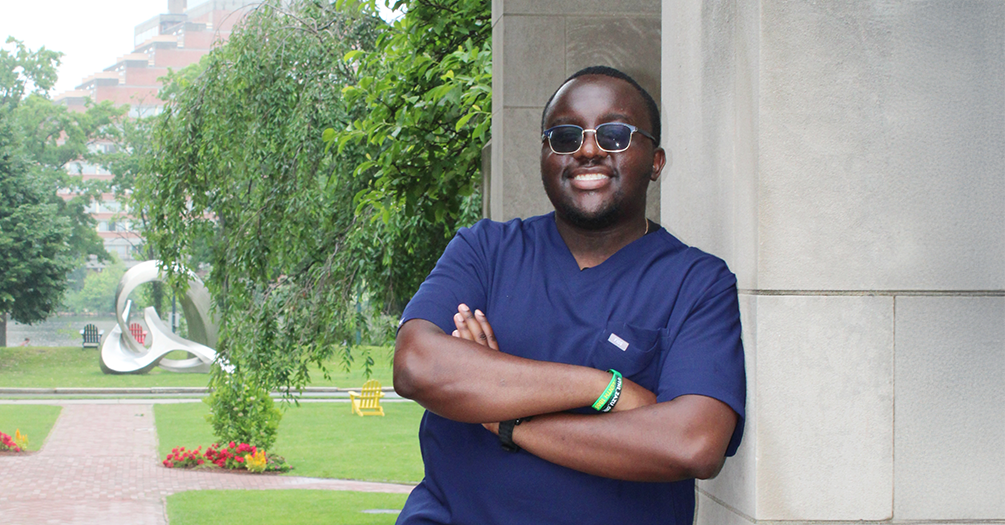
Jason Seekamp, MPH ’26
Epidemiology
By Bob Cunningham
Jason Seekamp had a lot going on to start his final year of study at the University of Michigan School of Public Health: classes, research, a student organization to lead, and a job search.
And somewhere in the middle of all of it, he received an invitation from University of Michigan Provost Laurie McCauley to serve on the School of Public Health Dean Search Advisory Committee.
It was a rare opportunity that put him in the room where some of the school’s most important decisions get made.
“It’s been really interesting, and it's a great experience to see how public health happens in a way that a lot of people don't think about,” Seekamp said. “A lot of work and thought goes into picking the next dean who’s going to carry that mission forward.”
Not only has this experience been a highlight of Seekamp’s college experience, but it's a window into how a world-class institution operates and a chance to give back to the school.
“It’s a great honor,” he said. “I’m more than happy to help the school in that way.”
Aubree Gordon, professor of Epidemiology and Global Public Health, is the chair for the Dean Search Advisory Committee. She said Seekamp has been an outstanding committee member.
“He’s thoughtful, articulate and has brought a valuable student perspective to our discussions,” Gordon said. “It’s been a pleasure working with him. From the start, Jason has approached his role with curiosity, professionalism and a genuine commitment to the school. He’s represented our student community exceptionally well, and I cannot wait to see what he accomplishes next.”
PROSPECTIVE STUDENT? Learn more about Michigan Public Health.
From Traverse City to Ann Arbor
Seekamp grew up in Traverse City, Michigan, and first came to Ann Arbor for his undergraduate degree at the College of Literature, Science, and the Arts (LSA), where he pursued an unusual double major: Biomolecular Science and Honors History.
“With that history degree, I took a lot of classes in the history of health and medicine,” he said. “That’s kind of how I came to find myself at Michigan Public Health.”
During his junior and senior years, Seekamp started to feel like the pre-med track, which he had been following since arriving on campus, wasn't quite the right fit. He had been working in clinics and a dentist’s office and noticed that what really piqued his interest wasn’t one-on-one patient care. It was the bigger picture.
“A lot of the things that I’m passionate about in health are more at population and systems levels,” he said.
That realization led him toward public health. Seekamp took a gap year, taught at a high school in his hometown, and used the time to figure out what he really wanted. Eventually, he found his answer in epidemiology—the science of how disease and health move through populations.
“Epidemiology gives you a lot of really great tools and ways of thinking to solve really complex problems in public health,” he said. “And that was something that was really exciting for me."
It’s been really interesting, and it's a great experience to see how public health happens in a way that a lot of people don't think about. A lot of work and thought goes into picking the next dean who’s going to carry that mission forward.”
— Jason Seekamp, on serving on the School of Public Health Dean Search Advisory Committee
Choosing Michigan again
When it came time to apply to graduate school, Seekamp didn’t have to look far. He’d already spent four years at Michigan and knew what the university stood for.
“Michigan is a leader in pretty much most areas of academia and research, and especially public health,” said Seekamp, pointing to the School of Public Health’s No. 2 ranking in U.S. News & World Report’s list of Best Public Health Schools.
But rankings weren't the only thing that drew him back. Seekamp said the admissions process felt more personal than anywhere else he considered.
“Michigan Public Health was one of the few schools where it felt like they really wanted me to be a student there,” he said.
Seekamp attended Admitted Students Day at Michigan Public Health, and said the experience sealed the deal. He loved meeting faculty, connecting with other prospective students, and feeling the energy in the building.
“It was overall just a really positive experience,” he said.
It stuck with him. Seekamp has served as an admissions ambassador for Michigan Public Health, helping prospective students get that same personal touch.
“It's really cool to talk to other people in public health, whether they’re applying for the Epidemiology department or not,” he said. “Meeting people from all over the country and all over the globe who are considering Michigan is an amazing opportunity.”
He’s even helping plan a first-generation student webinar for admitted students.
READ MORE about faculty, students, alumni and staff.
Building community from the inside out
As president of the Epidemiology Student Organization (ESO), Seekamp helped lead what he calls one of the group’s most active years in recent memory. Under his leadership, ESO raised $500 for the Epidemiology Student Scholarship Fund, organized social events, and ran a food drive with Food Gatherers, a local hunger relief organization.
Perhaps more important, Seekamp worked to build stronger connections between first-year and second-year students in the department, recruiting first-year representatives onto the ESO board to help bridge that gap.
“All of those projects have really been based on what the students want, what our peers wanted ESO to do,” he said. “That has been really exciting.”
He is also a co-founder of the Public Health Genetics Journal Club, started alongside fellow students and Jennifer Smith, associate professor of Epidemiology and director of the Public Health Genetics Certificate Program. The club brings students together to discuss research articles and connect with faculty in a relaxed, low-pressure setting.
“It incorporates both the more crunchy, scientific, epidemiology part and the social part,” Seekamp said. “Just getting together, talking about a journal article, hanging out and interacting with faculty has been a tremendous opportunity.”
In summer 2025, Seekamp interned as a research assistant under Monica Dus, associate professor in LSA’s Department of Molecular, Cellular, and Developmental Biology. Seekamp, who was supported by the Reproductive and Women’s Health Summer Internship fund, investigated the effects of maternal diet and childhood developmental outcomes.
He also serves as a student representative on the Epidemiology Practice Committee, helping organize community service events—including a blanket-making event at the Michigan-Flint campus on MLK Day—and spreading the word about those opportunities to fellow students.
“It’s really cool to get that insider look into how the school functions and how the school carries out its mission,” Seekamp said. “And it’s always great to work with other faculty, staff, and students—getting exposure that I might not get in the classroom.”
He’s thoughtful, articulate and has brought a valuable student perspective to our discussions. It’s been a pleasure working with him. From the start, Jason has approached his role with curiosity, professionalism and a genuine commitment to the school. He’s represented our student community exceptionally well, and I cannot wait to see what he accomplishes next.”
— Aubree Gordon, professor of Epidemiology and Global Public Health and the chair for the Dean Search Advisory Committee
Putting public health into practice
Outside of committees and student organizations, Seekamp has spent the last two years as a prevention and high-risk planning program assistant at Wolverine Wellness, the university’s student well-being office.
There, he has worked on alcohol and drug harm reduction campaigns, including the university’s well-known Stay in the Blue alcohol awareness initiative. He also helped build a newer campaign called Cannabis Conversations, a project designed to meet students where they are on the topic of cannabis use.
“I was able to benchmark what other universities are doing for cannabis harm reduction work,” he said. “I lead focus groups and really build up that campaign to meet the needs of students today.”
For Seekamp, watching his supervisors—both Michigan Public Health alumni—carry their public health training into real, everyday work has been one of the most meaningful lessons of his graduate experience.
“It’s really great to see how their training in public health is actually carried out in the work that they’re doing,” he said.
After graduation this spring, Seekamp is heading to Madison, Wisconsin, to start a new role at Epic, one of the country’s leading health information technology companies. He’ll work as a project manager, helping health systems put Epic’s software to use in ways that improve the patient experience from the inside out.
He found the job “the old-fashioned way.”
“I just cold applied,” he said. “I submitted my resume, went through the application and interview process, and was super lucky to get an offer.”
The role fits squarely with the interests he’s been building toward since those early history classes, making the healthcare system work better for the people who depend on it most.
“When people think about their health and those high-stress times, it’s often related to the health system,” he said. “If we can make those experiences as positive and efficient as possible, that will improve the whole system.”
SUPPORT research and engaged learning at Michigan Public Health.