Aspiring neurologist blends medicine and public health
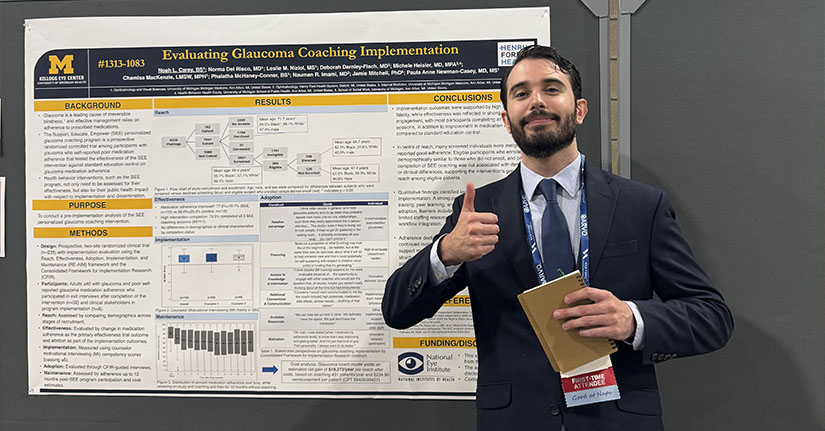
Noah Carey, MPH
General Epidemiology
By Bob Cunningham
During his family medicine rotation, Noah Carey cared for a woman with multiple sclerosis and severe chronic pain. She was also dealing with food insecurity, difficulty accessing care and significant emotional distress.
Her care team worked to connect her with mental health services and social work support. For Carey, the experience showed how closely health is tied to the circumstances in which people live.
“This experience strengthened my interest in understanding health beyond the individual patient,” he said.
That interest helped lead Carey to the University of Michigan School of Public Health, where he completed the accelerated 42-credit program for a Master of Public Health degree in General Epidemiology, a dual degree with the University of Michigan Medical School.
Carey grew up in San Jacinto, California, in a low-income setting.
“I saw how social and economic circumstances can shape a person’s health and well-being,” he said. “That perspective stayed with me.”
Years later, he volunteered with people experiencing homelessness in Skid Row. He valued connecting with people one-on-one, but he realized that many of their needs went beyond what he could address in a single interaction. The experience made him more aware of the challenges people face in getting basic resources and healthcare.
“I saw public health as an opportunity to build on my clinical training and develop the skills to make a broader impact,” he said.
Carey earned a bachelor’s degree in Neuroscience at UCLA before moving on to Michigan Medicine, where he is pursuing a Doctor of Medicine.
I saw public health as an opportunity to build on my clinical training and develop the skills to make a broader impact.”
A first-generation college student, Carey was considering leaving Southern California for the first time. He wanted to attend a university where he would feel supported while exploring his interests and growing professionally.
The University of Michigan stood out for its range of academic opportunities, its interdisciplinary approach, and faculty who are deeply engaged in their fields. During medical school, he said, he came to appreciate how much those resources and mentorship could shape his education.
He chose Michigan Public Health to add to his clinical training. He wanted to understand the factors that influence health across whole populations and learn how research methods can help identify disparities, evaluate interventions and improve access to care.
Within public health, he chose epidemiology, the study of how health and disease patterns affect groups of people. He also wanted “tangible research skills” to explore the questions that matter to him, and he was drawn to how the field uses data to understand health disparities.
The accelerated MPH is designed for students with a strong quantitative background who already hold a doctoral or advanced clinical degree, or who are enrolled in certain medical or clinical doctoral programs. It prepares graduates for careers in research, teaching, government and industry.
Carey said the experience was “very rewarding,” and the program gave him a strong foundation in public health and let him return to medical school within a year. He studied biostatistics, epidemiology, health behavior theory and other core topics.
He also applied his learning outside the classroom. Recognizing an opportunity to support his community, he established a partnership between the Michigan Branch of the Telluride Association and Wolverine Street Medicine to collect and distribute warm clothing to people experiencing homelessness.
He also worked closely with his advisor, Briana Mezuk, professor of Epidemiology, to develop an epidemiologic research project, analyze data and present his findings.
Not every influence came from school. Carey’s high school long-distance running coach, Janice Kelley, helped him through a difficult time. After a health scare, he was struggling with fears about returning to running. She helped him work through those concerns and gradually regain his confidence.
A year later, Kelley died. Losing her was hard, Carey said, but it also made him reflect on the impact she had on him and his teammates. He wanted to support the team, especially the younger runners, by sharing the lessons, training routines and encouragement she had given them.
“That experience shaped my understanding of mentorship and the importance of being present for others during challenging times,” he said.
Today, it continues to influence his commitment to education and mentorship, whether he is supporting fellow students or younger learners.
Carey’s experiences abroad reinforced the importance of approaching communities with curiosity and a willingness to learn.
In China, he joined a 10-day clinical immersion trip in spring 2025 through the Michigan Medical School’s Global REACH that took the group to hospitals across the eastern part of the country, including Union Hospital in Fuzhou, Foshan Hospital of Traditional Chinese Medicine and Peking Union Medical College Hospital, which Carey said is the top-ranked hospital in China.
One evening, a young cardiologist from Fuzhou overheard Carey and a couple of peers practicing Mandarin and helped with their pronunciation. She explained how she integrates acupuncture and other Traditional Chinese Medicine into her cardiology practice and showed him pressure points on his hand and forearm linked to digestion and cardiovascular health.
“These insights deepened my appreciation for integrative medicine and its potential role in patient-centered care,” he said.
A genuinely people-centered approach means understanding each patient’s priorities, recognizing the practical barriers they face, and developing care plans collaboratively.”
In Grenada, Carey and his teammates partnered through the Public Health Action Support Team (PHAST) with the Child Protection Authority on a systems-level analysis of child protection, with the goal of helping inform national child protection manuals. They held focus groups and key informant interviews with people working in healthcare, law, religious organizations and law enforcement, as well as Authority staff. In one session, he said, people from the Authority and law enforcement began discussing ways to strengthen their partnership, “a small but meaningful example of how bringing stakeholders together can extend the impact of the work beyond the room.”
Read about Michigan Public Health students’ experiences in Grenada.
“Effective interventions can’t simply be transferred from one setting to another,” he said, because communities have different priorities, resources and cultural contexts.
To him, cultural humility means “recognizing the limitations of your own perspective, listening before proposing solutions, and treating community members as partners.”
Now that Carey has returned to clinical training, he is more mindful of how social circumstances and access to resources affect patients’ ability to manage their health. In a future career in neurology, he hopes to combine patient care with research that identifies disparities and improves access to neurological services.
“A genuinely people-centered approach means understanding each patient’s priorities, recognizing the practical barriers they face, and developing care plans collaboratively,” he said.
More broadly, he hopes to partner with patients, caregivers and communities to identify gaps in care and evaluate possible solutions.
Read “Noah Carey, MD/MPH student: Connecting medicine, public health and purpose.”