New dean brings collaborative global health leadership to Michigan Public Health
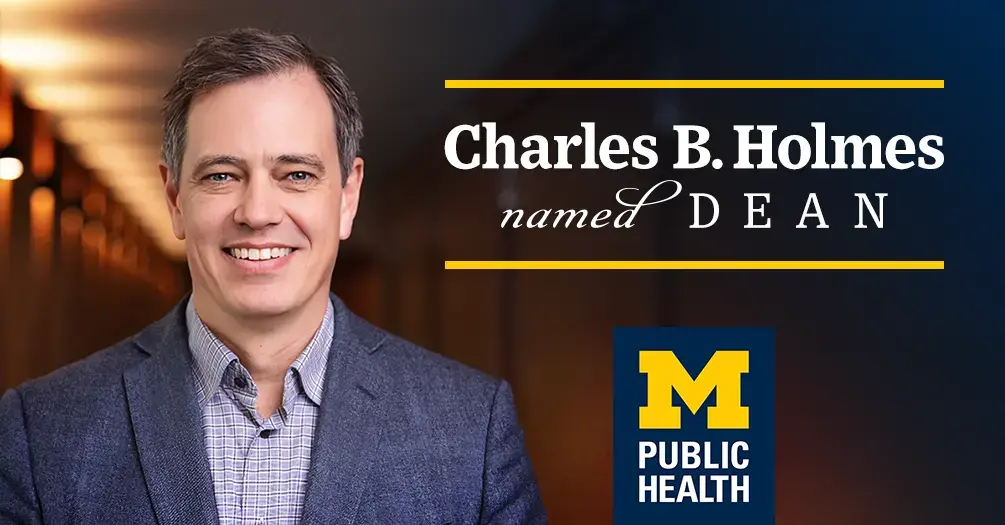
Dr. Charles B. Holmes, MPH ’95, brings decades of experience in infectious disease, policy and global partnerships to lead the school at a critical time
By Bob Cunningham
Public health challenges rarely fit neatly inside one field, one institution or one country. They require science, policy, trust, diplomacy and the ability to bring people together around a shared goal.
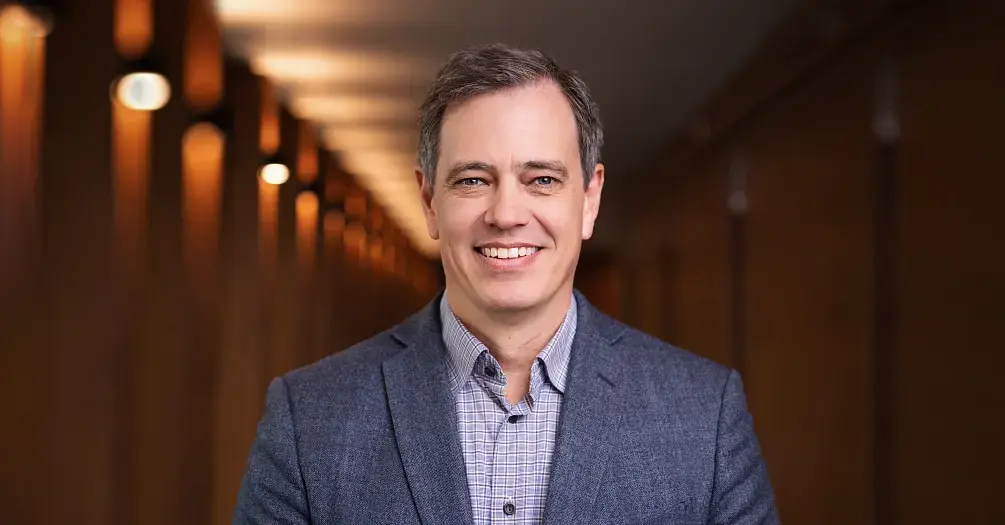
That is the kind of work Dr. Charles B. Holmes, MPH ’95, has spent his career doing.
As the next dean of the University of Michigan School of Public Health, Holmes brings decades of experience working at the intersection of infectious disease, health policy, implementation science and global partnerships. His career has included leadership roles with the US President’s Emergency Plan for AIDS Relief (PEPFAR), World Health Organization, Johns Hopkins University, Georgetown University, and major public health initiatives in Malawi, Zambia and other countries.
His five-year appointment was approved by the University of Michigan Board of Regents on June 25. Holmes previously served as director of the Georgetown University Center for Innovation in Global Health, professor of Medicine at Georgetown University Medical Center, and distinguished scholar and program director at the O’Neill Institute for National and Global Health Law.
“Dr. Holmes is a true global public health leader, and his career demonstrates that he lives out the school's mission of pursuing a healthier world for all," said Nicole Rubin, MHSA '95, a member of the School of Public Health Dean Search Advisory Committee. “I share Provost Laurie McCauley's and the Board of Regents’ confidence that he will usher in a new era of leadership. I look forward to seeing how he positively impacts our students—the next generation of public health leaders—and how he uplifts our world-class faculty and staff.”
Sir Peter Piot, MD, PhD, professor of global health and director emeritus of the London School of Hygiene and Tropical Medicine, said Holmes’ appointment brings one of global health’s most respected leaders to the University of Michigan.
“Charles Holmes has become one of the world’s most respected global health leaders, and the School of Public Health is lucky to benefit from his vast experience, policy insights, scientific credibility and global and domestic networks,” Piot said.
Holmes said he is stepping into the role at a time when public health is more important than ever but also facing serious challenges.
“What really excites me about stepping into the dean role is this opportunity to help shape the School of Public Health’s ability to build on its extraordinary strengths,” he said. “Public health has never been more important for communities around the world, but it’s also never really faced such critical challenges.”
Charles Holmes has become one of the world’s most respected global health leaders, and the School of Public Health is lucky to benefit from his vast experience, policy insights, scientific credibility and global and domestic networks.”
— Sir Peter Piot, MD, PhD, professor of global health and director emeritus of the London School of Hygiene and Tropical Medicine
Ambassador John Nkengasong, former US global AIDS coordinator for PEPFAR and senior bureau official for the Bureau of Global Health Security and Diplomacy at the US State Department, is executive director for Higher Education and Collaborative at Mastercard Foundation. He said Holmes is well suited to lead at this moment.
“It is truly inspiring to see Dr. Charles Holmes appointed as dean of the University of Michigan School of Public Health,” Nkengasong said. “Charles brings a rare combination of scientific rigor, deep commitment to health equity, and on-the-ground experience working with governments and communities to strengthen health systems.”
Nkengasong said Holmes’ leadership is especially important as public health professionals face increasingly connected global challenges.
“At a time when the world faces converging threats from pandemics, noncommunicable diseases and climate change, his leadership will help shape a new generation of public health professionals who are not only technically excellent, but also deeply attuned to partnership, inclusion and impact,” he said.
For Holmes, the work ahead is both local and global. He points to the school’s work with communities affected by the Flint water crisis, partnerships with farmers and agricultural communities across Michigan, research on environmental toxins such as PFAS, cancer prevention, and preparation for future infectious disease threats.
He also sees Michigan Public Health as a place that can connect scientific excellence with real-world action.
“I really think that the University of Michigan is poised to lead in public health because of its remarkable history and culture of collaboration,” Holmes said.
Collaboration as a leadership philosophy
That word—collaboration—comes up often when Holmes talks about public health. It also comes up often when colleagues describe him.
Michele Goodwin, the Linda D. and Timothy J. O’Neill Professor of Constitutional Law and Global Health Policy and faculty director of the O’Neill Institute for National and Global Health Law at Georgetown University, called Holmes “a pioneer and thought leader with the exceptional talent to draw the brightest minds around him and lift them up.”
Goodwin said Holmes’ public health leadership is built around “intellectual excellence, rigorous research, and the care for others.” What stands out most, she said, is his emotional intelligence and his clear sense of values.
“From this vantage point, he builds toward collaboration and the execution of ideas,” Goodwin said.
That approach has shaped much of Holmes’ work, especially in global health. He said effective public health partnerships require humility because no single person, institution or organization has every answer.
“I’ve learned time and time again that the best outcomes really do happen when you bring people together with different perspectives and expertise,” Holmes said.
Building systems that last
During his time with PEPFAR, Holmes saw how complex that kind of work can be. Different agencies brought different strengths. Some focused on biomedical tools, such as drugs, tests and laboratory systems. Others focused on long-term development, sustainability and health systems.
Those views could clash, Holmes said, but the best work happened when people stayed focused on the shared mission.
He remembers a saying from PEPFAR: The work went best when each US government agency left “their uniform at the door.”
“The development side brought long-term sustainability as a goal,” Holmes said. “The biomedical side brought, ‘Let’s get the best science into this great HIV program.’”
Together, those perspectives helped strengthen global HIV efforts.
Julia Mackenzie saw Holmes’ leadership up close when she reported to him at PEPFAR. At the time, Holmes was PEPFAR’s chief medical officer, and Mackenzie was in her first policy position after earning her PhD.
She described herself as being on “a steep learning curve” while Holmes was carrying an intensely demanding job. Even so, she said, he made time to mentor her and others.
Dr. Holmes is a true global public health leader, and his career demonstrates that he lives out the school's mission of pursuing a healthier world for all. I share Provost Laurie McCauley's and the Board of Regents’ confidence that he will usher in a new era of leadership. I look forward to seeing how he positively impacts our students—the next generation of public health leaders—and how he uplifts our world-class faculty and staff.”
— Nicole Rubin, MHSA '95, member of the School of Public Health Dean Search Advisory Committee
“As a leader, he was clear about what he wanted, invited feedback and different ideas, and genuinely lit up at good ideas—regardless of who they came from,” said Mackenzie, now chief program officer at the American Association for the Advancement of Science (AAAS).
She said Holmes’ appointment reflects a rare mix of strengths: “the ability to lead large, complex programs, genuinely cultivate the growth of others, and keep every effort aligned with a singular purpose—a healthier world for all.”
That combination of mentorship, systems thinking and long-term focus also influenced Holmes’ work in Zambia, where he led the Centre for Infectious Disease Research in Zambia (CIDRZ).
Dr. Izukanji Sikazwe, who joined CIDRZ in 2013 as Holmes’ deputy and later became CEO of the organization, said Holmes arrived at a defining moment. At the time, CIDRZ was transitioning from a field office of a US-based institution into a majority locally governed, Zambian-led organization.
“Charles’ leadership at CIDRZ was grounded in a vision to build an enduring institution that would serve as a permanent resource to Zambia and its people for its public health priorities,” said Sikazwe, now head of HIV at the Global Fund.
She said Holmes helped guide CIDRZ through a challenging transition by strengthening the policies, systems, leadership and resources needed for long-term sustainability. That shift, she said, improved the organization’s ability to support Zambia’s national health agenda with credibility, local ownership and scientific rigor.
For Sikazwe, Holmes was also an important mentor in people management and implementation science. Working as his deputy on CDC-funded HIV program implementation in high-burden settings, she said she learned how to align teams around a clear purpose, create space for local leadership to grow, and use evidence from implementation to improve outcomes for people living with HIV.
“His leadership helped shape CIDRZ as an institution that continues to thrive more than 10 years after his departure,” Sikazwe said. “He also shaped many of us as leaders committed to translating science into better health for communities.”
That purpose has guided Holmes’ work in Malawi, where he has partnered with government leaders, civil society and communities on HIV prevention.
Beatrice Matanje, CEO of the National AIDS Commission in Malawi, said Holmes’ appointment is “a true reflection of the incredible global health leadership that Charles Holmes has demonstrated over the years.”
Matanje said Malawi has benefited greatly from partnering with Holmes in HIV prevention. Together with the Ministry of Health and the National AIDS Commission, he helped co-design the Blantyre Prevention Strategy, a data-driven, locally led HIV prevention model developed to address a complex HIV epidemic in Blantyre City and District.
Holmes has also contributed to Malawi’s readiness to roll out innovative HIV prevention tools, including injectable pre-exposure prophylaxis, or PrEP, through the Path to Scale implementation science initiative.
“He is such a great, yet humble, leader and mentor to many of us,” Matanje said.
Holmes said the work in Malawi shows why public health decisions need to include the people most affected by them.
In recent years, he has worked with partners there to think through how to introduce long-acting HIV prevention methods. Some injectable options are given every two months. Newer ones may be given every six months. But introducing those tools raises practical and ethical questions.
Should they be offered through HIV clinics or primary care settings? How can health systems best reach women? How can they reach people at higher risk for HIV who may not want to come to a clinic because of stigma or fear?
Those questions cannot be answered by researchers alone, Holmes said. They require government officials, health workers, community representatives, people living with HIV, and people at high risk for HIV to be part of the discussion.
“When you have the right people around the table,” Holmes said, “you have the ability to make better decisions about the best approaches.”
Expanding access through partnership
That same focus on access and partnership has shaped Holmes’ advisory work with the Gates Medical Research Institute, a nonprofit medical research organization leading the development of the tuberculosis vaccine candidate M72/AS01E, which is currently in a Phase 3 clinical trial.
Krishnan Ramanathan, interim CEO of Gates MRI, said Holmes has advised the organization since 2023 on global access strategy for the vaccine candidate. That work has included helping Gates MRI engage with the WHO working groups; Gavi, the Vaccine Alliance; and ministries of health.
Those partnerships are important, Ramanathan said, because the success of a potential new TB vaccine would depend not only on science, but also on planning, demand, politics, delivery systems and trust.
“Our goal is to ensure that people living in TB-endemic communities will benefit from this potential innovation if results show it to be efficacious and it is approved for use,” Ramanathan said.
He said Holmes’ background in health systems strengthening in Africa helped Gates MRI think differently about how to prepare for a possible vaccine rollout.
“Working with Charles and drawing on his prior experiences has been seminal to the planning activities for MRI,” Ramanathan said.
Holmes’ own path into public health began well before his global leadership roles.
His mother earned her Master of Public Health from the University of Michigan and traveled across rural parts of the state training primary care doctors and nurses on the early diagnosis of dementia. Watching her work helped Holmes understand that health is improved not only inside hospitals, but also through education, prevention and community-based care.
That lesson deepened when Holmes was an undergraduate at Kalamazoo College and traveled to Nicaragua with nurses leading vaccination campaigns in rural communities. In one village, the group was asked to check on an elderly man who was gravely ill in a hut on the edge of town. The nurses quickly moved from vaccinating children to providing urgent care.
Looking back, Holmes said that moment helped him see the full range of public health: prevention, vaccination, community engagement, acute care and population health.
“That ended up being really pretty deeply embedded in me,” he said.
Holmes later earned his Master of Public Health from Michigan Public Health. He said the faculty he encountered at Michigan were deeply invested in students.
One faculty member, Peter Fajans, assistant professor of International Health (now Global Public Health), made a lasting impact by teaching Holmes how to write policy briefs. Holmes remembers turning in his first attempt and getting it back covered in red ink. The point was not just to correct the paper; it was to teach Holmes how to communicate with policymakers.
Policymakers, he learned, do not need the same details as classmates or researchers. They need to understand why an issue matters, how it affects the people they serve and what decisions are in front of them.
That lesson followed Holmes to the WHO, where he worked in the tuberculosis program, and later into roles where he wrote policy briefs for the White House, PEPFAR and the government of Zambia.
If we’re doing our job well, we’re not just preparing students for a job on day one. We’re preparing them to be the next generation of leaders within public health.”
— Charles B. Holmes, dean of Michigan Public Health
Preparing the next generation
As dean, Holmes said preparing students for a changing public health world will be one of his top responsibilities.
Students still need strong foundations in epidemiology, statistics, environmental health, policy, implementation science, health behavior and health education, he said. Most of all, they need critical thinking.
But today’s public health students also need to work across disciplines, communicate with many audiences, build trust with communities and use tools such as artificial intelligence and data science.
“If we’re doing our job well, we’re not just preparing students for a job on day one,” Holmes said. “We’re preparing them to be the next generation of leaders within public health.”
Holmes said he is inspired by students’ curiosity, energy and desire to make a difference. He is also inspired by communities, especially people directly affected by health issues.
In global HIV work, he said, people living with HIV have taught him to listen more carefully and to shift his thinking based on their lived experiences. He pointed to global HIV advocate Florence Anam, who often reminds public health leaders that stigma can shape whether people seek care.
“I always walk away from those meetings inspired, because I’ve learned something, and I’ve been challenged,” Holmes said.
That sense of listening, learning and building together will inform his leadership at Michigan Public Health.
For Holmes, the future of public health depends on rigorous science, but also on trust, humility and partnership: “It’s a continuous process of learning and incorporating those learnings into a more effective public health response over time.”