On the Heights: May 2026
Stay informed with the latest from the University of Michigan School of Public Health community in our monthly digest. Faculty expertise in action, new research, policy advocacy, and community engagement highlight our continued commitment to advancing public health and creating positive change.
Regents' meeting
Regents approve faculty promotions across Michigan Public Health
The University of Michigan Board of Regents approved several Michigan Public Health faculty for promotion at its May 21 meeting. Kate Bauer and Jennifer Smith were elevated to full professor with tenure, joining Justin Colacino and April Zeoli in that rank. Jennifer Garner, Elisa Maffioli, and Thuy Nguyen were promoted to associate professor with tenure.
Three faculty receive named professorships
Scott Greer has been named the Richard Carl Jelinek Professor of Health Services Management and Policy, effective May 1, 2026, through August 2031. Michael Shepherd and Laurie Svoboda each received John G. Searle Assistant Professorships in their respective departments, both effective September 1, 2026.
Six faculty retire after decades of contributions to public health
Michigan Public Health marks the retirements of six faculty members this spring: Michael Boehnke, Richard G. Cornell Distinguished University Professor of Biostatistics; Betsy Foxman, Hunein F. and Hilda Maassab Endowed Professor of Epidemiology; Susan Dorr Goold, professor of Health Management and Policy and Internal Medicine; Paula Lantz, James B. Hudak Professor of Health Policy; Jeremy M.G. Taylor, Pharmacia Research Professor of Biostatistics; and Zhenhua Yang, associate professor of Epidemiology.
Research & funding
$8.25M NIH award supports faculty research on metals, neurotoxins, and dementia risk
Epidemiologist Kelly Bakulski has received an $8.25 million award from the National Institutes of Health to examine how a lifetime of exposure to lead, cadmium, and other neurotoxic metals shapes who develops Alzheimer's disease and related dementias. Working with collaborators through the University of Michigan-led Health and Retirement Study—one of the largest and longest-running studies of aging in the United States—Bakulski's team will link participants' exposure histories to their cognitive outcomes over time.
The research builds on recent findings that cumulative lead exposure alone may be tied to roughly 90,000 new US dementia cases each year. As the population ages and dementia rates rise, understanding modifiable environmental contributors is increasingly urgent, and this work positions Michigan Public Health at the center of that effort.
Apple Hearing Study examines real-world impact of consumer hearing tools
New analysis from the Apple Hearing Study—a research collaboration between Michigan Public Health and Apple—examines the public health value of two features Apple introduced in 2024: a Hearing Test and a Hearing Aid function, both built into AirPods Pro. The analysis looks at whether tools that put hearing data directly in people's hands can improve how hearing health is understood and managed, particularly among the millions of people whose test results fall in the "normal" range but who still experience meaningful day-to-day difficulty.
Pete Larson publishes two new studies on drowning and air pollution
Environmental epidemiologist Pete Larson published two new studies this spring. In Environmental Research, Larson and colleagues analyzed more than 4,000 firearm discharge incidents in Detroit from 2021 to 2025, finding that warmer temperatures—particularly warmer nights—were associated with increased odds of incidents, while heavy rainfall was linked to short-term reductions in risk. The findings point to weather-sensitive opportunity structures, such as increased outdoor social activity on warm evenings, as meaningful contextual factors in urban gun violence. A separate study in Injury Prevention examined the epidemiology of drowning deaths in Michigan using municipal records—one of the most comprehensive looks yet at drowning mortality in the Great Lakes region, an area that has historically received limited research attention.
Anand Parekh co-authors JAMA viewpoint on the obesity epidemic at a crossroads
Chief Health Policy Officer Anand Parekh co-authored a viewpoint in JAMA examining the US obesity epidemic at what may be an inflection point. New data from Gallup and the CDC show the adult obesity rate declining for the first time in decades, but Parekh and his co-authors caution against reading too much into early numbers. The piece identifies three areas where policymakers must act carefully:
- Reducing weight stigma even as GLP-1 treatments reshape public perception of obesity
- Ensuring equitable access to those treatments across race, income, and geography
- Addressing food access at a moment when proposed SNAP cuts could erase hard-won progress
Expert contributions
Anand Parekh on NewsNation on US pandemic preparedness and the hantavirus response
Chief Health Policy Officer Anand Parekh appeared on NewsNation to discuss the US response to the hantavirus outbreak aboard the MV Hondius cruise ship and what it reveals about the country's readiness for infectious disease emergencies.
Researchers explain the science and politics of flavored vapes
Health policy researchers Holly Jarman and Claire Ma contributed to a piece in The Conversation explaining the science and regulatory history behind flavored vaping products, and what the recent shakeup at the FDA means for how those products are—and aren't—being regulated.
Community impact & awards
Devon Payne-Sturges travels Michigan with the U-M Road Scholars program
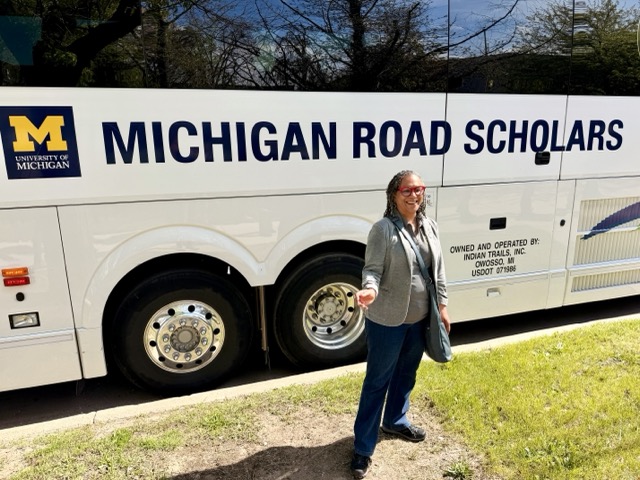
Professor of Environmental Health Sciences Devon Payne-Sturges recently participated in the Michigan Road Scholar Tour, an annual five-day traveling seminar funded by the U-M Office of the Provost that takes faculty across the state to learn firsthand about Michigan's economy, government, culture, health and social issues, and communities. Designed to strengthen ties between the university and the people it serves, the program introduces faculty to the places most U-M students call home and surfaces ways research and scholarship can address real state needs.
The tour spanned more than a dozen stops across the Lower and Upper Peninsulas. In Detroit, Payne-Sturges visited Focus: HOPE, a nonprofit fighting poverty through food access, early childhood education, and workforce development that serves tens of thousands of seniors across 18 counties. In the Upper Peninsula, a conversation with the owner of Massey Fish Co. offered a firsthand view of Great Lakes ecosystem health through the lens of a multigenerational fishing business. At North Ed Career Tech Center in Traverse City, the group toured programs in engineering, graphic arts, and aviation maintenance—a window into the growing demand for trades education across the state. A meeting with Tribal Council members of the Grand Traverse Band of Ottawa and Chippewa Indians surfaced research and program evaluation needs in housing, youth outreach, grant capacity, and community development that Payne-Sturges hopes can become the foundation for future partnerships with Michigan Public Health. In Lansing, the group learned about the Michigan Department of Education's Indigenous Education Initiative and their "Step Into Our Stories" curriculum—12 years in the making, developed with elders, youth, educators, and artists from tribal nations across Michigan—a reminder, as Payne-Sturges noted, that the Anishinaabek are here, still living and working and sharing land with the state.
"I hope to find ways for the School of Public Health to follow up and create partnerships with the tribal council," she wrote. "Michigan Road Scholars are really becoming a close group."
Jian Kang named Fellow of the Institute of Mathematical Statistics
Jian Kang, professor of Biostatistics, has been named a Fellow of the Institute of Mathematical Statistics. Kang was recognized for influential contributions to Bayesian methods, statistical machine learning, and imaging data analysis, as well as outstanding leadership, mentorship, and service to the statistical community. The IMS fellowship is among the field's most prestigious honors—only about 10% of the organization's 5,300 members worldwide hold the distinction.