Global Public Health leader: Connection is our greatest protection
Dr. Raj Panjabi, author of ‘Safer,’ discusses trust, resilience and leading through crisis at Global Public Health Futures event
By Bob Cunningham
In February 2020, Dr. Raj Panjabi was eating hash browns in an English castle when a colleague turned to him with a warning.
David Nabarro, a veteran World Health Organization envoy who had worked alongside Panjabi during the Ebola outbreak in West Africa, said he was worried about a new virus spreading overseas. At the time, it was still being called the “novel coronavirus.”
Panjabi kept eating his hash browns.
“I thought nothing of it,” he recalled, “despite having been in the Ebola outbreak with him.”
More than six years later, Panjabi shared that moment with an audience at the University of Michigan School of Public Health as an example of what psychologists call normalcy bias—the human tendency to assume that tomorrow will look like today, even when the evidence says otherwise.
It was one of several personal stories Panjabi, a physician and author of the new book “Safer” (HarperOne, 2026) used October 15 during the first Global Public Health Futures event to illustrate how individuals and communities can prepare for—and lead through—moments of crisis.
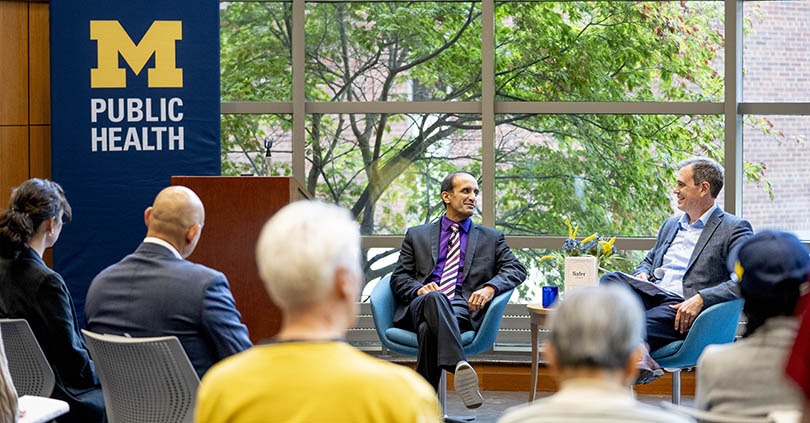
The event, “Safer: Turning Fear into Action and Crisis into Community,” featured Panjabi in a fireside chat with Dr. Charles B. Holmes, dean of Michigan Public Health, in the Paul B. Cornely Community Room.
“I couldn’t imagine a better person to be our inaugural speaker," Holmes said. “Raj brings together so much new thinking, new ways of seeing and thinking about the world. That is really at the heart of the academic enterprise.”
Panjabi, who fled civil war in Liberia as a child refugee, went on to found the nonprofit Last Mile Health and later served as a White House advisor on pandemic threats during the Biden administration. He said one of his earliest lessons on building trust came from his own life, when his family rallied around him after his daughter became critically ill as an infant.
“Safety doesn’t come from certainty,” Panjabi said. “It comes from community. Our greatest protection is not isolation. It’s connection.”
Safety doesn’t come from certainty. It comes from community. Our greatest protection is not isolation. It’s connection.”
— Dr. Raj Panjabi
Panjabi pointed to community health workers in rural Alaska as another example. In the 1950s, those workers helped bring a severe tuberculosis outbreak under control, and decades later, that same trusted network helped Alaska achieve one of the highest early COVID-19 vaccination rates in the country, even as national vaccine supply remained limited.
“The power of authority is actually weaker than the power of community,” he said. “As important as public health authority or medical authority is, when you combine the two some amazing things can happen.”
That idea runs throughout “Safer,” published on October 13, which argues that trust and relationships—not just science and technology—are what carry people through emergencies such as pandemics, disease outbreaks and other public health crises.
Panjabi shared several practical tools from the book, including “trigger-action pairing,” a method borrowed from epidemiology that helps people set clear thresholds for action, so they don’t overreact or underreact to slow-moving threats. He also reflected candidly on lessons from the COVID-19 pandemic, including shifting guidance on masks, and argued that false certainty in public health communication can do more harm than acknowledging what isn’t yet known.
“Certainty is a hoax,” he said.
Panjabi also described a program in Liberia where mothers were avoiding hospital deliveries because traditional midwives, who had long been paid two chickens for each home birth, stood to lose income and respect if mothers went elsewhere. Once his organization began paying midwives directly and included them as partners in care, hospital deliveries rose from about 4 in 10 to nearly 9 in 10.
“Don’t ask a blame-oriented question,” Panjabi said. “Ask a barrier-oriented one.”
Audience members asked Panjabi about building trust in minority communities, countering misinformation, and the role of wearable health technology. He encouraged University of Michigan students in the room to pursue careers in public health, even amid recent cuts to federal pandemic preparedness programs.
“No condition is permanent,” Panjabi said, citing a lesson from his father. “We can’t always control the conditions we face, but we can control how we respond.”
Lindsay Kobayashi, associate professor of Epidemiology and Global Public Health, closed the event by connecting Panjabi’s message to Michigan Public Health’s mission, posing a question Holmes had raised with faculty: What does the world need now from a great school of public health?
The first 75 attendees received a free copy of “Safer.” Introducing the event, Dr. Akbar Waljee, director of the University of Michigan Center for Global Health Equity, said he hoped the conversation would be the first in an ongoing series exploring major challenges in the future of global health. The evening closed with a reception where Panjabi signed books and spoke with attendees.
Media Contact
Destiny Cook
PR and Communications ManagerUniversity of Michigan School of Public Health734-647-8650