University of Michigan launches program to prepare master’s students for HIV research careers
NIH-funded Advancing Research Careers in HIV (ARCH) program pairs students from public health, nursing and social work with mentors and community partners
The University of Michigan School of Public Health recently launched a two-year program to prepare master’s students for doctoral study and careers in HIV social and behavioral science research, supported by a five-year grant from the National Institute of Mental Health (NIMH), part of the National Institutes of Health (NIH).
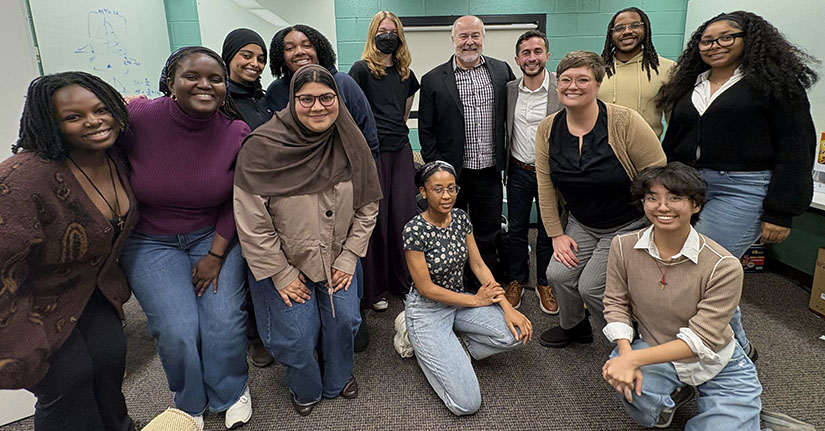
The program, called Advancing Research Careers in HIV (ARCH), brings together students from three University of Michigan schools. The NIH notified Michigan Public Health of the award on Aug. 21. Nine students are in the first cohort.
Program Director Gary Harper, professor of Health Behavior and Health Equity, said ARCH is the only program of its kind in the country. The team wrote the grant in summer 2025 and had planned to start this past March.
“We were on pins and needles because we got scored—and it was a really great score—but then they kept saying, ‘We’re not sure if we’re going to have the money, we’re not sure.’ And then, bam! A week before classes started, I got the call,” Harper said.
With so little notice, the team had only weeks to build the program.
Who ARCH serves
ARCH is open to students in terminal master’s programs at the School of Public Health, School of Nursing and School of Social Work. Eight of the nine inaugural scholars are in public health and the other is in social work.
Harper said these schools were chosen because their programs focus on practice. Students often want to work in communities and address social and structural problems. ARCH introduces them to HIV research and shows them they can pursue a PhD.
“We want people that are coming from different disciplinary backgrounds to bring them together,” Harper said.
ARCH follows a program called SOAR, or Student Opportunities for AIDS Research, which Harper co-directed with Anna Kirkland, the Kim Lane Scheppele Collegiate Professor of Women’s and Gender Studies in the College of Language, Science, and the Arts. SOAR served undergraduates and ended last May after four cohorts. Harper said every SOAR participant got into a graduate program.
“I have not heard of many programs that have such a success rate,” he said.
Having the opportunity to see how team science works in large network studies helps scholars appreciate that making progress in HIV prevention and treatment requires interdisciplinary thinking, planning and implementation.”
— K. Rivet Amico
‘High-impact educational practices’
Harper said ARCH uses what he calls “high-impact educational practices.” One is cohort-based learning, in which students move through the program together. When a second cohort joins, the two groups will learn from each other.
Another practice is a “mentoring ecosystem.” In the first year, each scholar does a paid research experience with a University of Michigan faculty member from one of the three schools. They work with other program faculty and can reach out to a network of about 50 researchers across the country, including some of the nation’s top HIV researchers.
ARCH connects students to HIV research networks funded by the NIH. These networks focus on topics such as adolescents, mothers and infants and prevention trials. Associate Director K. Rivet Amico, a professor of Health Behavior and Health Equity, leads that effort and has worked in several of the networks.
“Having the opportunity to see how team science works in large network studies helps scholars appreciate that making progress in HIV prevention and treatment requires interdisciplinary thinking, planning and implementation,” Amico said.
Scholars work with community partners, including health departments and organizations such as Corner Health Center, as well as groups in Ypsilanti and Flint that provide HIV services.
Scholars take two HIV-focused courses for credit and get coaching on PhD applications. Each can receive up to $500 to attend a local conference and up to $200 to join professional associations. The program also pays for summer research.
ARCH’s reach extends beyond Michigan. Several scholars are originally from Sub-Saharan Africa, and many in the first cohort are interested in working in the region. Some are already discussing summer internships abroad, and Harper said they are looking into funding opportunities such as those through the Office of Public Health Practice and Global Engagement.
“The students we have in the program and the mentors we have cut across global and local,” Harper said. “I think it can also be a draw for people who address the global HIV pandemic.”
Turning science into practice
Harper said ARCH stands out for its focus on putting research to work.
“A lot of the other programs that are out there are really just about training you to do research,” he said. “Even if they’re talking about implementation, they’re still talking about it in a more theoretical way. We’re going to be doing it in a very practical manner.”
In the second course, which Harper will teach, students will partner with a community organization to “turn data into practice.” For example, an agency might need new materials about injectable PrEP, a newer HIV prevention option. Students would help turn the best available science into health promotion materials. The team is also planning work with the Detroit Health Department’s HIV/STI Program.
HIV prevention and treatment options have improved a great deal, Harper said. But if people in the communities with the greatest need cannot get these options or do not know about them, the science has done little good.
“Then, we’re just sitting here as academics, patting ourselves on the back for creating these,” he said.
If you want to really do social behavioral science, HIV research with an implementation and dissemination focus, and a very much community-centered, participatory, collaborative focus, then we’re your school. And I don’t think anyone else can say that.”
— Gary Harper
A personal mission
Harper has worked in HIV since 1985. He began as an activist and is an openly gay man who watched his community suffer in the early years of the epidemic. He later trained as a clinical psychologist and worked with families of children with HIV. He has also done policy work, including on Capitol Hill.
That background shapes what Harper wants for ARCH scholars. He wants them to understand the human side of the work, not only the data.
“I want to make sure our scholars see every face behind every number,” Harper said.
He pointed to recent cuts to global health funding, including the dissolving of the US Agency for International Development (USAID) and reductions to the President’s Emergency Plan for AIDS Relief (PEPFAR). In many places, he said, people have lost access to testing, prevention and care.
“We need people who are really going to be in this to actually make an impact,” he said, “not just to get another publication or grant proposal funded.”
Harper said mentoring is a big part of who he is.
“At some point, I’d like to retire,” he said, “and so we need the next wave to come in.”
A team effort
Harper said ARCH is not a one-person project.
The leadership team includes associate directors Amico and Leah C. Neubauer, a clinical professor of Health Behavior and Health Equity; Managing Director Laura Jadwin-Cakmak, a research director in the Department of Health Behavior and Health Equity; and Peter Slutzker, a research area specialist. Neubauer has worked with Harper for two decades developing academic training programs with universities and global partners, with a particular focus on cohort learning.
Jadwin-Cakmak meets with scholars throughout each semester to help them build individual career development plans. Slutzker assists with training and course prep. Graduate students Darius Moore and Jalen Smith provide support. Moore, a doctoral student, hosts “Dinners with Darius,” where scholars share a meal and learn from his experience. Smith sends the weekly ARCH roundup of opportunities.
Kristi Gamarel, associate professor of Health Behavior and Health Equity, serves as the Michigan Public Health advisor on the executive committee, and several Michigan Public Health faculty members have agreed to serve as research mentors.
“I really want this to be our team’s program,” Harper said.
Harper hopes ARCH will attract students who want to do this kind of work.
“If you want to really do social behavioral science, HIV research with an implementation and dissemination focus, and a very much community-centered, participatory, collaborative focus, then we’re your school,” Harper said. “And I don’t think anyone else can say that.”
Written by Bob Cunningham
Media Contact
Destiny Cook
PR and Communications ManagerUniversity of Michigan School of Public Health734-647-8650