Panel of national public health leaders traces 250 years of American history—and asks what comes next?
By Bob Cunningham
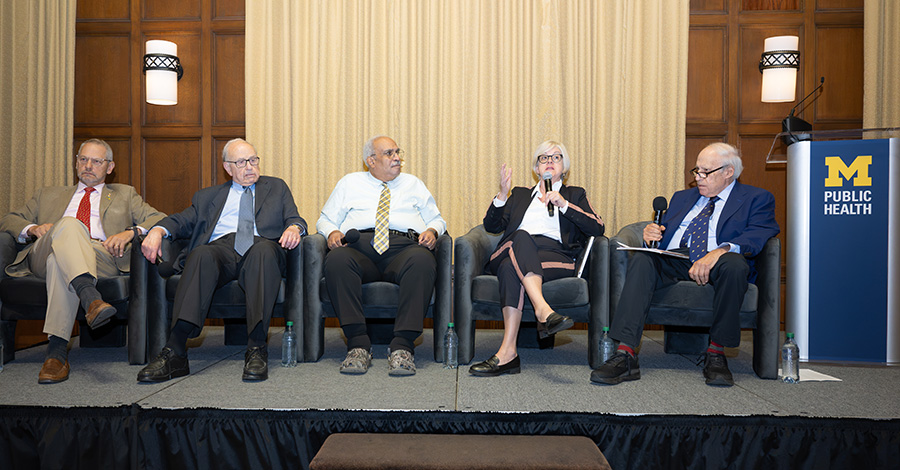
As part of Democracy Week at the University of Michigan, the School of Public Health welcomed four of the nation’s most respected public health leaders on September 15 for a wide-ranging conversation about the role public health has played—and continues to play—in American life.
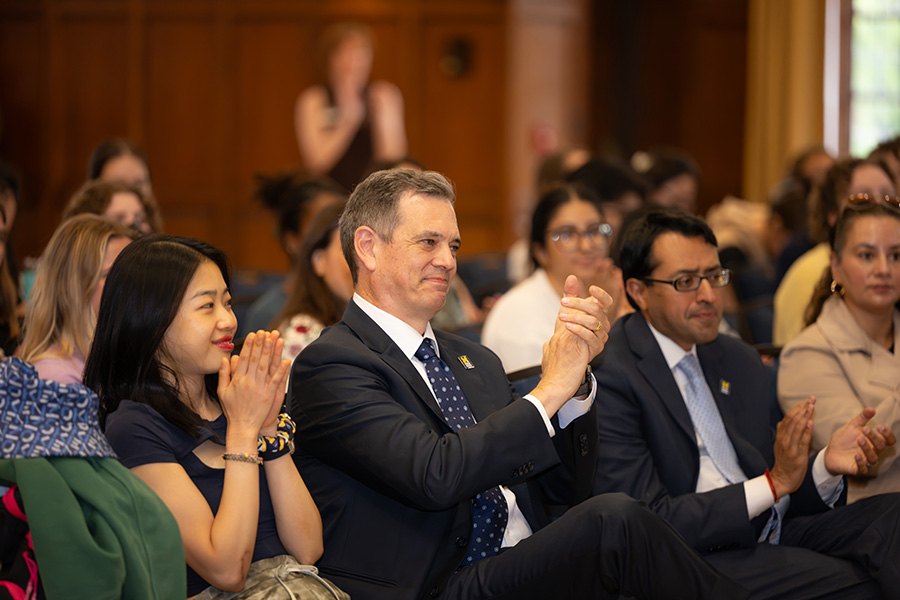
The event “America at 250: How Public Health Has Shaped the Course of Our Nation’s History” brought together more than 200 people to the Michigan League, with over 200 watching the livestream. The panel and participants considered more than two centuries of progress, and asked hard questions about what happens next.
Democracy Week, sponsored by the University of Michigan Center for Democracy and Civic Empowerment, celebrates civic participation and informed dialogue across campus. For the School of Public Health, the moment carries extra weight: This year marks both the nation’s 250th anniversary and the school’s 85th.
In opening remarks, Charles B. Holmes, dean of Michigan Public Health, traced that history from Victor Vaughan’s work on sanitation in 1881 at the University of Michigan Medical School to Paul Cornely, who was denied a medical residency at the University of Michigan because of his race, only to return to become the first Black American to earn a doctorate in public health.
Holmes also recalled Pearl Kendrick and Grace Eldering, two Michigan school teachers who developed the whooping cough vaccine, and Thomas Francis Jr., the founder of the school’s Department of Epidemiology, who stood in Ann Arbor in 1955 and told the world that the polio vaccine was “safe, effective and potent.”
“Public health begins with evidence, but it doesn’t end there,” Holmes said. “At its best, it turns evidence into action, institutions, policy and, ultimately, healthier lives.”
That history set the stage for a panel moderated by Dan Glickman, a former US Secretary of Agriculture and University of Michigan alumnus, who posed one guiding question to the group: What does the health of the public require of us now?
Public health begins with evidence, but it doesn’t end there. At its best, it turns evidence into action, institutions, policy and, ultimately, healthier lives.”
— Charles B. Holmes, dean of Michigan Public Health
A life spent studying how disease moves through communities
For Dr. Arnold Monto, the Thomas Francis Collegiate Professor Emeritus of Public Health at Michigan Public Health, that question has driven a career spanning more than five decades.
Monto’s path into public health started almost by accident. As a young infectious disease fellow at Stanford University, he learned about an National Institutes of Health research lab in the Panama Canal Zone studying newly discovered respiratory viruses. The work meant living among Panamanian communities and tracking how viruses spread among people—not just in a hospital, but in daily life.
That population-based approach caught the attention of Francis, who recruited Monto to Michigan to study respiratory infections as part of the landmark Tecumseh Study. Monto recalled arriving at the old School of Public Health building to a lab containing little more than a large bottle of distilled water, and government funding eager to be spent.
One of his earliest projects became one of public health’s most cited experiments. During the 1968 flu pandemic, Francis had a theory: If you vaccinate school-age children, you might slow the spread of disease through an entire community—even though almost no one used the phrase “herd immunity” yet. Monto drove to Eli Lilly and Co. in Indianapolis to bring the vaccine back to Ann Arbor in a cooler. The study vaccinated roughly 90% of grade-schoolers and became one of the first real-world demonstrations that herd immunity works.
Decades later, Monto pointed to that same community trust—built through the polio vaccine story that unfolded in Ann Arbor—as a model for how public health earns credibility.
“We had the tools, we had the vaccines, and we convinced the population that the vaccine was one of the most effective tools of public health,” Monto said. “It was a joint effort. People did not question vaccines.”
Monto, however, noted that public confidence eroded during COVID-19, in part because officials didn’t always explain why guidance changed, such as the shift from emphasizing handwashing to recommending masks.
“People were accused of changing their minds,” he said, “but this shows that not only do you have to have a population that understands, but you also need leaders who communicate clearly.”
Looking ahead, Monto struck a note of realism, cautioning that progress in public health can't be rushed.
“It takes years to build the American healthcare system and its research base. It takes a lot of effort to bring it back, and it’s not going to happen quickly,” he said, calling for renewed investment in the partnership between public health and medicine—two fields that, unlike in most countries, operate largely apart in the United States.
Rebuilding trust, one conversation at a time
Dr. Boris Lushniak, dean of the University of Maryland School of Public Health and a former US Deputy Surgeon General, framed trust as public health’s central challenge. Drawing on the World Health Organization’s definition of health as “complete physical, mental and social well-being,” Lushniak argued that America’s medical system focuses too heavily on treating sickness rather than preventing it.
He proposed a bold fix: extending medical school to five years, with one year devoted entirely to a mandatory public health degree.
“We’re a profession of love,” Lushniak said. “We love our neighbor. We love our community. And I think we have to get back into feeling love for others.”
Dr. Georges Benjamin, CEO of the American Public Health Association, pushed the group to think about accountability. He reminded the audience that three physicians signed the Declaration of Independence and argued that improving health is, at its core, an ethical obligation. Benjamin also warned that new technology—including artificial intelligence—poses fresh risks to public trust, even as it offers new tools.
“Science itself is not the goal,” Benjamin said. “Science is the quest for truth.”
Historian Marian Moser Jones, an associate professor at Ohio State University, offered a historical lens. A former health journalist who witnessed the attacks on 9/11 firsthand, Jones compared today’s economic inequality to the Gilded Age of the late 1800s—an era of enormous wealth alongside devastating public health crises in American cities.
She said the last Gilded Age ended in part because a new generation of educated Americans stepped into public service and were unafraid to be political about funding health programs.
“Public health is purchasable,” Jones said, quoting public health pioneer Herman Biggs. “Within the natural limits, a community can determine its own death rate.”
Much of the conversation turned toward the students in the room. Lushniak urged them to see public health as active, not passive.
“It is not a spectator profession,” he said.
Benjamin encouraged optimism, telling students they were now responsible for writing “the list of the 10 major accomplishments of public health in the 21st century.”
Closing the event, Glickman reflected on the stakes of that responsibility.
“If you save one life, you save the entire world,” he said. “You could be saving the entire world every single day.”
Media Contact
Destiny Cook
PR and Communications ManagerUniversity of Michigan School of Public Health734-647-8650