National biodefense leaders call for coordination and stable public health support
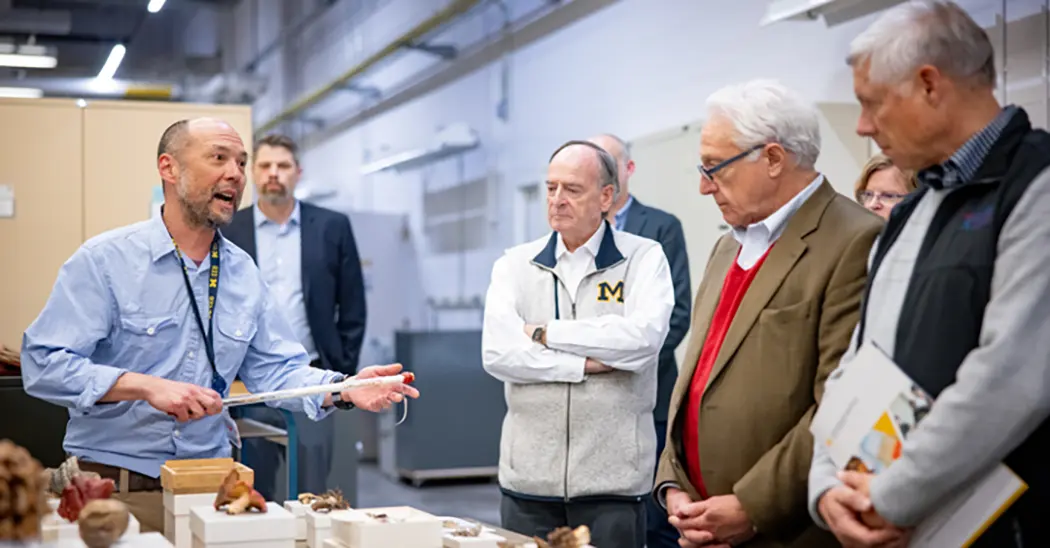
ANN ARBOR—As concerns grow about new disease outbreaks and the misuse of biotechnology, the University of Michigan welcomed a bipartisan group of former federal leaders and experts on April 10 for a day of discussions on how the nation can better prepare for biological threats.
The Bipartisan Commission on Biodefense at Atlantic Council met on campus to talk about everything from pandemic readiness and public health communication to protecting research and the supply chains needed to make vaccines and other medical countermeasures. The privately funded commission was established in 2014 to assess US biodefense efforts and to issue recommendations aimed at strengthening the nation’s ability to prevent and respond to biological incidents.
The event was brought to Ann Arbor by Fred Upton, a University of Michigan alumnus and former member of Congress from West Michigan who now serves on the commission. Upton told the audience that biotechnology is central to national security and economic competitiveness, pointing to lessons from the COVID-19 pandemic and warning that the United States cannot afford to fall behind in the global life sciences race.
“This kind of bipartisan commitment to the public good is very much in the spirit of our namesake, President Gerald R. Ford,” said Celeste Watkins-Hayes, dean of the Gerald R. Ford School of Public Policy. “We are especially pleased that, together with our colleagues in the School of Public Health, we were able to help bring this commission to Ann Arbor for the first time.”
‘Federal leadership matters’ for preparedness
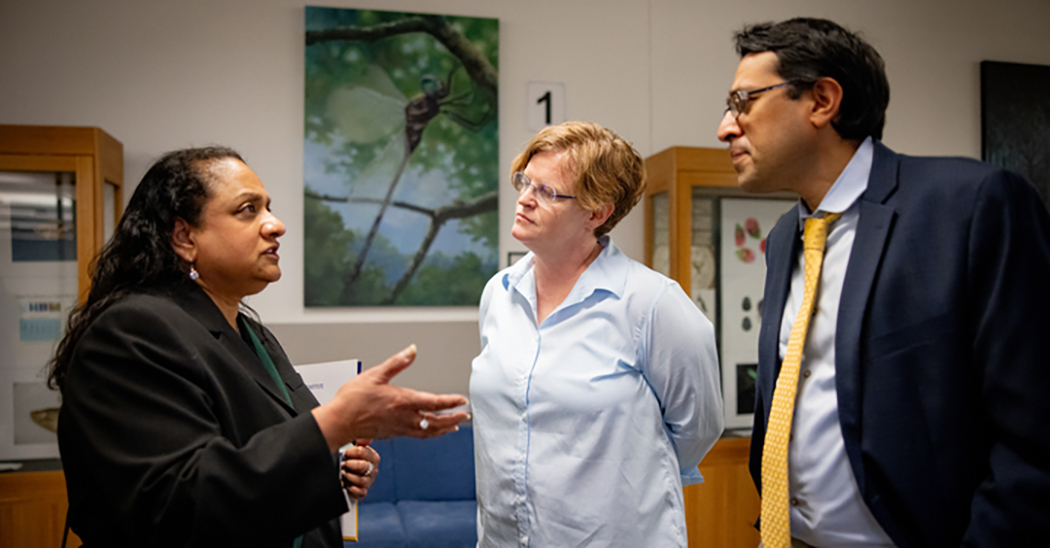
A major theme of the day was what it takes to sustain the country’s preparedness between crises. Dr. Anand Parekh, chief health policy officer at the University of Michigan School of Public Health and a senior advisor at the Institute for Healthcare Policy and Innovation, said the US has seen before how bipartisan action and clear leadership can build durable systems—and how quickly that capacity can weaken.
Parekh described his early work after 9/11 on mass prophylaxis planning and later efforts to strengthen national readiness during concerns about H5N1 avian influenza overseas. Those experiences, he said, led to two lasting lessons: “Federal leadership matters and bipartisanship support matters.”
But in remarks at the commission’s “Pure Science” panel, Parekh argued that many lessons of COVID-19 are not being followed. He pointed to recent changes which he said reduce confidence in the country’s preparedness posture, including cuts and uncertainty in federal research support, reduced global public health engagement, and the loss of experienced personnel needed to keep programs running.
He cited proposed cuts discussed during the meeting, including reductions affecting research and preparedness agencies, and said these signals can ripple through universities and the broader biomedical workforce. When funding is unstable, he said, it becomes harder to attract and keep talent—especially in fields like infectious diseases and public health preparedness.
“We can’t have a strong public-private partnership in biodefense without the leadership of the federal government,” Parekh said.
He urged policymakers to update the national biodefense strategy to reflect advances in synthetic biology and artificial intelligence, and he called for reauthorizing the Pandemic and All-Hazards Preparedness Act (PAHPA), which supports programs such as hospital preparedness and public health emergency response.
Parekh also stressed that the “pipeline” of future experts depends on students and early-career researchers feeling that the work is valued and supported. A strong biodefense posture, he said, is not only about scientific breakthroughs, but also about ensuring communities can use those tools during emergencies.
We can’t have a strong public-private partnership in biodefense without the leadership of the federal government.”
— Dr. Anand Parekh, chief health policy officer at the University of Michigan School of Public Health and a senior adviser at the Institute for Healthcare Policy and Innovation
‘One Health’ coordination and clearer communication
While Parekh focused on federal policy and systems, Dr. Natasha Bagdasarian spoke from the front lines of state public health response. Bagdasarian is Michigan’s chief medical executive and an adjunct faculty member in Michigan Public Health’s Department of Epidemiology. She also earned her Master of Public Health in Hospital and Molecular Epidemiology from the School of Public Health in 2001.
Bagdasarian said biodefense is where public health, animal health and national security come together, but she argued those worlds too often operate in silos. She called for a “One Health” approach that recognizes how threats can move between people, animals and the environment.
“A lot of what we do in public health, in animal health and national security, is very siloed,” she said, describing barriers to cross-sector data sharing and planning.
As an example, Bagdasarian pointed to the challenges posed by H5N1, where data sharing can depend on voluntary cooperation and may be slowed by financial disincentives. She said the country needs better ways to coordinate strategy across agencies and sectors, including clearer plans for how new tools—like wastewater surveillance—should be used and interpreted.
But Bagdasarian emphasized that preparedness is also a communication challenge. She said one lesson from COVID-19 was that officials did not always explain shifts in strategy clearly. When guidance changes, she said, people want to understand why.
“The public wants to know why we are asking them to do certain things,” Bagdasarian said. “We never really explained to the public that we were moving from one stage to another.”
In her closing remarks, Bagdasarian said the tools to prevent the next major biological threat already exist—what is missing is the coordination to use them well.
“Right now in 2026, we have the tools, we have the science, and we have the experience to prevent the next bio threat from occurring,” she said. “But what we need now is the coordination and the clarity to use those tools.”
Right now in 2026, we have the tools, we have the science, and we have the experience to prevent the next bio threat from occurring. But what we need now is the coordination and the clarity to use those tools.”
— Dr. Natasha Bagdasarian, Michigan’s chief medical executive and an adjunct faculty member in the University of Michigan School of Public Health Department of Epidemiology
University research and preparedness capacity
Commissioners and speakers repeatedly pointed to the role research universities play in strengthening national readiness. In opening remarks, Arthur Lupia, University of Michigan vice president for research and innovation, said the university’s mission is to serve the public good and that the university works with state and federal partners on biosafety, data infrastructure and emergency planning.
During the discussion, Parekh also highlighted work underway at the university, including the Michigan Center for Infectious Disease Threats and Pandemic Preparedness, led by Aubree Gordon, a professor of Epidemiology and Global Public Health at the School of Public Health and the center’s director.
Commissioners toured the research unit Microbes, Parasites, and Biodiversity Initiative (MPABI), a collaborative between the University of Michigan Center for Infectious Disease Threats and the Department of Ecology and Evolutionary Biology. MPABI facilitates robust pandemic prevention and preparedness by providing high quality wildlife-associated parasite and pathogen specimens for basic and translational research.
“We were honored to host the commissioners at the Michigan Center for Infectious Disease Threats,” Gordon said. “Their visit, including time spent touring M-PABI and other collections within the University of Michigan Museum of Zoology as well as the University of Michigan Herbarium, underscores the critical importance of connecting national policy leadership with frontline research and operational capabilities. These exchanges are essential to strengthening the nation's preparedness for emerging biological threats.”
The commission’s work includes convening public meetings and issuing reports aimed at improving the nation’s preparedness. In its 2024 update, The National Blueprint for Biodefense, the commission recommended dozens of actions to strengthen the US capacity to prevent, detect, respond to and recover from biological incidents.
The commission’s visit, organizers said, was designed to connect national policy discussions with the on-the-ground realities of research, public health practice and the partnerships required to respond quickly when the next biological threat emerges.
“We had the opportunity to take a ‘behind-the-scenes’ tour and spent hours with University of Michigan research staff learning about the exciting potential breakthroughs they’re pursuing,” Upton said.
“That experience was invaluable to me when I chaired the House Energy and Commerce Committee: I would bring key health staff to Ann Arbor to see the work firsthand and to learn directly from researchers about how we could shape H.R. 6, the ‘21st Century Cures Act,’ to strengthen US-based research rather than see it move overseas. We’re seeing many of the same dynamics today—especially as the current administration proposes cuts to research funding.”
Written by Bob Cunningham