On the Heights: April 2026
Stay informed with the latest from the University of Michigan School of Public Health community in our monthly digest. Faculty expertise in action, new research, policy advocacy, and community engagement highlight our continued commitment to advancing public health and creating positive change.
Research & funding
Alzheimer's Association partners with NPHA team for new brain health report
Most Americans over 40 say brain health is just as important as physical health, but only 9% say they actually know how to maintain it. That's a key finding from a new Alzheimer's Association report developed in partnership with U-M's National Poll on Healthy Aging (NPHA) at the Institute for Healthcare Policy and Innovation. The special report draws on a 2026 poll of more than 3,800 adults and finds that while most people believe lifestyle behaviors matter for brain health, fewer than half connect those behaviors to actually reducing their risk of Alzheimer's or other dementias.
Health Behavior & Health Equity professor Scott Roberts, who is also the associate director of the NPHA, led the collaboration alongside senior project manager Dianne Singer. Further analyses will be released through the NPHA in the future.
Poverty Solutions awards grants to faculty studying cash transfers, job access, food-as-medicine
Kristi Gamarel, an associate professor of Health Behavior & Health Equity, has received a grant from Poverty Solutions at U-M to study equitable access to Michigan's new food-as-medicine programs. In 2025, Michigan implemented Medicaid In Lieu of Services, which enables Medicaid health plans to offer healthy and medically tailored home-delivered meals, healthy food packs, and produce prescriptions as substitutes for other covered services. Through an eight-year partnership with the Trans Sistas of Color Project in Detroit, Gamarel's team has documented that 78.3% of trans women of color surveyed were food insecure and 66.7% earned less than $1,000 per month. The project will interview trans women of color about their experiences with food assistance and medically linked food pathways, then convene community members and state health officials to co-develop a policy brief with implementable recommendations.
Expert contributions
Nutritional Sciences researcher brings food policy expertise to state legislature
Associate Professor of Nutritional Sciences Kate Bauer testified before the Michigan House Health Policy Committee this week, presenting two initiatives she leads at U-M aimed at improving nutrition and health for Michigan families. Drawing on community listening work through the Feeding MI Families project and the newly launched Institute for Food, Nutrition, and Health Policy, Bauer shared findings that put families' own voices at the center, from the stigma and barriers that discourage use of food assistance programs, to the small policy changes that could make a meaningful difference. The institute aims to be a trusted resource for policymakers working on food and nutrition issues at the state and national level.
Josh Sharfstein joins Dean Lisabeth for a fireside chat about the state of federal public health policy
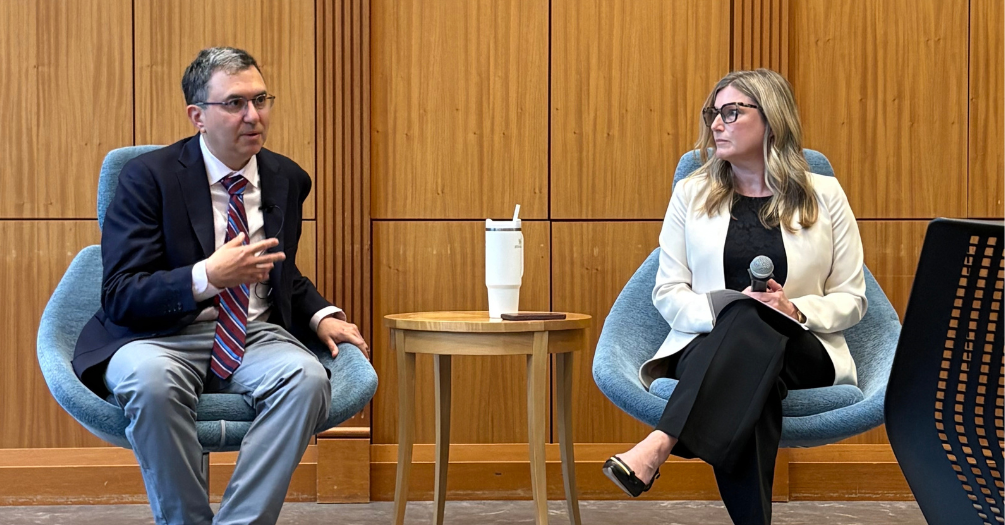
Dr. Josh Sharfstein, Vice-Dean for Public Health Practice and Community Engagement at the Johns Hopkins Bloomberg School of Public Health, joined Dean Lisbeth for a discussion about the state of federal public health policy. Previously, Dr. Sharfstein served as the Secretary of the Maryland Department of Health and Mental Hygiene, the Principal Deputy Commissioner of the U.S. Food and Drug Administration, and Commissioner of Health for Baltimore City.
Superfund designation shows Michigan must focus on prevention thinking
America’s lax environmental policies harm the health of our communities and place the cost burden of cleaning up the hazardous material on our taxpayers. What if we took a different approach, one where we invested our public dollars in preventing environmental disasters and other harms from happening in the first place?
In this op-ed, Health Behavior & Health Equity associate professor Paul Fleming argues for prevention thinking in policymaking. This forward thinking shift means investing into resources people need to thrive, addressing the root causes of what is harming us, and partnering with the people most affected by environmental health disparities to co-create the solutions and policies.
Community impact & Awards
April Zeoli receives prestigious SAVIR award for work on firearm legislation
Health Management and Policy associate professor April Zeoli received the 2026 Society for Advancement of Violence and Injury Research (SAVIR) Excellence in Advocacy Award for her work on firearm legislation.
Zeoli researches how policy and law can prevent firearm violence, intimate partner violence, and homicide. She is one of the nation’s leading experts on policy interventions for firearm use in intimate partner violence, including the implementation and impact of extreme risk protection orders.
Our Stories, Our Strength campaign puts youth at the center of gun violence prevention
A new youth-led campaign from the Michigan Youth Violence Prevention Center at U-M is putting personal stories at the center of gun violence prevention. Our Stories, Our Strength launched this week, and more than 50 young people have already shared their experiences anonymously. The campaign is inviting youth ages 13-26 to do the same.
Created by youth leaders from Muskegon, Michigan, and Washington, D.C., the campaign centers young voices in the conversation about what gun violence prevention actually looks like.
Roshanak Mehdipanah receives IHPI honor for impact on health policy and practice
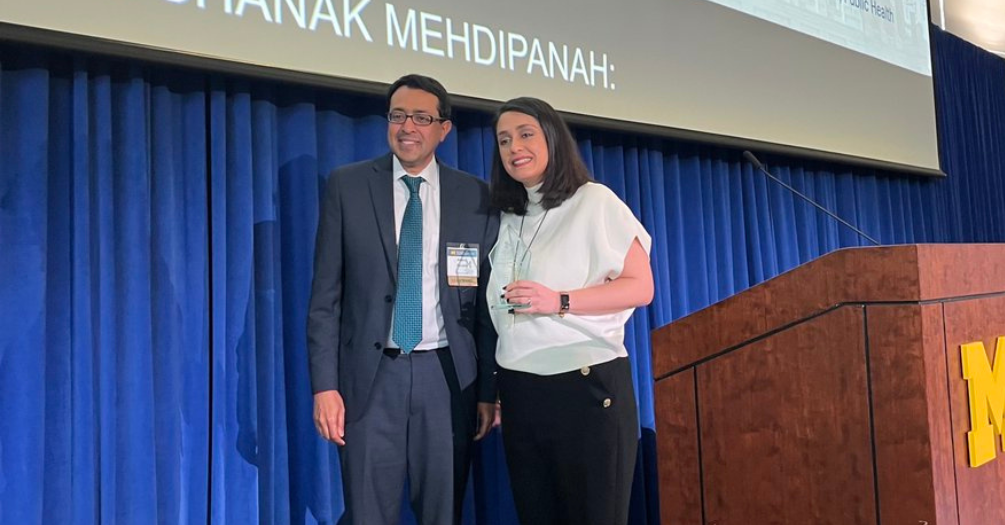
The University of Michigan Institute for Healthcare Policy & Innovation (IHPI) has named Roshanak Mehdipanah as one of two recipients of its 2026 Policy Impact Award, recognizing her far-reaching contributions to housing policy.
Mehdipanah, associate professor of Health Behavior & Health Equity, examines how housing instability and policy decisions—such as disinvestment, tax foreclosure, and housing governance—shape health outcomes. Through collaboration with government agencies, housing authorities, and community partners, she helps translate research into policies that tackle housing as a root cause of health inequities and improve conditions for vulnerable communities.
OVPR recognizes 2 Epidemiology staff members with research awards
The Office of the Vice President for Research recently recognized two School of Public Health staff for their significant contributions to the university’s research enterprise. Lily Johns, a research associate in the department of epidemiology, received the Research Associate/Assistant/Technician Recognition Award. Julie Gilbert, a database administrator senior in the department of Epidemiology, received the Research Data Management & Analysis Staff Recognition Award.