NSF CEO challenges Class of 2026: ‘Build bridges that outlast you’
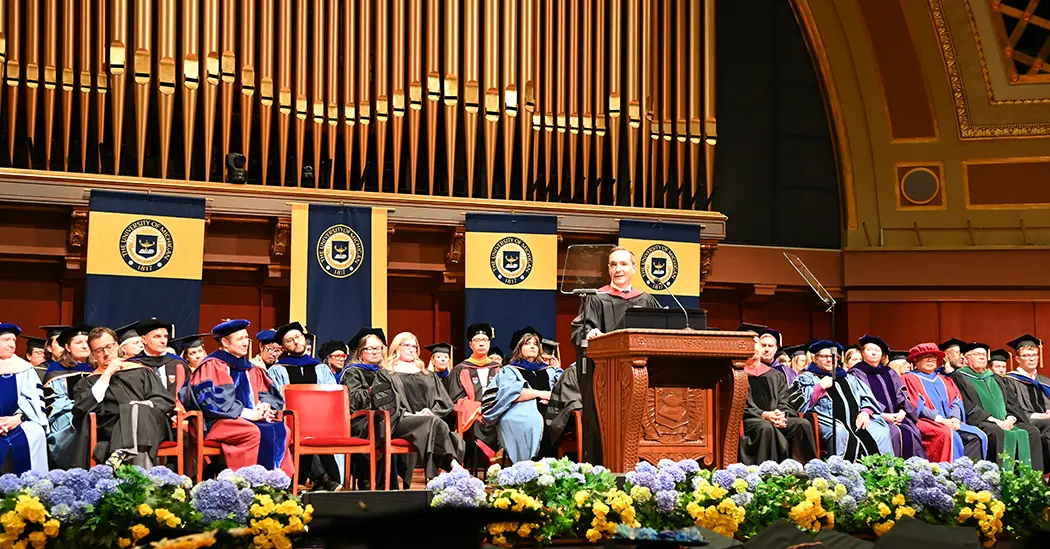
More than 450 Michigan Public Health graduates celebrated as leaders urge stewardship, resilience, hope
ANN ARBOR—Pedro Sancha, CEO and President of NSF, issued a challenge to the graduating Class of 2026: “Build bridges that outlast you.”
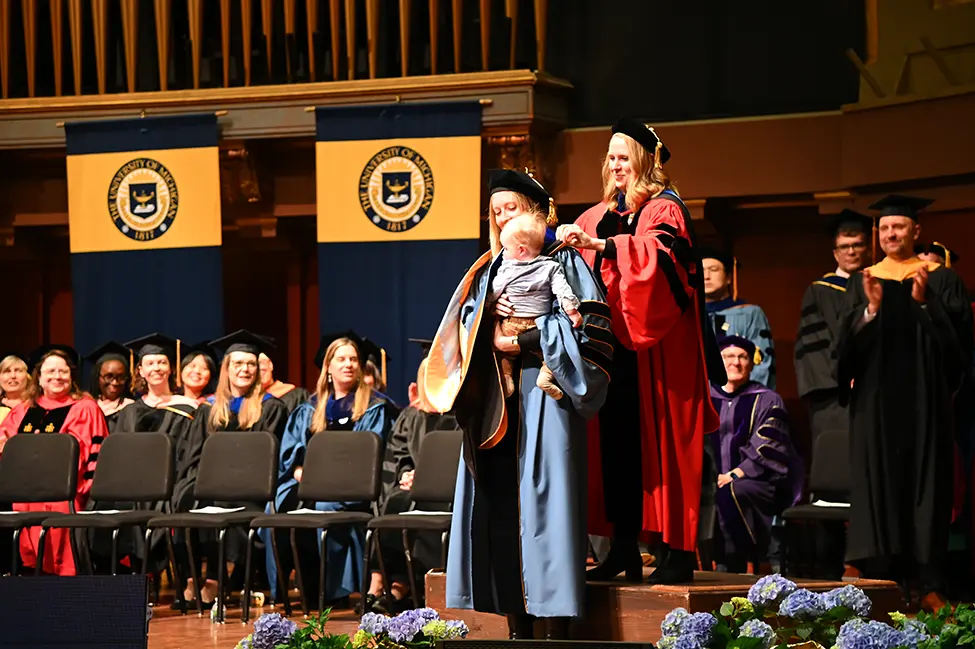
The featured guest speaker’s call to action was rooted in both personal experience and professional purpose, as he addressed the University of Michigan School of Public Health’s graduates during commencement April 30 at historic Hill Auditorium.
“Graduates, you’re entering a profession where your most important work may never be celebrated,” said Sancha, who leads the international public health and safety organization that traces its origins to Michigan Public Health more than 80 years ago. “Preventing a crisis rarely attracts attention. Strengthening a system rarely generates applause. Often, the proof of your impact will be something that did not happen.”
Sancha, a native of Spain who studied engineering before finding his way to public health leadership, drew on a childhood memory to ground his remarks. At 9 years old, while living in North Africa, he contracted hepatitis despite his mother’s vigilant efforts to keep the family safe—boiling water, soaking fruit in disinfectant, doing everything she could.
“Just a hundred miles across the Mediterranean Sea, in my native Spain, children didn’t have to worry about their water,” he said. “That experience taught me that health is precious and fragile—and that inequalities are real. Everyone deserves the chance to be healthy, no matter where they live.”
That early lesson, he said, became the first bridge of his life — connecting experience and purpose—eventually leading him to NSF, founded in 1944 by three visionary scientists from Michigan Public Health: Henry Vaughan, Nathan Sinai and Walter Snyder.
Preventing a crisis rarely attracts attention. Strengthening a system rarely generates applause. Often, the proof of your impact will be something that did not happen.”
— Pedro Sancha, CEO and President of NSF
“What began in a basement of this very same school now operates quietly in more than a hundred countries,” said Sancha, who also serves on the Dean’s Advisory Board. “When someone turns on the tap. When a family buys groceries. When someone buys a health supplement. Chances are NSF is at work behind the scenes. Most people will never know that. And that’s often how public health works.”
Sancha reminded graduates that at the turn of the 20th century, life expectancy in the United States was fewer than 50 years. By 2000, it had increased by roughly 30 years—progress driven in large part by public health advances in vaccines, food and water sanitation, and workplace safety. Michigan Public Health, he said, played a significant role in that progress, including through the Salk polio vaccine trial.
But he cautioned that progress cannot be taken for granted, pointing to stalled life expectancy in some communities, emerging environmental contaminants like PFAS, a global mental health crisis, and the rapid spread of health misinformation.
“You're graduating into a different world,” he said. “A world where information moves instantly. Opinion spreads faster than evidence. Trust erodes in a single news cycle. Public health today demands more than technical expertise. In my early career, defending scientific evidence wasn’t part of the job description. For you, it will be.”
Still, Sancha said he remains optimistic.
“We humans are great at causing problems, but we’re even better at solving them— especially when we work together with science and innovation on our side.”
He closed with a charge to the more than 450 graduates to embrace stewardship with an understanding that what they carry from their education does not belong to them alone.
“Most of the bridges you build will never have your name on them,” he said. “Build them anyway. Build bridges that outlast you. That carry the weight of future generations. That make the world safer for someone you will never meet. That is stewardship. That is public health.”
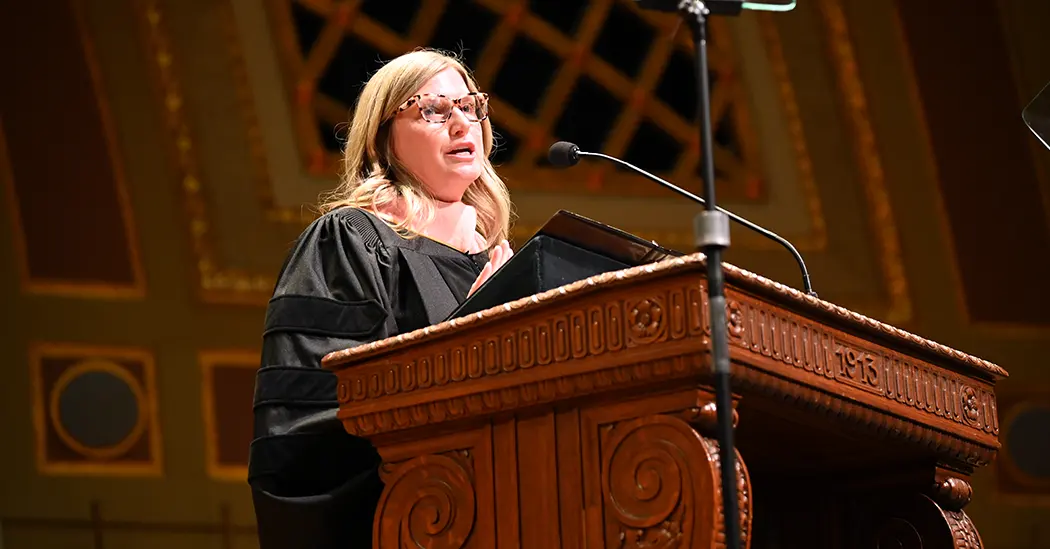
Interim Dean Lynda Lisabeth, who earned her master’s degree in Biostatistics and PhD in Epidemiology from Michigan Public Health, also addressed the crowd, speaking not only as the school’s leader but as someone who has walked a similar path as the graduates before her.
“You’re entering the field of public health at an incredibly important time,” she said. “Those of us in public health work on many of society’s most pressing issues such as gun violence prevention, environmental justice issues, advancing health equity, fighting infectious diseases, and so much more.”
Lisabeth acknowledged that targeted actions weakening public health—particularly threats to federal funding—might feel daunting and discouraging. But looking out at the graduating class, she said she felt only hope.
“I see a group of students who have committed themselves to improving our world,” she said. “I see students who have chosen to pursue bold and courageous scholarship, even when doing so might be difficult. I see students who remain focused on partnering with and supporting communities in need. Our future is brighter because of you.”
Lisabeth encouraged graduates who may feel uncertain about what comes next to trust themselves and remain open to change.
“Seek opportunities that excite and challenge you,” she said. “Find the places where you can make a difference and pursue experiences that allow you to grow. Trust yourself to know what is right for you, and to know what isn’t. Don’t be afraid to change directions or to seek new opportunities.”
She also took a moment to recognize the community that made each graduate’s journey possible—faculty, staff, classmates, and the families gathered in Hill Auditorium.
“Pursuing your education takes a village,” she said. “And you can look around today and see some of the people who make up yours.”
Lisabeth told the graduates—comprising 294 master’s degrees, 119 undergraduate degrees, and 41 doctoral degrees—that what the day truly celebrated was not just their completion of a degree, but the determination it took to get there.
Seek opportunities that excite and challenge you. Find the places where you can make a difference and pursue experiences that allow you to grow. Trust yourself to know what is right for you, and to know what isn’t. Don’t be afraid to change directions or to seek new opportunities.”
— Lynda Lisabeth, Interim Dean of Michigan Public Health
“You have demonstrated your resolve, and despite these challenges, you made it,” she said. “That is what we are truly celebrating today—your grit, your determination, your perseverance, and your tenacity in completing this step of your educational journey.”
She closed by anchoring her remarks in the field’s most enduring characteristic.
“We are a field built on a foundation of hope and optimism, the fundamental belief that we can and will change the world for the better,” Lisabeth said. “My wish is that you move into the next stage of your journey wrapped in this hope and optimism for the future and also anchored by your determination and will to persevere.”
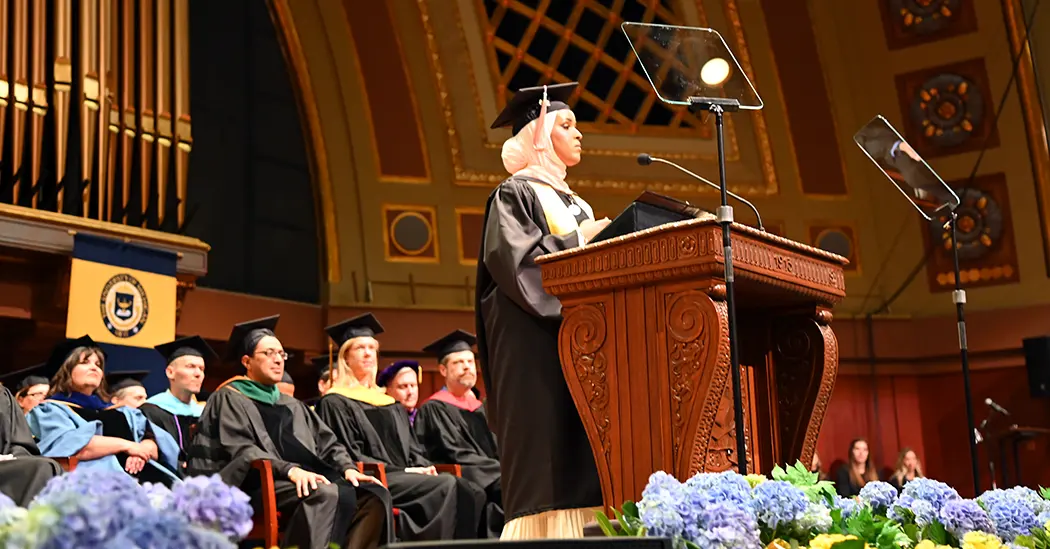
Student speaker Farhia Ahmed Mohamed, MPH '26, who is graduating with a Master of Public Health in Nutritional Sciences, opened her remarks with a greeting in Arabic—As-salamu alaykum wa rahmatullahi wa barakatuh (peace be upon you all)—before taking her fellow graduates back to the moment they first arrived in Ann Arbor.
“We came here ready,” she said. “Ready to learn, to grow, to understand public health—not just as a field, but as a way of thinking. We had plans. Timelines. A sense of direction.”
But then, she said, things shifted. Headlines about funding cuts, political pressure on public health, and disappearing internship opportunities made the systems they were studying feel anything but theoretical.
“The systems we were studying didn’t feel theoretical anymore—they felt fragile, real, and, honestly, overwhelming,” she said. “For a moment, everything felt unsettled and unsure. Like we were being pushed into uncertainty before we felt ready.”
For Mohamed, that uncertainty was deeply personal. She shared that she had worked as a clinical dietitian supporting cancer patients—present in some of the most vulnerable moments of people’s lives—and that experience had drawn her to public health, to prevention, to the belief that outcomes could be changed before they began. But amid the upheaval, she said, she almost lost sight of that.
“I got so caught up in what was falling apart around us that I lost sight of the reason I started at all,” she said. “Which was to be part of preventing the very diseases that took the lives of people I once cared for and supported.”
Having rebuilt before—moving across countries, adjusting to new environments and systems—Mohamed said she knew how to find her way back. And she said her classmates helped her do it.
“We showed up for each other,” she said. “We had those conversations where someone would say, ‘I hear you, but we have to keep going.’ We reminded each other why we started. Why we chose this field. Why this work matters.”
That collective resilience, she told the graduating class, is what shaped them most and what makes them the kind of public health professionals the world needs.
“People who don't wait for certainty,” she said. “People who don't need a perfect map. People who understand that behind every data point is a human story.”
Mohamed paused to thank her parents, Ahmed and Keysa, who were present in the auditorium, her older sister Zeinab watching the livestream from London, her siblings Abdullah, Nalaye, Sarah and Ali, and her friends and mentors in both the United States and Kuwait.
Remember this version of yourself. The one who showed up even when things were unclear. The one who kept going when plans fell apart. The one who chose to move forward anyway. This is not just the end of something. It's proof of who we’ve already become. Let’s go out and do the work.”
— Farhia Ahmed Mohamed, who earned her MPH in Nutritional Sciences
“Thank you for raising a strong, ambitious daughter and leader,” she told her parents, “and for molding me into someone who is ready to succeed in whatever comes next.”
She closed by reminding her fellow graduates of what they have already proved about themselves.
“When things feel uncertain again— and they will—don't wait for clarity. Don't wait for everything to make sense. Don’t wait for someone else to fix it,” Mohamed said. “Remember this version of yourself. The one who showed up even when things were unclear. The one who kept going when plans fell apart. The one who chose to move forward anyway.
“This is not just the end of something. It's proof of who we’ve already become. Let’s go out and do the work.”
Read more about the class of 2026!