On the Heights: March 2026
Stay informed with the latest from the University of Michigan School of Public Health community in our monthly digest. Faculty expertise in action, groundbreaking research, policy advocacy, and community engagement highlight our continued commitment to advancing public health and creating positive change.
Research & funding
School of Public Health research highlighted at President’s Symposium for Research Impact and Policy Leadership
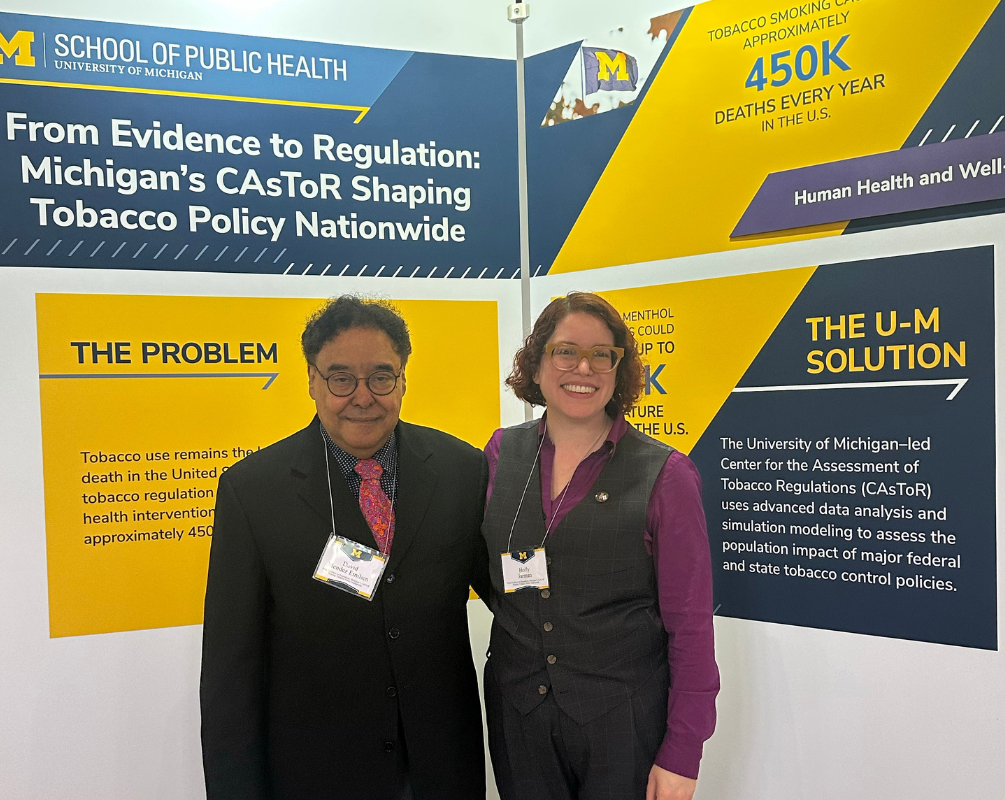
On March 11, the university hosted a symposium highlighting research, innovation, and public service that embodies the Look to Michigan vision. The Center for the Assessment of Tobacco Regulations—also known as CAsToR—was highlighted as an example work happening at the U-M School of Public Health. Faculty members Holly Jarman and David Mendez attended the event to discuss the center’s work.
Global Public Health poster session celebrates international internships and student research
The Michigan Public Health community gathered to share and celebrate the international internships and research completed by master's and doctoral students during the summer of 2025 at the annual Global Public Health poster session.
Congratulations to this year’s award recipients.
People's Choice Award
Cynthia Adebayo, PhD student, Environmental Health Sciences
Cultural Hair Product Usage in the West African Diaspora: A Preliminary Ethnographic Understanding
Gelman Global Scholar Award
McKerron Scott, MPH candidate, Environmental Health Sciences
Enhancing Community Resilience: Emergency Preparation, Evacuation, and Wildfire Smoke Mitigation in Yukon
Gelman Global Scholar Honorable Mention
Matilda Schiewe, MPH candidate, Health Behavior & Health Equity
Global Health in Action: Interdisciplinary Collaboration in Ghana
Expert contributions
Dana Dolinoy co-leads new diamond open access environmental sciences journal
The Academic Research Community (ARC) Alliance recently launched a new environmental sciences journal, Environmental Health Advances (EHA), to serve the community of scholars working in the environmental health area. ARC EHA will publish innovative, timely peer-reviewed research spanning across environmental health disciplines that can lead to actionable solutions that foster healthier communities and sustainable ecosystems.
NSF Chair and Professor of Environmental Health Sciences Dana Dolinoy is part of a distinguished team of editors in chief collaborating across institutions to lead the new journal.
Anand Parekh joins the ASPPH Advocacy Advisory Committee
Chief Health Policy Officer Anand Parekh was recently welcomed onto the Association of Schools and Programs of Public Health (ASPPH) Advocacy Advisory Committee. As a member of the committee, Parekh will advise on regulatory and legislative issues affecting ASPPH schools, programs, faculty, and students.
Health Behavior & Health Equity faculty joins Africa CDC fellowship curriculum review
Health Behavior & Health Equity Professor Leah Neubauer, serving as the Chair of the ASPPH Africa CDC Public Health Emergency Management (PHEM) Fellowship Task Force, traveled to Nairobi, Kenya to participate in a curriculum review workshop and meet with the Fellowship’s Technical Advisory Committee. Neubauer’s visit marked an important next step in ASPPH’s collaboration with the Africa Centres for Disease Control and Prevention to strengthen the PHEM Fellowship and advance emergency preparedness workforce development across the continent.
Community impact & Awards
Health Behavior & Health Equity faculty awarded 2026 Practice Excellence Award from ASPPH
Paul Fleming, associate professor of Health Behavior & Health Equity, recently received the 2026 Practice Excellence Award from the Association of Schools and Programs of Public Health (ASPPH) for his work identifying and addressing the root causes of racial health inequities.
Flemming conducts community-based participatory research on the health needs of Latinx immigrants in Michigan and examines how to best integrate anti-racist principles into public health training and practice.
Phoebe Kulik receives Candace J. Johnson Award for Staff Excellence
The University of Michigan Provost’s Office selected Phoebe Kulik as one of three recipients of the 2025-2026 Candace J. Johnson Award for Staff Excellence. Described by colleagues as a steady, prepared leader, Kulik navigates uncertainty with her people-centered approach and ingenious strategic planning abilities.
In her role at the Region V Public Health Training Center, Kulik oversaw major workforce-development efforts spanning six states and spearheaded a number of behind-the-scenes wins with unwavering dedication.
“She really went above and beyond to make sure [everyone] felt heard, cared for, and supported,” wrote Ryleigh Emelander, a marketing and communications coordinator in the Department of Epidemiology in the School of Public Health.
“[Kulik’s] most distinguishing quality [is her] ability to calmly listen, evaluate, and guide stakeholders through even the most challenging situations”, wrote Dana Thomas, director of the Adolescent Health Initiative within Community Health Services at Michigan Medicine.
Two Health Behavior & Health Equity professors announce retirement
Linda Chatters and Amy Schulz recently announced their retirements from the University of Michigan School of Public Health.
As a developmental psychologist and gerontologist, Linda Chatters' research focused on the health and well-being of Black populations across the life course and within diverse social contexts. Chatters is designated by Thomson-ISI as a Highly Cited Researcher Category of General Social Sciences, producing more than 200 journal articles, chapters and books. Last year, Chatters was awarded the 2025 Distinguished Career Achievement Award from the Society for Social Work Research.
Amy Schulz, MPH ‘81, is a sociologist with expertise in the joint contributions of social and physical environmental exposures to health inequities and a leading scholar in the field of community based participatory research. Schulz taught graduate courses on environmental health, community change and survey research, and was a dedicated mentor, serving as dissertation committee chair and member for over 40 doctoral candidates, as well as multiple generations of MPH students.