On the Heights: October 2025

On the Heights is a monthly digest highlighting faculty achievements, research contributions, and community engagement at the University of Michigan School of Public Health.
Faculty research and expert contributions
Lopez examines high costs of mass deportation at Poverty Solutions event
William Lopez, clinical associate professor of Health Behavior & Health Equity, presented "The High Cost of Mass Deportation" as part of a Poverty Solutions event series. Lopez's expertise in immigration policy and health equity provided critical insights into the social, economic, and health impacts of deportation policies on communities. Lopez was also recently featured in an Instagram takeover on the School of Public Health's channel, speaking to his work and life as a researcher at the University of Michigan.
Zikmund-Fisher publishes health communication guidance in JAMA
A new article in JAMA authored by Health Behavior & Health Equity professor Brian Zikmund-Fisher details how healthcare professionals can more effectively communicate numerical information to patients. The research addresses a critical challenge: while health professionals routinely use numbers to guide decisions and communicate with patients, many people struggle to understand these numbers, particularly those with limited numeracy skills. Zikmund-Fisher's work builds on his extensive research in health risk communication and his development of the Icon Array tool, which helps make health data more visually intuitive.
Hudson co-authors call to action for social and behavioral sciences
Darrell Hudson, chair of the Department of Health Behavior & Health Equity, joined department chairs from universities and colleges across the country in an important commentary published in the American Journal of Public Health. The piece emphasizes the current moment that is reshaping the foundation of public health and calls on the field to ground itself in the core principles of social and behavioral sciences.
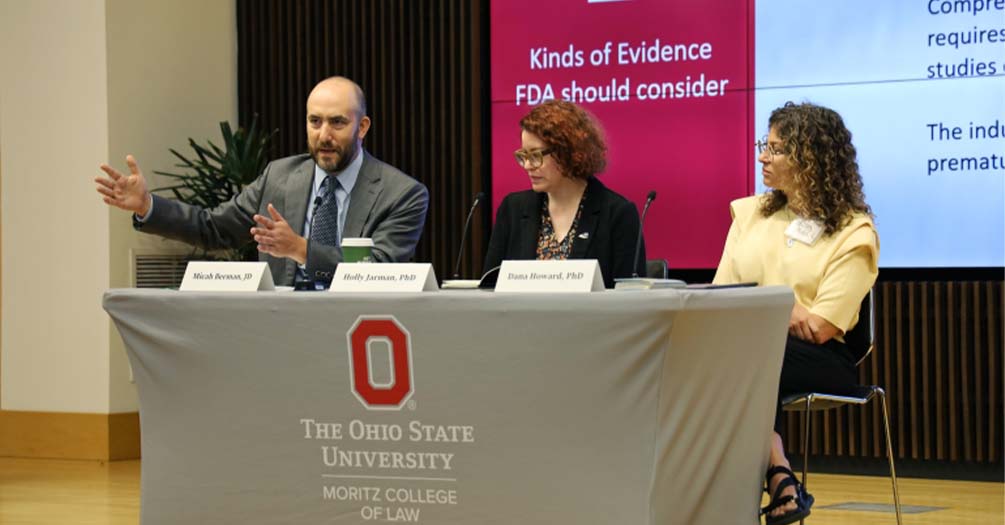
Jarman launches OMLET research network with Ohio State scholars
Holly Jarman, associate professor of Health Management & Policy, is co-leading the launch of a new Ohio-Michigan Law, Ethics, and Technology (OMLET) research network with scholars from The Ohio State University Moritz College of Law. This collaborative initiative brings together experts in health law, policy, ethics, and technology to address emerging challenges at the intersection of these fields. The network will facilitate research partnerships, knowledge exchange, and policy analysis on critical issues affecting health systems in both states.
“Emerging technologies, from new products and scientific techniques to novel applications of AI, have the potential to revolutionize our approach to promoting, protecting, and preserving health. But as disruptive innovations, they also present real risks,” says Jarman. “Our goal in creating this network is to explore new ways to govern that can keep up with the fast pace of technological change, support the benefits that technologies can bring, and uphold our core public health values.”
Shepherd advocates for rural health workforce in Bridge Michigan op-ed
Michael Shepherd, assistant professor of Health Management and Policy, authored an op-ed in Bridge Michigan arguing that Michigan's Rural Health Transformation Program should prioritize health care workforce development and sustainable access. Shepherd highlights that Michigan has the fourth most residents living in rural counties with primary care workforce shortages—1.7 million people—and the sixth most with mental health workforce shortages. He emphasizes that without workforce investment and resources to prevent rural hospital closures, communities will lose their primary source of care and face devastating economic impacts. The op-ed comes as Michigan confronts an estimated $5.6 billion loss in Medicaid spending over the next decade due to federal cuts. Shepherd previously discussed rural health challenges in a Q&A earlier this year, where he analyzed what proposed Medicaid cuts could mean for rural communities and hospital access.
Garner and Bauer provide expertise on SNAP benefit suspension
Department of Nutritional Sciences professors Jennifer Garner and Kate Bauer, provided extensive media commentary on the suspension of SNAP benefits due to the federal government shutdown. Read their commentary in:
In 2024, Bauer led the Feeding MI Families Community Food Advocacy Fellowship (CFAF) program as an outgrowth of yearslong statewide food insecurity work. The program trained 19 parents from across Michigan to become food advocates in their communities and beyond. Following the conclusion of the program, Bauer introduced a speakers bureau to connect particpants with relevant media and policymakers to share their stories. One of the program participants was recently featured on ABC News Live regarding SNAP benefits.
Faculty honors and recognition
Langa named Distinguished University Professor
Kenneth Langa, professor of Internal Medicine and Health Management and Policy, was recognized with one of the university's most prestigious honors: the Distinguished University Professorship. The Board of Regents approved his appointment as the A. Regula Herzog Distinguished University Professor of Internal Medicine and Survey Research on October 16, with the appointment beginning September 1, 2025. Langa, who also serves as Cyrus Sturgis Research Professor of Internal Medicine and co-director of the National Institutes of Health-funded Health and Retirement Study, is a global leader in research advancing the understanding of risk factors, prevalence, outcomes, and trends of cognitive impairment and dementia.
Patel and Payne-Sturges join as senior fellows in Michigan Society of Fellows
Minal Patel, professor of Health Behavior & Health Equity, and Devon Payne-Sturges, professor of Environmental Health Sciences, serve as senior fellows in the Michigan Society of Fellows, where they mentor postdoctoral scholars and contribute to the Society's mission of fostering interdisciplinary scholarship. The Society recently welcomed eight new fellows from more than 900 applications to serve three-year appointments as postdoctoral scholars and assistant professors beginning this fall.
Research center updates
Center for Midlife Science becomes CLEAR; SWAN study featured in Spectrum News
On October 6, 2025, the Center for Midlife Science officially became the Center for Lifecourse Epidemiology and Aging Research (CLEAR), reflecting the center's expanded focus on lifecourse epidemiologic approaches to understanding health, aging, and disease across the lifespan.
The center's work was recently showcased in a Spectrum News feature on SWAN (Study of Women's Health Across the Nation), one of CLEAR's flagship projects. Spectrum News spent two days on campus earlier this year filming the piece, which highlights how SWAN—the largest, longest, most in-depth study of women traversing the midlife and menopausal transition—has fundamentally shaped our understanding of women's health. As CLEAR director Carrie Karvonen-Gutierrez noted in the feature, "If you open an endocrinology textbook and look at what hormone patterns look like across the menopause transition, that is data from SWAN." The 30-year study has followed more than 3,000 women from five ethnic groups, investigating cardiovascular disease, diabetes, bone health, osteoarthritis, physical function, cognitive function, and endocrine function.
In the spotlight
Immersive XR technology advances undergraduate laboratory safety training
A team from the School of Public Health is contributing to the development of campus-wide immersive extended reality (XR) technology for undergraduate laboratory health and safety training. Through collaboration with the Center for Academic Innovation's XR Initiative, the university is creating virtual and augmented reality simulations that allow students to practice laboratory safety protocols in risk-free, immersive environments. This innovative approach enables students to experience hazardous scenarios and learn proper safety procedures without real-world consequences, making laboratory training more accessible, consistent, and effective across campus.
More than a dozen Michigan Public Health students receive CEW+ awards
Students across departments and degree programs at Michigan Public Health are among 132 University of Michigan students who collectively received over $1,005,000 in scholarship and fellowship funds from the Center for the Education of Women+ (CEW+) for the 2025-26 academic year. The cohort includes 102 new scholarship recipients, 13 continuing scholars, and 17 graduate fellows selected through a highly competitive process recognizing student parents and primary caregivers, students returning to school after educational interruptions, students underrepresented in STEM fields, first-generation students, international students, and those who have overcome significant obstacles to pursue higher education.
Q&A with NSF International Chair of Environmental Health Sciences Dana Dolinoy
Dana Dolinoy, NSF International Chair of Environmental Health Sciences, was featured in a Scientist Spotlight by the Environmental Mutagenesis and Genomics Society (EMGS). In the interview, Dolinoy discussed her work in environmental epigenetics, investigating how environmental exposures influence gene expression through epigenetic mechanisms, with specific focus on the impacts of nutrition and chemical exposures on the epigenome and their implications for health and disease. She shared insights on the most rewarding aspects of her scientific work, her involvement with EMGS, and advice for early career investigators, emphasizing the importance of interdisciplinary collaboration, mentorship, and focusing on research impact that can influence public health and environmental policy.
Tags
- Environmental Health Sciences
- Epidemiology
- Health Behavior and Health Equity
- Health Management and Policy
- News
- Nutritional Sciences
- On The Heights
- Epidemiology
- Food Policy
- Health Behavior and Health Equity
- Health Care Access
- Health Care Policy
- Health Communication
- Health for Women
- Immigration
- Innovation
- Nutrition
- Policy
- Research
- Scholarships
- Technology